 Add to Chrome
 Add to Firefox
 Add to Edge
GeoPose: Patient-agnostic CTA-to-DSA registration through projection-space calibration
Aug 17, 2026
Aligning intraoperative biplanar digital subtraction angiography (DSA) to pre-procedural computed tomography angiography (CTA) requires rapid and accurate 3D-to-2D registration. Optimization-based methods are sensitive to initialization and may require hundreds of iterations, whereas learning-based approaches commonly rely on patient-specific training. We propose GeoPose, a population-trained framework that estimates the C-arm pose in a learned canonical frame and transfers it to the native frame of an unseen CTA through projection-space calibration and transform composition. A population-trained residual network refines the pose, followed optionally by low-budget image-driven optimization. GeoPose requires neither patient-specific adaptation nor explicit inter-volume preregistration. On 80 DSA observations from 20 held-out patients, optimization-free GeoPose achieved a carotid mean projected centerline distance (mPCD) of 5.8 mm and a clDice of 0.45, compared with 14.5 mm and 0.28 for the best-performing baseline, while requiring only 0.15 s. After 25 optimization iterations, GeoPose reached an mPCD of 4.6 mm and a clDice of 0.58 in approximately two seconds. Under the same budget, native-initialized optimization achieved 14.6 mm and 0.15, respectively. GeoPose thus provides rapid native-frame registration with fixed population-level weights and the geometric correspondence required for downstream biplanar 3D vascular reconstruction.

Recursive Variational Autoencoders for 3D Blood Vessel Generative Modeling
Jun 17, 2025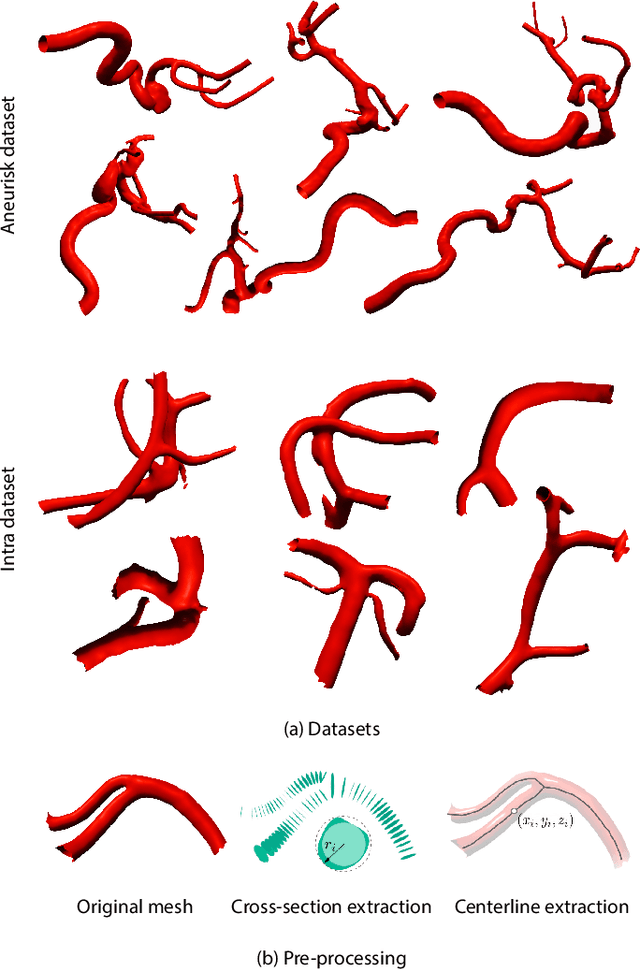
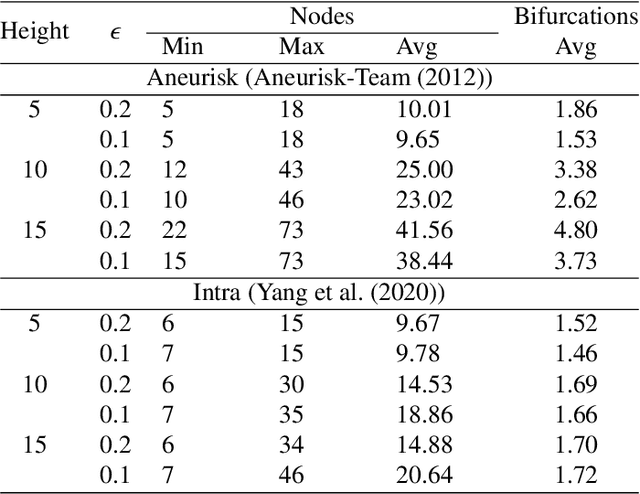
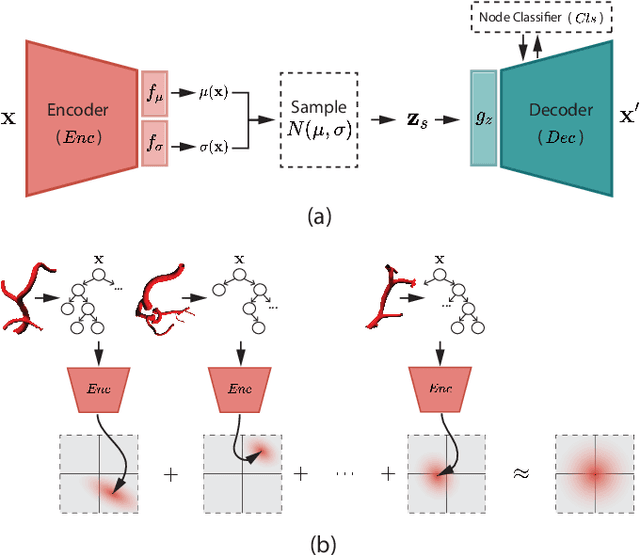

Anatomical trees play an important role in clinical diagnosis and treatment planning. Yet, accurately representing these structures poses significant challenges owing to their intricate and varied topology and geometry. Most existing methods to synthesize vasculature are rule based, and despite providing some degree of control and variation in the structures produced, they fail to capture the diversity and complexity of actual anatomical data. We developed a Recursive variational Neural Network (RvNN) that fully exploits the hierarchical organization of the vessel and learns a low-dimensional manifold encoding branch connectivity along with geometry features describing the target surface. After training, the RvNN latent space can be sampled to generate new vessel geometries. By leveraging the power of generative neural networks, we generate 3D models of blood vessels that are both accurate and diverse, which is crucial for medical and surgical training, hemodynamic simulations, and many other purposes. These results closely resemble real data, achieving high similarity in vessel radii, length, and tortuosity across various datasets, including those with aneurysms. To the best of our knowledge, this work is the first to utilize this technique for synthesizing blood vessels.
VesselGPT: Autoregressive Modeling of Vascular Geometry
May 19, 2025
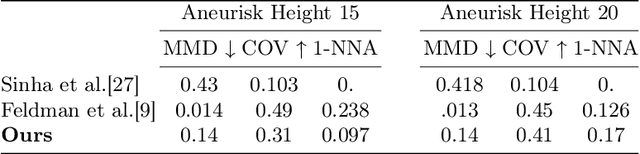
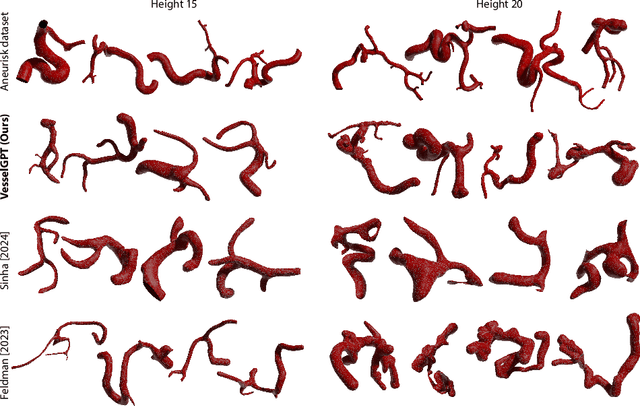
Anatomical trees are critical for clinical diagnosis and treatment planning, yet their complex and diverse geometry make accurate representation a significant challenge. Motivated by the latest advances in large language models, we introduce an autoregressive method for synthesizing anatomical trees. Our approach first embeds vessel structures into a learned discrete vocabulary using a VQ-VAE architecture, then models their generation autoregressively with a GPT-2 model. This method effectively captures intricate geometries and branching patterns, enabling realistic vascular tree synthesis. Comprehensive qualitative and quantitative evaluations reveal that our technique achieves high-fidelity tree reconstruction with compact discrete representations. Moreover, our B-spline representation of vessel cross-sections preserves critical morphological details that are often overlooked in previous' methods parameterizations. To the best of our knowledge, this work is the first to generate blood vessels in an autoregressive manner. Code, data, and trained models will be made available.
VesselVAE: Recursive Variational Autoencoders for 3D Blood Vessel Synthesis
Jul 07, 2023We present a data-driven generative framework for synthesizing blood vessel 3D geometry. This is a challenging task due to the complexity of vascular systems, which are highly variating in shape, size, and structure. Existing model-based methods provide some degree of control and variation in the structures produced, but fail to capture the diversity of actual anatomical data. We developed VesselVAE, a recursive variational Neural Network that fully exploits the hierarchical organization of the vessel and learns a low-dimensional manifold encoding branch connectivity along with geometry features describing the target surface. After training, the VesselVAE latent space can be sampled to generate new vessel geometries. To the best of our knowledge, this work is the first to utilize this technique for synthesizing blood vessels. We achieve similarities of synthetic and real data for radius (.97), length (.95), and tortuosity (.96). By leveraging the power of deep neural networks, we generate 3D models of blood vessels that are both accurate and diverse, which is crucial for medical and surgical training, hemodynamic simulations, and many other purposes.