 Add to Chrome
 Add to Firefox
 Add to Edge
Do Large Language Models Understand Data Visualization Rules?
Feb 23, 2026
Data visualization rules-derived from decades of research in design and perception-ensure trustworthy chart communication. While prior work has shown that large language models (LLMs) can generate charts or flag misleading figures, it remains unclear whether they can reason about and enforce visualization rules directly. Constraint-based systems such as Draco encode these rules as logical constraints for precise automated checks, but maintaining symbolic encodings requires expert effort, motivating the use of LLMs as flexible rule validators. In this paper, we present the first systematic evaluation of LLMs against visualization rules using hard-verification ground truth derived from Answer Set Programming (ASP). We translated a subset of Draco's constraints into natural-language statements and generated a controlled dataset of 2,000 Vega-Lite specifications annotated with explicit rule violations. LLMs were evaluated on both accuracy in detecting violations and prompt adherence, which measures whether outputs follow the required structured format. Results show that frontier models achieve high adherence (Gemma 3 4B / 27B: 100%, GPT-oss 20B: 98%) and reliably detect common violations (F1 up to 0.82),yet performance drops for subtler perceptual rules (F1 < 0.15 for some categories) and for outputs generated from technical ASP formulations.Translating constraints into natural language improved performance by up to 150% for smaller models. These findings demonstrate the potential of LLMs as flexible, language-driven validators while highlighting their current limitations compared to symbolic solvers.

De-rendering, Reasoning, and Repairing Charts with Vision-Language Models
Feb 23, 2026Data visualizations are central to scientific communication, journalism, and everyday decision-making, yet they are frequently prone to errors that can distort interpretation or mislead audiences. Rule-based visualization linters can flag violations, but they miss context and do not suggest meaningful design changes. Directly querying general-purpose LLMs about visualization quality is unreliable: lacking training to follow visualization design principles, they often produce inconsistent or incorrect feedback. In this work, we introduce a framework that combines chart de-rendering, automated analysis, and iterative improvement to deliver actionable, interpretable feedback on visualization design. Our system reconstructs the structure of a chart from an image, identifies design flaws using vision-language reasoning, and proposes concrete modifications supported by established principles in visualization research. Users can selectively apply these improvements and re-render updated figures, creating a feedback loop that promotes both higher-quality visualizations and the development of visualization literacy. In our evaluation on 1,000 charts from the Chart2Code benchmark, the system generated 10,452 design recommendations, which clustered into 10 coherent categories (e.g., axis formatting, color accessibility, legend consistency). These results highlight the promise of LLM-driven recommendation systems for delivering structured, principle-based feedback on visualization design, opening the door to more intelligent and accessible authoring tools.
VesselGPT: Autoregressive Modeling of Vascular Geometry
May 19, 2025
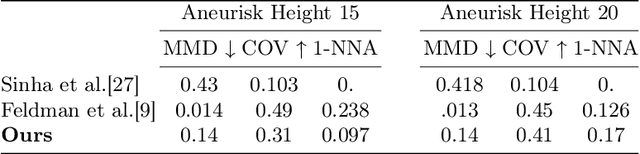
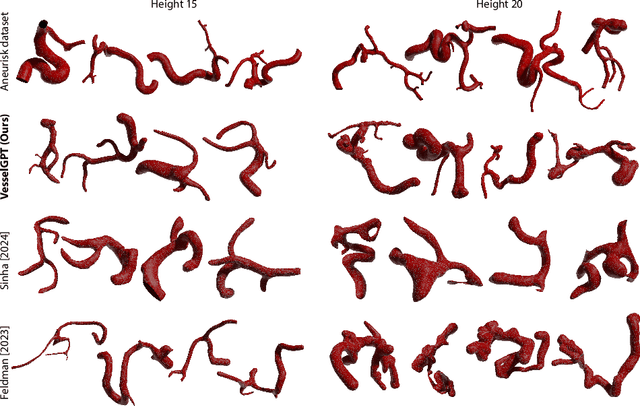
Anatomical trees are critical for clinical diagnosis and treatment planning, yet their complex and diverse geometry make accurate representation a significant challenge. Motivated by the latest advances in large language models, we introduce an autoregressive method for synthesizing anatomical trees. Our approach first embeds vessel structures into a learned discrete vocabulary using a VQ-VAE architecture, then models their generation autoregressively with a GPT-2 model. This method effectively captures intricate geometries and branching patterns, enabling realistic vascular tree synthesis. Comprehensive qualitative and quantitative evaluations reveal that our technique achieves high-fidelity tree reconstruction with compact discrete representations. Moreover, our B-spline representation of vessel cross-sections preserves critical morphological details that are often overlooked in previous' methods parameterizations. To the best of our knowledge, this work is the first to generate blood vessels in an autoregressive manner. Code, data, and trained models will be made available.