 Add to Chrome
 Add to Firefox
 Add to Edge
RealDESED: A Real-World Domestic Sound Event Detection Benchmark
Jul 18, 2026
This paper presents RealDESED, a real-world domestic sound event detection (SED) benchmark comprising 5,710 audio recordings collected by 652 participants in their homes. Each recording is between 15 and 35 seconds long and contains temporally precise annotations for 15 common domestic sound classes. In contrast to existing SED datasets, which typically rely on simulated soundscapes or broad web-crawled audio, RealDESED consists exclusively of recordings captured in natural domestic environments, reflecting realistic variability in recording devices, device placement, acoustic conditions, background sounds, and naturally occurring event co-occurrences. A distinguishing characteristic of the dataset is its multi-annotator labeling scheme, where each recording is independently annotated by multiple annotators, while the validation and test sets undergo an additional review process to ensure high annotation quality and reliable benchmarking. Furthermore, the dataset provides rich metadata, including recording device, device placement, environment labels, and textual scene descriptions. We establish a strong transformer-based baseline and investigate annotation aggregation strategies, post-processing methods, long-form inference, and the impact of recording metadata on model performance. Our baseline achieves a macro-averaged PSDS1 score of 0.731 on the test set. We believe RealDESED provides a valuable benchmark for developing and evaluating robust SED systems under realistic domestic conditions, helping to bridge the gap between current research benchmarks and real-world deployment.

On Temporal Guidance and Iterative Refinement in Audio Source Separation
Jul 23, 2025Spatial semantic segmentation of sound scenes (S5) involves the accurate identification of active sound classes and the precise separation of their sources from complex acoustic mixtures. Conventional systems rely on a two-stage pipeline - audio tagging followed by label-conditioned source separation - but are often constrained by the absence of fine-grained temporal information critical for effective separation. In this work, we address this limitation by introducing a novel approach for S5 that enhances the synergy between the event detection and source separation stages. Our key contributions are threefold. First, we fine-tune a pre-trained Transformer to detect active sound classes. Second, we utilize a separate instance of this fine-tuned Transformer to perform sound event detection (SED), providing the separation module with detailed, time-varying guidance. Third, we implement an iterative refinement mechanism that progressively enhances separation quality by recursively reusing the separator's output from previous iterations. These advancements lead to significant improvements in both audio tagging and source separation performance, as demonstrated by our system's second-place finish in Task 4 of the DCASE Challenge 2025. Our implementation and model checkpoints are available in our GitHub repository: https://github.com/theMoro/dcase25task4 .
TACOS: Temporally-aligned Audio CaptiOnS for Language-Audio Pretraining
May 12, 2025Learning to associate audio with textual descriptions is valuable for a range of tasks, including pretraining, zero-shot classification, audio retrieval, audio captioning, and text-conditioned audio generation. Existing contrastive language-audio pretrained models are typically trained using global, clip-level descriptions, which provide only weak temporal supervision. We hypothesize that CLAP-like language-audio models - particularly, if they are expected to produce frame-level embeddings - can benefit from a stronger temporal supervision. To confirm our hypothesis, we curate a novel dataset of approximately 12,000 audio recordings from Freesound, each annotated with single-sentence free-text descriptions linked to a specific temporal segment in an audio recording. We use large language models to clean these annotations by removing references to non-audible events, transcribed speech, typos, and annotator language bias. We further propose a frame-wise contrastive training strategy that learns to align text descriptions with temporal regions in an audio recording and demonstrate that our model has better temporal text-audio alignment abilities compared to models trained only on global captions when evaluated on the AudioSet Strong benchmark. The dataset and our source code are available on Zenodo and GitHub, respectively.
Effective Pre-Training of Audio Transformers for Sound Event Detection
Sep 14, 2024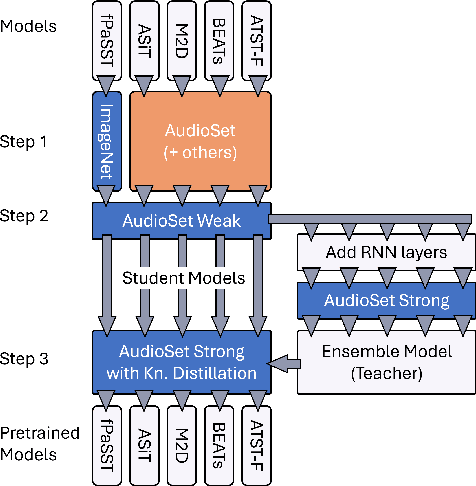
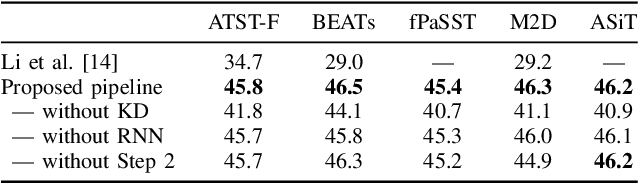
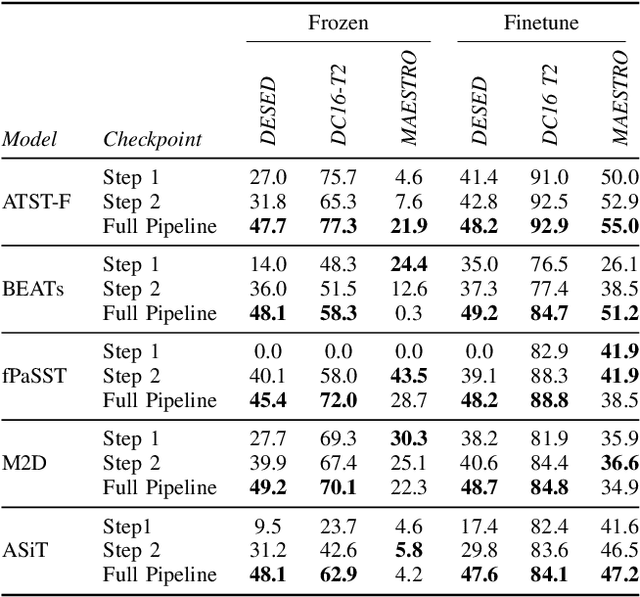
We propose a pre-training pipeline for audio spectrogram transformers for frame-level sound event detection tasks. On top of common pre-training steps, we add a meticulously designed training routine on AudioSet frame-level annotations. This includes a balanced sampler, aggressive data augmentation, and ensemble knowledge distillation. For five transformers, we obtain a substantial performance improvement over previously available checkpoints both on AudioSet frame-level predictions and on frame-level sound event detection downstream tasks, confirming our pipeline's effectiveness. We publish the resulting checkpoints that researchers can directly fine-tune to build high-performance models for sound event detection tasks.
Estimated Audio-Caption Correspondences Improve Language-Based Audio Retrieval
Aug 21, 2024Dual-encoder-based audio retrieval systems are commonly optimized with contrastive learning on a set of matching and mismatching audio-caption pairs. This leads to a shared embedding space in which corresponding items from the two modalities end up close together. Since audio-caption datasets typically only contain matching pairs of recordings and descriptions, it has become common practice to create mismatching pairs by pairing the audio with a caption randomly drawn from the dataset. This is not ideal because the randomly sampled caption could, just by chance, partly or entirely describe the audio recording. However, correspondence information for all possible pairs is costly to annotate and thus typically unavailable; we, therefore, suggest substituting it with estimated correspondences. To this end, we propose a two-staged training procedure in which multiple retrieval models are first trained as usual, i.e., without estimated correspondences. In the second stage, the audio-caption correspondences predicted by these models then serve as prediction targets. We evaluate our method on the ClothoV2 and the AudioCaps benchmark and show that it improves retrieval performance, even in a restricting self-distillation setting where a single model generates and then learns from the estimated correspondences. We further show that our method outperforms the current state of the art by 1.6 pp. mAP@10 on the ClothoV2 benchmark.
Improving Query-by-Vocal Imitation with Contrastive Learning and Audio Pretraining
Aug 21, 2024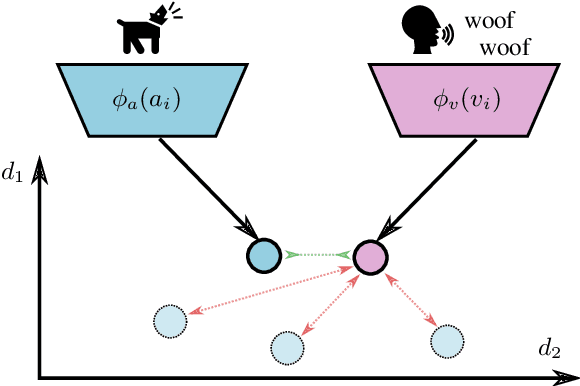
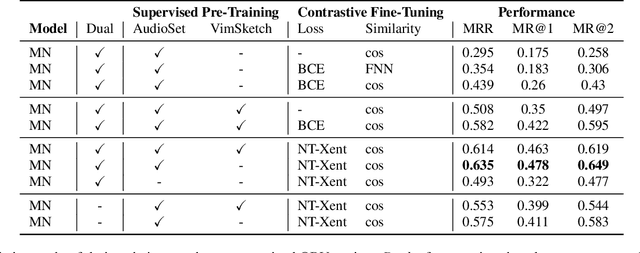
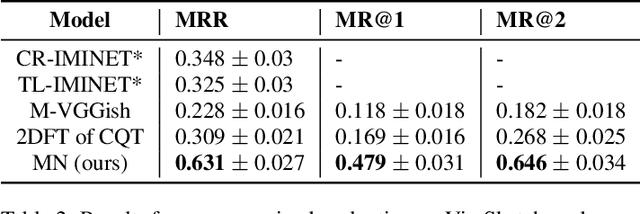
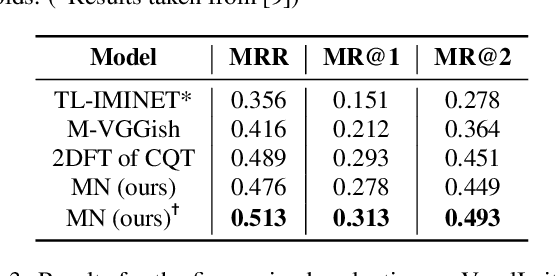
Query-by-Vocal Imitation (QBV) is about searching audio files within databases using vocal imitations created by the user's voice. Since most humans can effectively communicate sound concepts through voice, QBV offers the more intuitive and convenient approach compared to text-based search. To fully leverage QBV, developing robust audio feature representations for both the vocal imitation and the original sound is crucial. In this paper, we present a new system for QBV that utilizes the feature extraction capabilities of Convolutional Neural Networks pre-trained with large-scale general-purpose audio datasets. We integrate these pre-trained models into a dual encoder architecture and fine-tune them end-to-end using contrastive learning. A distinctive aspect of our proposed method is the fine-tuning strategy of pre-trained models using an adapted NT-Xent loss for contrastive learning, creating a shared embedding space for reference recordings and vocal imitations. The proposed system significantly enhances audio retrieval performance, establishing a new state of the art on both coarse- and fine-grained QBV tasks.
Multi-Iteration Multi-Stage Fine-Tuning of Transformers for Sound Event Detection with Heterogeneous Datasets
Jul 17, 2024A central problem in building effective sound event detection systems is the lack of high-quality, strongly annotated sound event datasets. For this reason, Task 4 of the DCASE 2024 challenge proposes learning from two heterogeneous datasets, including audio clips labeled with varying annotation granularity and with different sets of possible events. We propose a multi-iteration, multi-stage procedure for fine-tuning Audio Spectrogram Transformers on the joint DESED and MAESTRO Real datasets. The first stage closely matches the baseline system setup and trains a CRNN model while keeping the pre-trained transformer model frozen. In the second stage, both CRNN and transformer are fine-tuned using heavily weighted self-supervised losses. After the second stage, we compute strong pseudo-labels for all audio clips in the training set using an ensemble of fine-tuned transformers. Then, in a second iteration, we repeat the two-stage training process and include a distillation loss based on the pseudo-labels, achieving a new single-model, state-of-the-art performance on the public evaluation set of DESED with a PSDS1 of 0.692. A single model and an ensemble, both based on our proposed training procedure, ranked first in Task 4 of the DCASE Challenge 2024.
Fusing Audio and Metadata Embeddings Improves Language-based Audio Retrieval
Jun 22, 2024Matching raw audio signals with textual descriptions requires understanding the audio's content and the description's semantics and then drawing connections between the two modalities. This paper investigates a hybrid retrieval system that utilizes audio metadata as an additional clue to understand the content of audio signals before matching them with textual queries. We experimented with metadata often attached to audio recordings, such as keywords and natural-language descriptions, and we investigated late and mid-level fusion strategies to merge audio and metadata. Our hybrid approach with keyword metadata and late fusion improved the retrieval performance over a content-based baseline by 2.36 and 3.69 pp. mAP@10 on the ClothoV2 and AudioCaps benchmarks, respectively.
Data-Efficient Low-Complexity Acoustic Scene Classification in the DCASE 2024 Challenge
May 16, 2024

This article describes the Data-Efficient Low-Complexity Acoustic Scene Classification Task in the DCASE 2024 Challenge and the corresponding baseline system. The task setup is a continuation of previous editions (2022 and 2023), which focused on recording device mismatches and low-complexity constraints. This year's edition introduces an additional real-world problem: participants must develop data-efficient systems for five scenarios, which progressively limit the available training data. The provided baseline system is based on an efficient, factorized CNN architecture constructed from inverted residual blocks and uses Freq-MixStyle to tackle the device mismatch problem. The baseline system's accuracy ranges from 42.40% on the smallest to 56.99% on the largest training set.
Advancing Natural-Language Based Audio Retrieval with PaSST and Large Audio-Caption Data Sets
Aug 08, 2023This work presents a text-to-audio-retrieval system based on pre-trained text and spectrogram transformers. Our method projects recordings and textual descriptions into a shared audio-caption space in which related examples from different modalities are close. Through a systematic analysis, we examine how each component of the system influences retrieval performance. As a result, we identify two key components that play a crucial role in driving performance: the self-attention-based audio encoder for audio embedding and the utilization of additional human-generated and synthetic data sets during pre-training. We further experimented with augmenting ClothoV2 captions with available keywords to increase their variety; however, this only led to marginal improvements. Our system ranked first in the 2023's DCASE Challenge, and it outperforms the current state of the art on the ClothoV2 benchmark by 5.6 pp. mAP@10.