 Add to Chrome
 Add to Firefox
 Add to Edge
Hereditary Geometric Meta-RL: Nonlocal Generalization via Task Symmetries
Feb 28, 2026
Meta-Reinforcement Learning (Meta-RL) commonly generalizes via smoothness in the task encoding. While this enables local generalization around each training task, it requires dense coverage of the task space and leaves richer task space structure untapped. In response, we develop a geometric perspective that endows the task space with a "hereditary geometry" induced by the inherent symmetries of the underlying system. Concretely, the agent reuses a policy learned at the train time by transforming states and actions through actions of a Lie group. This converts Meta-RL into symmetry discovery rather than smooth extrapolation, enabling the agent to generalize to wider regions of the task space. We show that when the task space is inherited from the symmetries of the underlying system, the task space embeds into a subgroup of those symmetries whose actions are linearizable, connected, and compact--properties that enable efficient learning and inference at the test time. To learn these structures, we develop a differential symmetry discovery method. This collapses functional invariance constraints and thereby improves numerical stability and sample efficiency over functional approaches. Empirically, on a two-dimensional navigation task, our method efficiently recovers the ground-truth symmetry and generalizes across the entire task space, while a common baseline generalizes only near training tasks.

Enabling Mixed Effects Neural Networks for Diverse, Clustered Data Using Monte Carlo Methods
Jul 01, 2024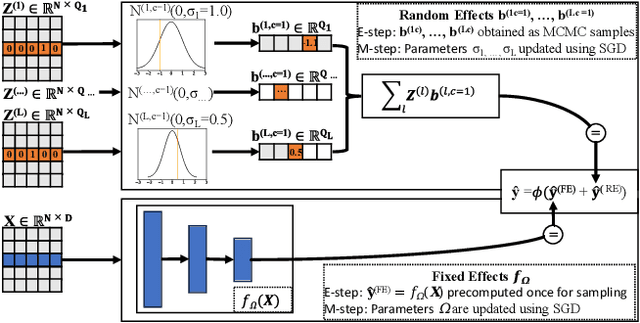
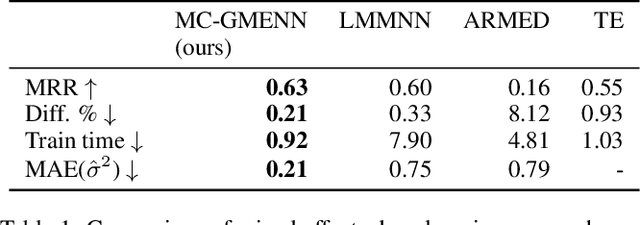
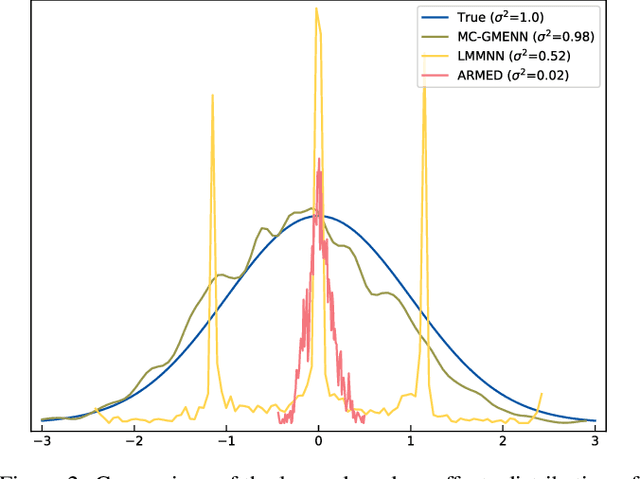
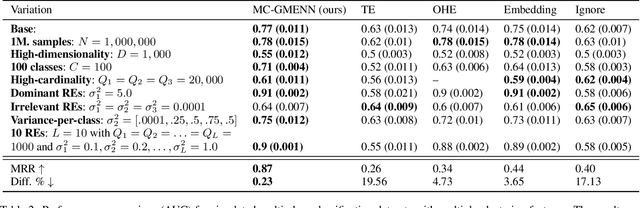
Neural networks often assume independence among input data samples, disregarding correlations arising from inherent clustering patterns in real-world datasets (e.g., due to different sites or repeated measurements). Recently, mixed effects neural networks (MENNs) which separate cluster-specific 'random effects' from cluster-invariant 'fixed effects' have been proposed to improve generalization and interpretability for clustered data. However, existing methods only allow for approximate quantification of cluster effects and are limited to regression and binary targets with only one clustering feature. We present MC-GMENN, a novel approach employing Monte Carlo methods to train Generalized Mixed Effects Neural Networks. We empirically demonstrate that MC-GMENN outperforms existing mixed effects deep learning models in terms of generalization performance, time complexity, and quantification of inter-cluster variance. Additionally, MC-GMENN is applicable to a wide range of datasets, including multi-class classification tasks with multiple high-cardinality categorical features. For these datasets, we show that MC-GMENN outperforms conventional encoding and embedding methods, simultaneously offering a principled methodology for interpreting the effects of clustering patterns.