 Add to Chrome
 Add to Firefox
 Add to Edge
Lost in Aggregation: How Benchmarks Overlook Irreplaceable Model Strengths
Aug 19, 2026
Tabular machine learning benchmarks typically summarize performance by averaging scores, ranks, or pairwise wins across datasets. Such aggregates are useful for selecting robust default models, but they can obscure a different question: which models are necessary to attain peak performance on particular datasets? We argue that benchmark evaluation should also consider the data-centric peak performance frontier, defined by the best statistically supported performance achieved on each dataset. From this perspective, a model may be irreplaceable, sufficient, redundant, or fallible depending on where it lies on the frontier relative to other models. Applying this framework to the TabArena benchmark, we find that common aggregation metrics are highly correlated and largely measure consistency and avoiding failures, while being much less aligned with dataset-level irreplaceability. Consequently, models performing decently across datasets without ever being the best choice are rewarded while models with unique dataset-specific strengths appear mediocre under aggregation. Hence, benchmark progress should be measured not only by improvements on aggregation metrics but also by whether new models expand the set of attainable peak performances across datasets.

Solver-Aware Decompositions for Programming-by-Example: When Dividing Requires Knowing how to Conquer
Aug 04, 2026Decomposition-based Programming-by-example (PBE) scales performance by splitting tasks into subtasks that a learned synthesizer solves: a decomposer predicts intermediate subgoals, and a synthesizer generates programs conditioned on them. Current approaches train the decomposer to imitate ground-truth ( GT) subgoals, implicitly treating decomposition quality as intrinsic to the task. We challenge this assumption: for bounded solvers with fixed inductive biases, GT decompositions reflect the annotator's factorization choices - not the solver's search dynamics. A decomposer trained to match GT decompositions may therefore propose subgoals that are logically valid yet intractable for the solver. We propose Solver-Aware Decomposition (SAD), a training framework that retains supervised training on GT subgoals as a structural scaffold, while additionally optimizing the decomposer via direct feedback from a frozen synthesizer. Subgoals are rewarded based on the synthesizer's loss on the target program - a signal of subtask difficulty that encourages decompositions the solver can act on. Our experiments reveal an accuracy paradox: higher agreement with GT decompositions does not improve synthesis success - even though the synthesizer was trained on the very same GT data the decomposer is optimized to mimic. SAD instead learns decompositions that trade GT alignment for solver tractability, yielding consistent gains in synthesis and end-to-end task accuracy across two PBE domains. Moreover, SAD solves tasks that a GT decomposition oracle fails - empirical evidence that GT decompositions are not universally optimal for bounded solvers, and that decomposition quality is solver-relative, not intrinsic.
BIM-Edit: Benchmarking Large Language Models for IFC-Based Building Information Modeling
Jun 18, 2026Large language models (LLMs) are increasingly applied to computer-aided design (CAD) to generate design artifacts from textual instructions. In engineering practice, this requires more than creating new geometry, models must also understand existing scenes, edit them correctly, and preserve semantics and relations. However, many CAD benchmarks focus on creating new models rather than editing existing ones, and mostly evaluate geometric correctness. We introduce BIM-Edit, a benchmark for evaluating LLMs on natural-language editing of Building Information Models (BIM) represented in the Industry Foundation Classes (IFC) format. BIM provides a challenging testbed because building models encode geometry together with semantic and relational structure. BIM-Edit contains 324 editing tasks spanning 11 realistic building models and 36 synthetic scenes. Tasks are expressed using three instruction categories - direct, spatial, and topological - covering both explicit and scene-grounded edits. We evaluate outputs along three dimensions: geometric accuracy, semantic validity, and topological consistency. Across evaluated LLMs, the best-performing model achieves only 49.5% average score across the three metrics, and no model fully solves more than 3.4% of tasks. These results demonstrate a substantial gap between current LLM capabilities and the requirements of structured engineering design workflows.
TabPrep: Closing the Feature Engineering Gap in Tabular Benchmarks
Jun 01, 2026Progress in tabular machine learning has largely focused on increasingly sophisticated model architectures. At the same time, feature engineering remains a critical yet underexplored component of real-world modeling pipelines that is entirely absent from modern benchmarks, which creates an unquantified evaluation gap. In this work, we introduce TabPrep, a lightweight preprocessing pipeline composed of feature generators that are carefully designed to target three specific structural data patterns. We show that many widely used model classes exhibit predictable blind spots to these patterns and that systematic feature engineering alone can establish new peak performance. Across the TabArena benchmark, integrating TabPrep into model training and tuning consistently improves performance for tree-based, neural, linear, and foundation models, often surpassing gains achieved by model-centric innovations alone. TabPrep outperforms previous automated feature engineering approaches in performance, efficiency, and applicability across datasets, enabling integration into large-scale benchmarks. By releasing TabPrep (see https://github.com/atschalz/tabprep), we enable researchers to integrate feature engineering into their benchmarking setup, filling a longstanding gap in tabular evaluations.
Revisiting Metafeatures to Explain Model Differences on Tabular Data
May 28, 2026With the rise of tabular foundation models alongside traditional models still performing well on many tasks, choosing the right model for a tabular dataset remains difficult. We investigate whether dataset meta-features can explain performance gaps between model families on tabular prediction tasks. Using the TabArena benchmark results, we analyze dataset-level performance gaps and relate them to model-agnostic dataset descriptors. After strict statistical tests with false discovery control, we find that (1) for neural network vs. tree gaps, no meta-feature survives false discovery control, (2) for non-foundation vs. foundation model gaps, one association is robust but does not generalize when tested in leave-one-dataset-out prediction, and (3) for TabICLv2 vs. TabPFN-2.6, one robust association also improves held-out prediction. Furthermore, we conduct a leave-one-dataset-out analysis and find that meta-feature predictors fail to improve meaningfully over a simple baseline. Overall, our results show the heterogeneity of tabular datasets and that global meta-feature approaches are not robust enough to offer explanations on the 51 TabArena datasets.
BARISTA: A Multi-Task Egocentric Benchmark for Compositional Visual Understanding
May 12, 2026Scene understanding is central to general physical intelligence, and video is a primary modality for capturing both state and temporal dynamics of a scene. Yet understanding physical processes remains difficult, as models must combine object localization, hand-object interactions, relational parsing, temporal reasoning, and step-level procedural inference. Existing benchmarks usually evaluate these capabilities separately, limiting diagnosis of why models fail on procedural tasks. We introduce BARISTA, a densely annotated egocentric dataset and benchmark of 185 real-world coffee-preparation videos covering fully automatic, portafilter-based, and capsule-based workflows. BARISTA provides verified per-frame scene graphs linking persistent object identities to masks, tracks, boxes, attributes, typed relations, hand-object interactions, activities, and process steps. From these graphs, we derive zero-shot language-based tasks spanning phrase grounding, hand-object interaction recognition, referring, activity recognition, relation extraction, and temporal visual question answering. Experiments reveal strong variation across task families and no consistently dominant model family, positioning BARISTA as a challenging diagnostic benchmark for procedural video understanding. Code and dataset available at https://huggingface.co/datasets/ramblr/BARISTA.
From Codebooks to VLMs: Evaluating Automated Visual Discourse Analysis for Climate Change on Social Media
Apr 23, 2026Social media platforms have become primary arenas for climate communication, generating millions of images and posts that - if systematically analysed - can reveal which communication strategies mobilise public concern and which fall flat. We aim to facilitate such research by analysing how computer vision methods can be used for social media discourse analysis. This analysis includes application-based taxonomy design, model selection, prompt engineering, and validation. We benchmark six promptable vision-language models and 15 zero-shot CLIP-like models on two datasets from X (formerly Twitter) - a 1,038-image expert-annotated set and a larger corpus of over 1.2 million images, with 50,000 labels manually validated - spanning five annotation dimensions: animal content, climate change consequences, climate action, image setting, and image type. Among the models benchmarked, Gemini-3.1-flash-lite outperforms all others across all super-categories and both datasets, while the gap to open-weight models of moderate size remains relatively small. Beyond instance-level metrics, we advocate for distributional evaluation: VLM predictions can reliably recover population level trends even when per-image accuracy is moderate, making them a viable starting point for discourse analysis at scale. We find that chain-of-thought reasoning reduces rather than improves performance, and that annotation dimension specific prompt design improves performance. We release tweet IDs and labels along with our code at https://github.com/KathPra/Codebooks2VLMs.git.
Transductively Informed Inductive Program Synthesis
May 20, 2025Abstraction and reasoning in program synthesis has seen significant progress through both inductive and transductive paradigms. Inductive approaches generate a program or latent function from input-output examples, which can then be applied to new inputs. Transductive approaches directly predict output values for given inputs, effectively serving as the function themselves. Current approaches combine inductive and transductive models via isolated ensembling, but they do not explicitly model the interaction between both paradigms. In this work, we introduce \acs{tiips}, a novel framework that unifies transductive and inductive strategies by explicitly modeling their interactions through a cooperative mechanism: an inductive model generates programs, while a transductive model constrains, guides, and refines the search to improve synthesis accuracy and generalization. We evaluate \acs{tiips} on two widely studied program synthesis domains: string and list manipulation. Our results show that \acs{tiips} solves more tasks and yields functions that more closely match optimal solutions in syntax and semantics, particularly in out-of-distribution settings, yielding state-of-the-art performance. We believe that explicitly modeling the synergy between inductive and transductive reasoning opens promising avenues for general-purpose program synthesis and broader applications.
Which LIME should I trust? Concepts, Challenges, and Solutions
Mar 31, 2025As neural networks become dominant in essential systems, Explainable Artificial Intelligence (XAI) plays a crucial role in fostering trust and detecting potential misbehavior of opaque models. LIME (Local Interpretable Model-agnostic Explanations) is among the most prominent model-agnostic approaches, generating explanations by approximating the behavior of black-box models around specific instances. Despite its popularity, LIME faces challenges related to fidelity, stability, and applicability to domain-specific problems. Numerous adaptations and enhancements have been proposed to address these issues, but the growing number of developments can be overwhelming, complicating efforts to navigate LIME-related research. To the best of our knowledge, this is the first survey to comprehensively explore and collect LIME's foundational concepts and known limitations. We categorize and compare its various enhancements, offering a structured taxonomy based on intermediate steps and key issues. Our analysis provides a holistic overview of advancements in LIME, guiding future research and helping practitioners identify suitable approaches. Additionally, we provide a continuously updated interactive website (https://patrick-knab.github.io/which-lime-to-trust/), offering a concise and accessible overview of the survey.
Unreflected Use of Tabular Data Repositories Can Undermine Research Quality
Mar 12, 2025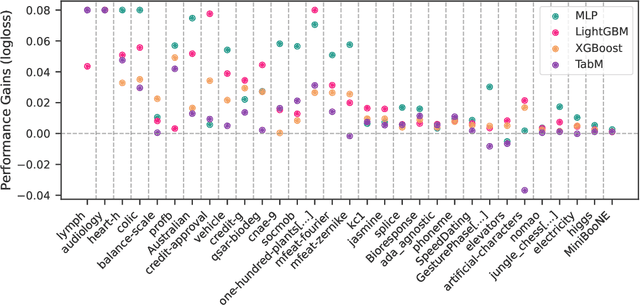
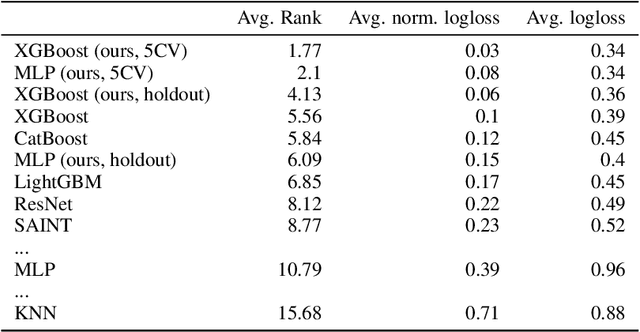
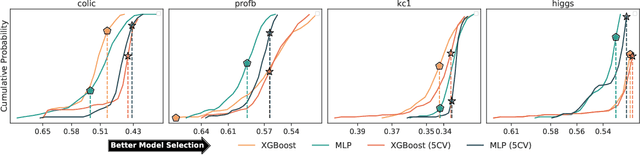
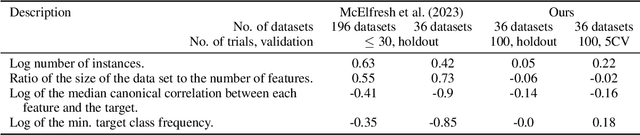
Data repositories have accumulated a large number of tabular datasets from various domains. Machine Learning researchers are actively using these datasets to evaluate novel approaches. Consequently, data repositories have an important standing in tabular data research. They not only host datasets but also provide information on how to use them in supervised learning tasks. In this paper, we argue that, despite great achievements in usability, the unreflected usage of datasets from data repositories may have led to reduced research quality and scientific rigor. We present examples from prominent recent studies that illustrate the problematic use of datasets from OpenML, a large data repository for tabular data. Our illustrations help users of data repositories avoid falling into the traps of (1) using suboptimal model selection strategies, (2) overlooking strong baselines, and (3) inappropriate preprocessing. In response, we discuss possible solutions for how data repositories can prevent the inappropriate use of datasets and become the cornerstones for improved overall quality of empirical research studies.