 Add to Chrome
 Add to Firefox
 Add to Edge
Closed-loop coupling of personalised and foundation models for real-time treatment guidance with MRI
Jul 01, 2026
Image-guided therapies, including radiotherapy, biopsy and deep brain stimulation, rely on real-time targeting of anatomical structures. However, in the presence of motion, imaging latencies create a temporal misalignment between observed and true anatomy, compromising treatment accuracy. Artificial intelligence-based frameworks have increasingly been presented to close this latency gap, but leading personalised models can fail due to a lack of stable anatomical grounding. Foundation models can provide grounded behaviour, but they do not adapt to real-time, individual patient dynamics. Here we introduce a closed-loop coupling framework that synergises patient-specific temporal prediction with continuous segmentation-based anatomical interpretation from a foundation model. A personalised model predicts future anatomy to compensate for system latency, while a streaming foundation model provides anatomical supervision used to continuously update the temporal predictor in real time during treatment. We validate the framework using a digital phantom and intrafraction magnetic resonance imaging (MRI) from patients undergoing MRI-guided radiotherapy. For a prediction horizon of 400 ms, the proposed method improves anatomical prediction and reduces dosimetric error compared with existing approaches, within clinically relevant latency constraints. These results establish closed-loop coupling as a general strategy for real-time image-guided intervention.

TrackRAD2025 challenge dataset: Real-time tumor tracking for MRI-guided radiotherapy
Mar 24, 2025Purpose: Magnetic resonance imaging (MRI) to visualize anatomical motion is becoming increasingly important when treating cancer patients with radiotherapy. Hybrid MRI-linear accelerator (MRI-linac) systems allow real-time motion management during irradiation. This paper presents a multi-institutional real-time MRI time series dataset from different MRI-linac vendors. The dataset is designed to support developing and evaluating real-time tumor localization (tracking) algorithms for MRI-guided radiotherapy within the TrackRAD2025 challenge (https://trackrad2025.grand-challenge.org/). Acquisition and validation methods: The dataset consists of sagittal 2D cine MRIs in 585 patients from six centers (3 Dutch, 1 German, 1 Australian, and 1 Chinese). Tumors in the thorax, abdomen, and pelvis acquired on two commercially available MRI-linacs (0.35 T and 1.5 T) were included. For 108 cases, irradiation targets or tracking surrogates were manually segmented on each temporal frame. The dataset was randomly split into a public training set of 527 cases (477 unlabeled and 50 labeled) and a private testing set of 58 cases (all labeled). Data Format and Usage Notes: The data is publicly available under the TrackRAD2025 collection: https://doi.org/10.57967/hf/4539. Both the images and segmentations for each patient are available in metadata format. Potential Applications: This novel clinical dataset will enable the development and evaluation of real-time tumor localization algorithms for MRI-guided radiotherapy. By enabling more accurate motion management and adaptive treatment strategies, this dataset has the potential to advance the field of radiotherapy significantly.
Decoupling Respiratory and Angular Variation in Rotational X-ray Scans Using a Prior Bilinear Model
Nov 05, 2018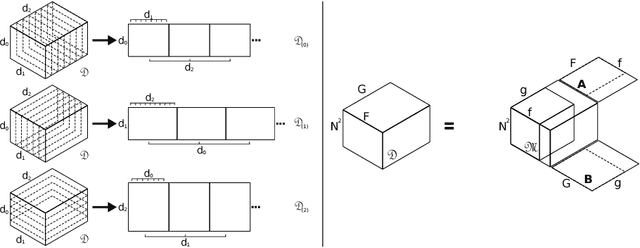
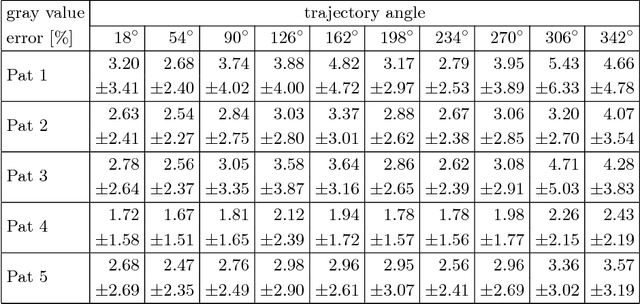
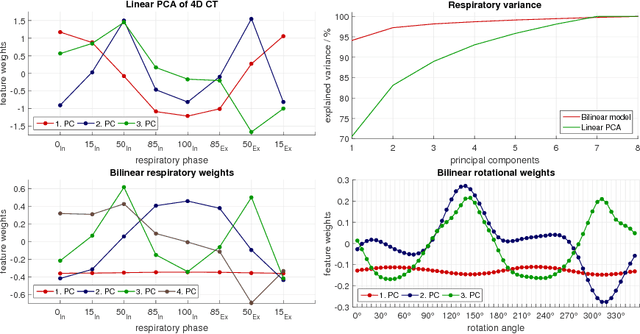
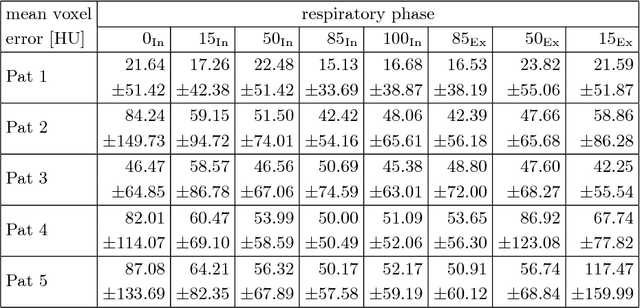
Data-driven respiratory signal extraction from rotational X-ray scans is a challenge as angular effects overlap with respiration-induced change in the scene. In this paper, we use the linearity of the X-ray transform to propose a bilinear model based on a prior 4D scan to separate angular and respiratory variation. The bilinear estimation process is supported by a B-spline interpolation using prior knowledge about the trajectory angle. Consequently, extraction of respiratory features simplifies to a linear problem. Though the need for a prior 4D CT seems steep, our proposed use-case of driving a respiratory motion model in radiation therapy usually meets this requirement. We evaluate on DRRs of 5 patient 4D CTs in a leave-one-phase-out manner and achieve a mean estimation error of 3.01 % in the gray values for unseen viewing angles. We further demonstrate suitability of the extracted weights to drive a motion model for treatments with a continuously rotating gantry.