 Add to Chrome
 Add to Firefox
 Add to Edge
Introduction to Stochastic Differential Equations for Generative Machine Learning: A Variational Perspective
Jun 30, 2026
The use of ordinary and stochastic differential equations has led to substantial progress in generative machine learning with applications to, for example, image, video and biomolecule generation. This paper provides a self-contained and informal introduction to the differential equations, the probabilistic framework for using them in generative modeling and the Fokker--Planck equation that governs the temporal evolution of the marginal distribution of the stochastic variables of the differential equations. The variational lower bound on the log-likelihood (the evidence lower bound, ELBO) is derived and used as a general starting point for a discussion of diffusion models, score matching, and flow matching. All of these approaches may be viewed as specific parameterizations of the most general variational approach. A one-dimensional density modeling problem is used as a simple example to compare different parameterizations.

Mix, Don't Tune: Bilingual Pre-Training Outperforms Hyperparameter Search in Data-Constrained Settings
May 13, 2026For most languages of the world, language model pre-training operates in a data-constrained regime where models must repeat their training data many times, degrading generalization. Two remedies exist: aggressive hyperparameter tuning such as high weight decay, and mixing in data from a high-resource auxiliary language to directly aid the low-resource target. While hyperparameter tuning regularizes the model by shrinking weights to restrict network capacity, auxiliary data mixing uses a tunable mixing ratio to expand the training distribution and diversify the training signal with new knowledge. Both offer a principled way to improve training in a data-constrained domain. We compare these levers systematically across four model scales from 150M to 1.43B parameters, using Arabic as the low-resource target and English as the auxiliary, over approximately 1000 pre-training runs. Three findings emerge. First, mixing yields larger improvements than hyperparameter tuning on both validation loss and downstream task accuracy, and the gap grows with model size. Second, we quantify how much mixing helps: it boosts performance by an amount equivalent to 2--3$\times$ the unique target data on validation loss and 2--13$\times$ on downstream task accuracy, with the gain scaling steeply with model size. Third, this divergence reveals that target-language validation loss systematically underestimates mixing's value. Mixing regularizes by diversifying the training signal and contributes knowledge the repeated target corpus cannot supply; validation loss captures only the first effect. Our practical recommendations are: mix in a high-resource language, prioritize the mixing ratio over hyperparameter tuning, and transfer hyperparameters from a small proxy model via $μ$P.
Learning Energy-Based Models by Self-normalising the Likelihood
Mar 10, 2025Training an energy-based model (EBM) with maximum likelihood is challenging due to the intractable normalisation constant. Traditional methods rely on expensive Markov chain Monte Carlo (MCMC) sampling to estimate the gradient of logartihm of the normalisation constant. We propose a novel objective called self-normalised log-likelihood (SNL) that introduces a single additional learnable parameter representing the normalisation constant compared to the regular log-likelihood. SNL is a lower bound of the log-likelihood, and its optimum corresponds to both the maximum likelihood estimate of the model parameters and the normalisation constant. We show that the SNL objective is concave in the model parameters for exponential family distributions. Unlike the regular log-likelihood, the SNL can be directly optimised using stochastic gradient techniques by sampling from a crude proposal distribution. We validate the effectiveness of our proposed method on various density estimation tasks as well as EBMs for regression. Our results show that the proposed method, while simpler to implement and tune, outperforms existing techniques.
Debiasing Guidance for Discrete Diffusion with Sequential Monte Carlo
Feb 10, 2025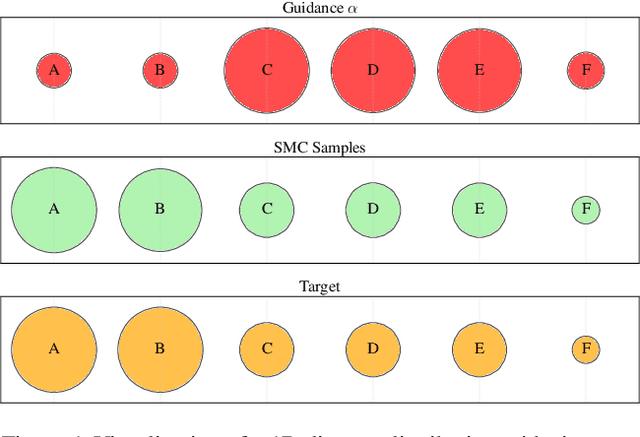
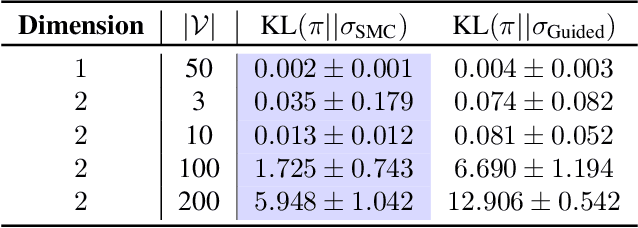
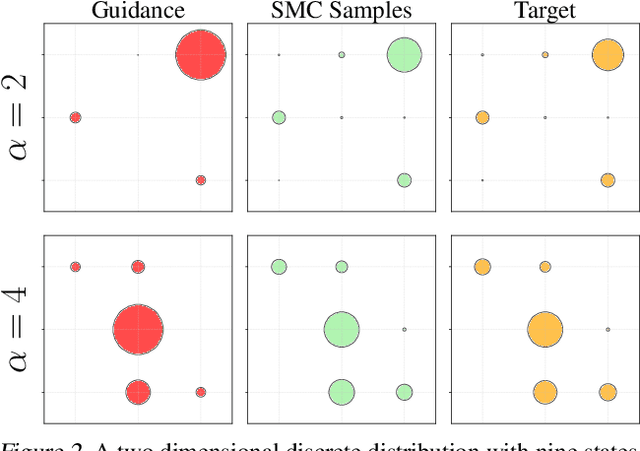

Discrete diffusion models are a class of generative models that produce samples from an approximated data distribution within a discrete state space. Often, there is a need to target specific regions of the data distribution. Current guidance methods aim to sample from a distribution with mass proportional to $p_0(x_0) p(\zeta|x_0)^\alpha$ but fail to achieve this in practice. We introduce a Sequential Monte Carlo algorithm that generates unbiasedly from this target distribution, utilising the learnt unconditional and guided process. We validate our approach on low-dimensional distributions, controlled images and text generations. For text generation, our method provides strong control while maintaining low perplexity compared to guidance-based approaches.
Generative Diffusion Models for Sequential Recommendations
Oct 25, 2024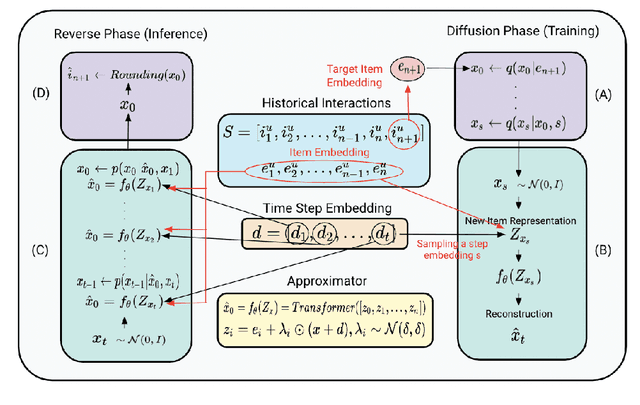
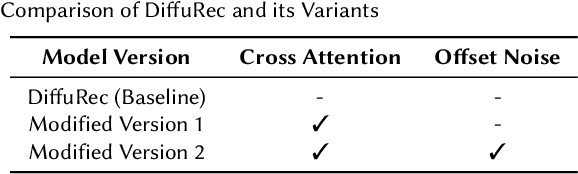
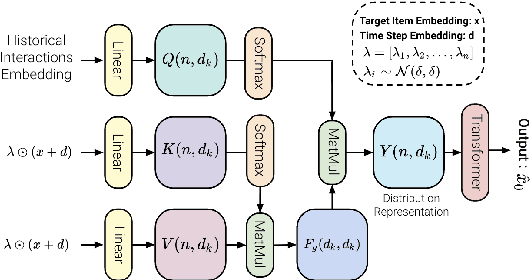
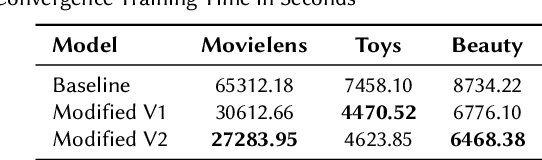
Generative models such as Variational Autoencoders (VAEs) and Generative Adversarial Networks (GANs) have shown promise in sequential recommendation tasks. However, they face challenges, including posterior collapse and limited representation capacity. The work by Li et al. (2023) introduces a novel approach that leverages diffusion models to address these challenges by representing item embeddings as distributions rather than fixed vectors. This approach allows for a more adaptive reflection of users' diverse interests and various item aspects. During the diffusion phase, the model converts the target item embedding into a Gaussian distribution by adding noise, facilitating the representation of sequential item distributions and the injection of uncertainty. An Approximator then processes this noisy item representation to reconstruct the target item. In the reverse phase, the model utilizes users' past interactions to reverse the noise and finalize the item prediction through a rounding operation. This research introduces enhancements to the DiffuRec architecture, particularly by adding offset noise in the diffusion process to improve robustness and incorporating a cross-attention mechanism in the Approximator to better capture relevant user-item interactions. These contributions led to the development of a new model, DiffuRecSys, which improves performance. Extensive experiments conducted on three public benchmark datasets demonstrate that these modifications enhance item representation, effectively capture diverse user preferences, and outperform existing baselines in sequential recommendation research.
Variance reduction of diffusion model's gradients with Taylor approximation-based control variate
Aug 22, 2024
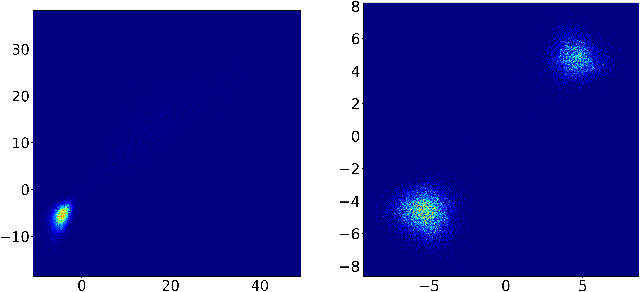


Score-based models, trained with denoising score matching, are remarkably effective in generating high dimensional data. However, the high variance of their training objective hinders optimisation. We attempt to reduce it with a control variate, derived via a $k$-th order Taylor expansion on the training objective and its gradient. We prove an equivalence between the two and demonstrate empirically the effectiveness of our approach on a low dimensional problem setting; and study its effect on larger problems.