 Add to Chrome
 Add to Firefox
 Add to Edge
HyperFitS -- Hypernetwork Fitting Spectra for metabolic quantification of ${}^1$H MR spectroscopic imaging
Apr 03, 2026
Purpose: Proton magnetic resonance spectroscopic imaging ($^1$H MRSI) enables the mapping of whole-brain metabolites concentrations in-vivo. However, a long-standing problem for its clinical applicability is the metabolic quantification, which can require extensive time for spectral fitting. Recently, deep learning methods have been able to provide whole-brain metabolic quantification in only a few seconds. However, neural network implementations often lack configurability and require retraining to change predefined parameter settings. Methods: We introduce HyperFitS, a hypernetwork for spectral fitting for metabolite quantification in whole-brain $^1$H MRSI that flexibly adapts to a broad range of baseline corrections and water suppression factors. Metabolite maps of human subjects acquired at 3T and 7T with isotropic resolutions of 10 mm, 3.4 mm and 2 mm by water-suppressed and water-unsuppressed MRSI were quantified with HyperFitS and compared to conventional LCModel fitting. Results: Metabolic maps show a substantial agreement between the new and gold-standard methods, with significantly faster fitting times by HyperFitS. Quantitative results further highlight the impact of baseline parametrization on metabolic quantification, which can alter results by up to 30%. Conclusion: HyperFitS shows strong agreement with state-of-the-art conventional methods, while reducing processing times from hours to a few seconds. Compared to prior deep learning based spectral fitting methods, HyperFitS enables a wide range of configurability and can adapt to data quality acquired with multiple protocols and field strengths without retraining.

Deep learning water-unsuppressed MRSI at ultra-high field for simultaneous quantitative metabolic, susceptibility and myelin water imaging
Dec 16, 2025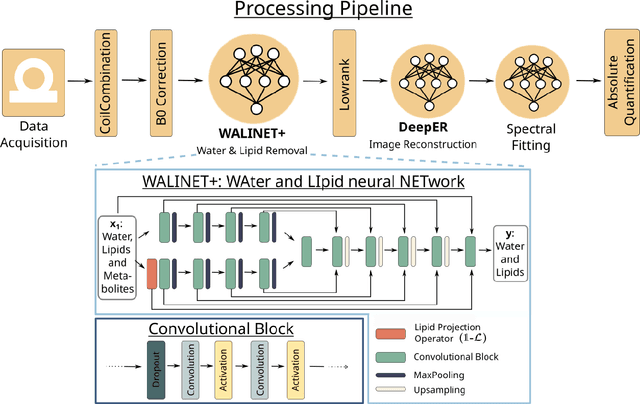
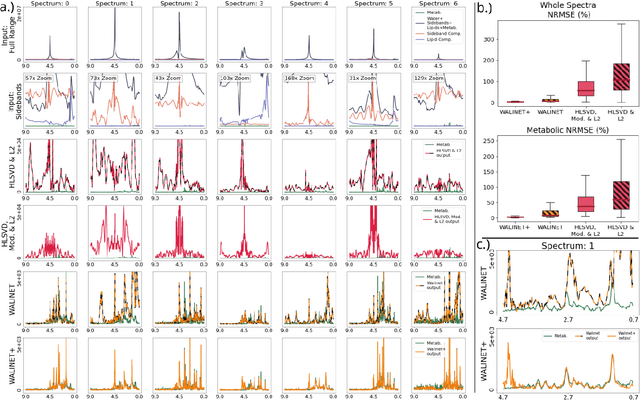
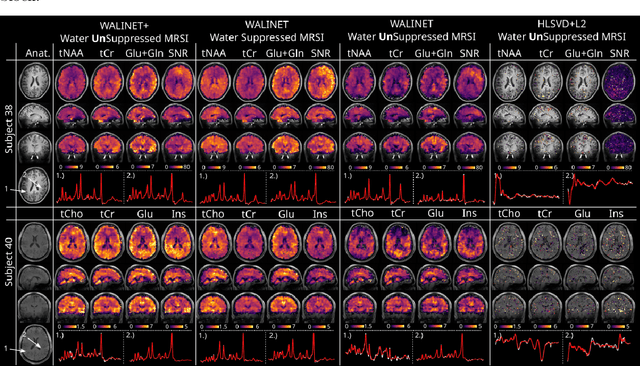
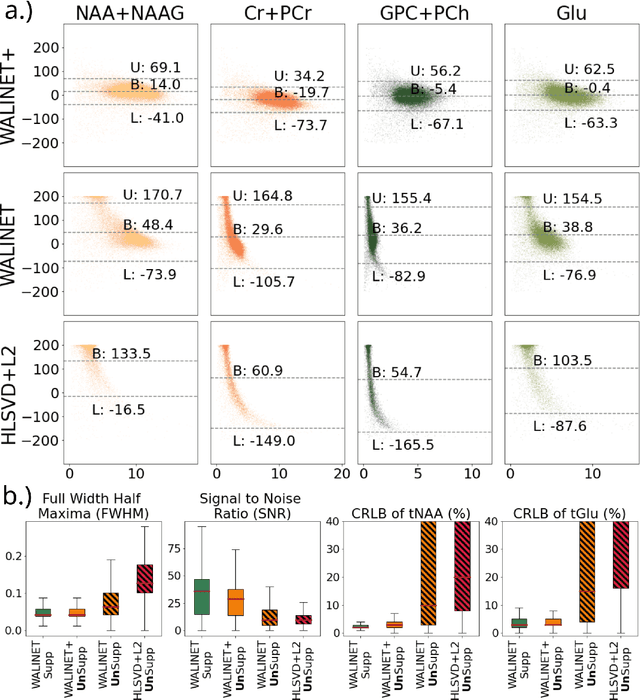
Purpose: Magnetic Resonance Spectroscopic Imaging (MRSI) maps endogenous brain metabolism while suppressing the overwhelming water signal. Water-unsuppressed MRSI (wu-MRSI) allows simultaneous imaging of water and metabolites, but large water sidebands cause challenges for metabolic fitting. We developed an end-to-end deep-learning pipeline to overcome these challenges at ultra-high field. Methods:Fast high-resolution wu-MRSI was acquired at 7T with non-cartesian ECCENTRIC sampling and ultra-short echo time. A water and lipid removal network (WALINET+) was developed to remove lipids, water signal, and sidebands. MRSI reconstruction was performed by DeepER and a physics-informed network for metabolite fitting. Water signal was used for absolute metabolite quantification, quantitative susceptibility mapping (QSM), and myelin water fraction imaging (MWF). Results: WALINET+ provided the lowest NRMSE (< 2%) in simulations and in vivo the smallest bias (< 20%) and limits-of-agreement (+-63%) between wu-MRSI and ws-MRSI scans. Several metabolites such as creatine and glutamate showed higher SNR in wu-MRSI. QSM and MWF obtained from wu-MRSI and GRE showed good agreement with 0 ppm/5.5% bias and +-0.05 ppm/ +- 12.75% limits-of-agreement. Conclusion: High-quality metabolic, QSM, and MWF mapping of the human brain can be obtained simultaneously by ECCENTRIC wu-MRSI at 7T with 2 mm isotropic resolution in 12 min. WALINET+ robustly removes water sidebands while preserving metabolite signal, eliminating the need for water suppression and separate water acquisitions.