 Add to Chrome
 Add to Firefox
 Add to Edge
LePREC: Reasoning as Classification over Structured Factors for Assessing Relevance of Legal Issues
Apr 21, 2026
More than half of the global population struggles to meet their civil justice needs due to limited legal resources. While Large Language Models (LLMs) have demonstrated impressive reasoning capabilities, significant challenges remain even at the foundational step of legal issue identification. To investigate LLMs' capabilities in this task, we constructed a dataset from 769 real-world Malaysian Contract Act court cases, using GPT-4o to extract facts and generate candidate legal issues, annotated by senior legal experts, which reveals a critical limitation: while LLMs generate diverse issue candidates, their precision remains inadequate (GPT-4o achieves only 62%). To address this gap, we propose LePREC (Legal Professional-inspired Reasoning Elicitation and Classification), a neuro-symbolic framework combining neural generation with structured statistical reasoning. LePREC consists of: (1) a neuro component leverages LLMs to transform legal descriptions into question-answer pairs representing diverse analytical factors, and (2) a symbolic component applies sparse linear models over these discrete features, learning explicit algebraic weights that identify the most informative reasoning factors. Unlike end-to-end neural approaches, LePREC achieves interpretability through transparent feature weighting while maintaining data efficiency through correlation-based statistical classification. Experiments show a 30-40% improvement over advanced LLM baselines, including GPT-4o and Claude, confirming that correlation-based factor-issue analysis offers a more data-efficient solution for relevance decisions.

Methods for Legal Citation Prediction in the Age of LLMs: An Australian Law Case Study
Dec 09, 2024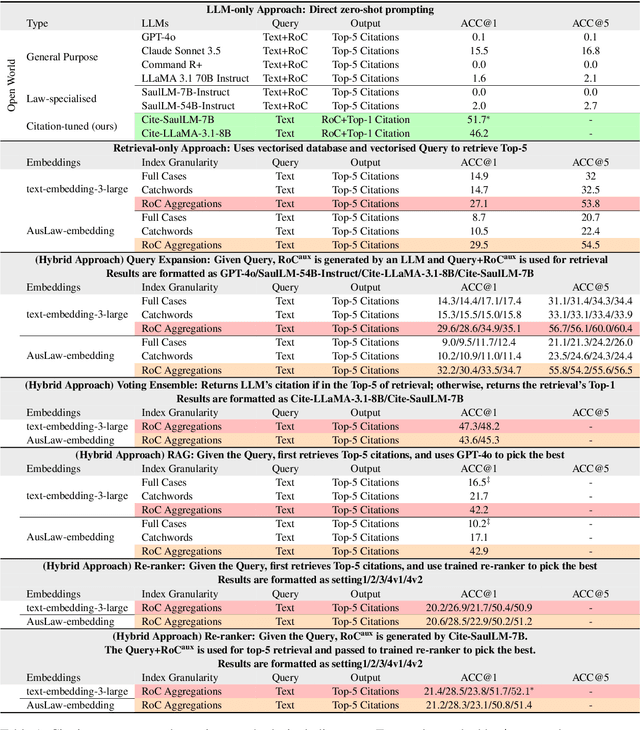
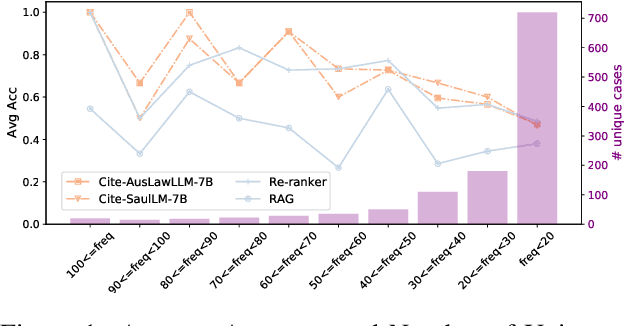
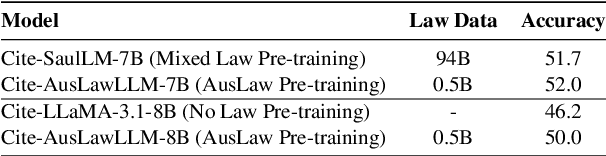
In recent years, Large Language Models (LLMs) have shown great potential across a wide range of legal tasks. Despite these advances, mitigating hallucination remains a significant challenge, with state-of-the-art LLMs still frequently generating incorrect legal references. In this paper, we focus on the problem of legal citation prediction within the Australian law context, where correctly identifying and citing relevant legislations or precedents is critical. We compare several approaches: prompting general purpose and law-specialised LLMs, retrieval-only pipelines with both generic and domain-specific embeddings, task-specific instruction-tuning of LLMs, and hybrid strategies that combine LLMs with retrieval augmentation, query expansion, or voting ensembles. Our findings indicate that domain-specific pre-training alone is insufficient for achieving satisfactory citation accuracy even after law-specialised pre-training. In contrast, instruction tuning on our task-specific dataset dramatically boosts performance reaching the best results across all settings. We also highlight that database granularity along with the type of embeddings play a critical role in the performance of retrieval systems. Among retrieval-based approaches, hybrid methods consistently outperform retrieval-only setups, and among these, ensemble voting delivers the best result by combining the predictive quality of instruction-tuned LLMs with the retrieval system.