 Add to Chrome
 Add to Firefox
 Add to Edge
GSRAIN: Physically Calibrated High-/Low-Frequency Rainfall Synthesis for 3D Gaussian Driving Scenes
Aug 03, 2026
Existing rainfall simulation methods for autonomous driving remain limited in physical controllability and multi-view consistency. This paper presents GSRAIN, a high-/low-frequency rainfall synthesis method for 3D Gaussian Splatting (3DGS) driving scenes. GSRAIN constructs a high-frequency raindrop model from measured rainfall data and generates low-frequency rainy appearance using a geometry-aware single-step diffusion model. The two effects are then fused in a unified 3DGS scene, enabling rainfall-intensity control over the range of 0--13~mm/h. The proposed method achieves a Fréchet Inception Distance (FID) of 149.09, outperforming CycleGAN-Turbo (155.71) and WeatherEdit (157.94). Object-detection and closed-loop driving experiments further show that the generated scenes expose scene-dependent performance changes of the evaluated algorithms under controllable rainfall. These results indicate that GSRAIN provides an effective approach for constructing physically controllable, repeatable, and closed-loop-compatible rainy-weather test scenes for autonomous driving.

LePREC: Reasoning as Classification over Structured Factors for Assessing Relevance of Legal Issues
Apr 21, 2026More than half of the global population struggles to meet their civil justice needs due to limited legal resources. While Large Language Models (LLMs) have demonstrated impressive reasoning capabilities, significant challenges remain even at the foundational step of legal issue identification. To investigate LLMs' capabilities in this task, we constructed a dataset from 769 real-world Malaysian Contract Act court cases, using GPT-4o to extract facts and generate candidate legal issues, annotated by senior legal experts, which reveals a critical limitation: while LLMs generate diverse issue candidates, their precision remains inadequate (GPT-4o achieves only 62%). To address this gap, we propose LePREC (Legal Professional-inspired Reasoning Elicitation and Classification), a neuro-symbolic framework combining neural generation with structured statistical reasoning. LePREC consists of: (1) a neuro component leverages LLMs to transform legal descriptions into question-answer pairs representing diverse analytical factors, and (2) a symbolic component applies sparse linear models over these discrete features, learning explicit algebraic weights that identify the most informative reasoning factors. Unlike end-to-end neural approaches, LePREC achieves interpretability through transparent feature weighting while maintaining data efficiency through correlation-based statistical classification. Experiments show a 30-40% improvement over advanced LLM baselines, including GPT-4o and Claude, confirming that correlation-based factor-issue analysis offers a more data-efficient solution for relevance decisions.
AxBERT: An Interpretable Chinese Spelling Correction Method Driven by Associative Knowledge Network
Mar 04, 2025Deep learning has shown promising performance on various machine learning tasks. Nevertheless, the uninterpretability of deep learning models severely restricts the usage domains that require feature explanations, such as text correction. Therefore, a novel interpretable deep learning model (named AxBERT) is proposed for Chinese spelling correction by aligning with an associative knowledge network (AKN). Wherein AKN is constructed based on the co-occurrence relations among Chinese characters, which denotes the interpretable statistic logic contrasted with uninterpretable BERT logic. And a translator matrix between BERT and AKN is introduced for the alignment and regulation of the attention component in BERT. In addition, a weight regulator is designed to adjust the attention distributions in BERT to appropriately model the sentence semantics. Experimental results on SIGHAN datasets demonstrate that AxBERT can achieve extraordinary performance, especially upon model precision compared to baselines. Our interpretable analysis, together with qualitative reasoning, can effectively illustrate the interpretability of AxBERT.
An Adversarial Multi-Task Learning Method for Chinese Text Correction with Semantic Detection
Jun 28, 2023Text correction, especially the semantic correction of more widely used scenes, is strongly required to improve, for the fluency and writing efficiency of the text. An adversarial multi-task learning method is proposed to enhance the modeling and detection ability of character polysemy in Chinese sentence context. Wherein, two models, the masked language model and scoring language model, are introduced as a pair of not only coupled but also adversarial learning tasks. Moreover, the Monte Carlo tree search strategy and a policy network are introduced to accomplish the efficient Chinese text correction task with semantic detection. The experiments are executed on three datasets and five comparable methods, and the experimental results show that our method can obtain good performance in Chinese text correction task for better semantic rationality.
Constructing Word-Context-Coupled Space Aligned with Associative Knowledge Relations for Interpretable Language Modeling
May 19, 2023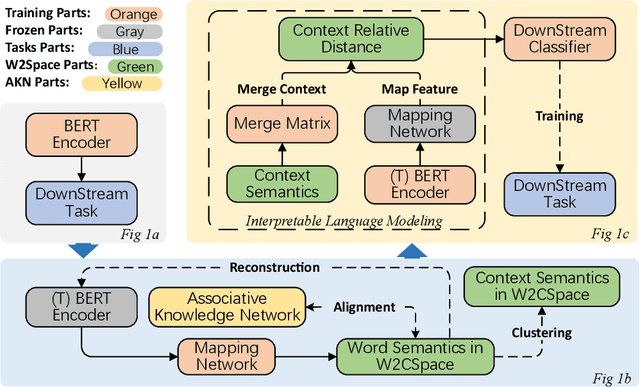


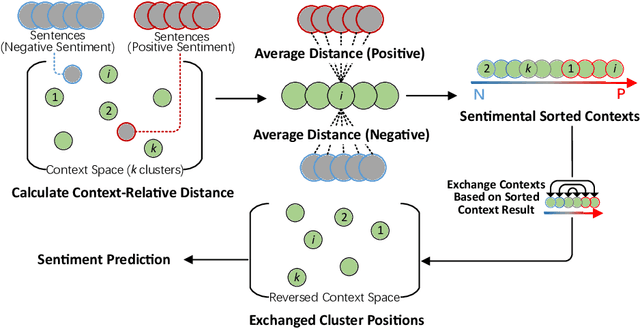
As the foundation of current natural language processing methods, pre-trained language model has achieved excellent performance. However, the black-box structure of the deep neural network in pre-trained language models seriously limits the interpretability of the language modeling process. After revisiting the coupled requirement of deep neural representation and semantics logic of language modeling, a Word-Context-Coupled Space (W2CSpace) is proposed by introducing the alignment processing between uninterpretable neural representation and interpretable statistical logic. Moreover, a clustering process is also designed to connect the word- and context-level semantics. Specifically, an associative knowledge network (AKN), considered interpretable statistical logic, is introduced in the alignment process for word-level semantics. Furthermore, the context-relative distance is employed as the semantic feature for the downstream classifier, which is greatly different from the current uninterpretable semantic representations of pre-trained models. Our experiments for performance evaluation and interpretable analysis are executed on several types of datasets, including SIGHAN, Weibo, and ChnSenti. Wherein a novel evaluation strategy for the interpretability of machine learning models is first proposed. According to the experimental results, our language model can achieve better performance and highly credible interpretable ability compared to related state-of-the-art methods.