 Add to Chrome
 Add to Firefox
 Add to Edge
Critical Points of Degenerate Metrics on Algebraic Varieties: A Tale of Overparametrization
Dec 24, 2025
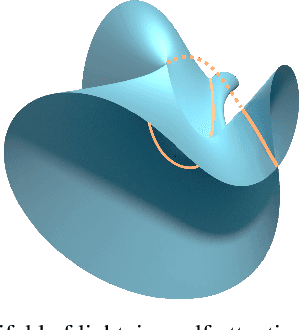
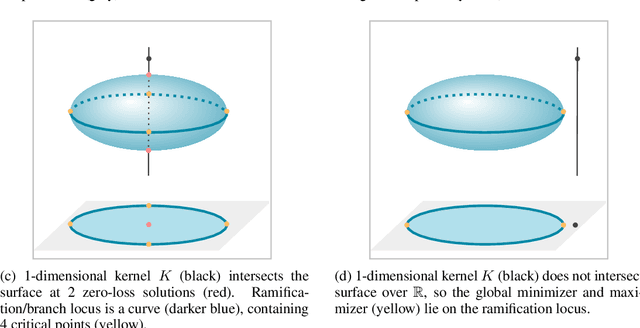
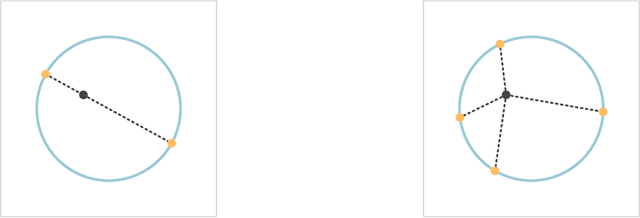
We study the critical points over an algebraic variety of an optimization problem defined by a quadratic objective that is degenerate. This scenario arises in machine learning when the dataset size is small with respect to the model, and is typically referred to as overparametrization. Our main result relates the degenerate optimization problem to a nondegenerate one via a projection. In the highly-degenerate regime, we find that a central role is played by the ramification locus of the projection. Additionally, we provide tools for counting the number of critical points over projective varieties, and discuss specific cases arising from deep learning. Our work bridges tools from algebraic geometry with ideas from machine learning, and it extends the line of literature around the Euclidean distance degree to the degenerate setting.

Average degree of the essential variety
Dec 03, 2022The essential variety is an algebraic subvariety of dimension $5$ in real projective space $\mathbb{R}\mathrm{P}^{8}$ which encodes the relative pose of two calibrated pinhole cameras. The $5$-point algorithm in computer vision computes the real points in the intersection of the essential variety with a linear space of codimension $5$. The degree of the essential variety is $10$, so this intersection consists of 10 complex points in general. We compute the expected number of real intersection points when the linear space is random. We focus on two probability distributions for linear spaces. The first distribution is invariant under the action of the orthogonal group $\mathrm{O}(9)$ acting on linear spaces in $\mathbb{R}\mathrm{P}^{8}$. In this case, the expected number of real intersection points is equal to $4$. The second distribution is motivated from computer vision and is defined by choosing 5 point correspondences in the image planes $\mathbb{R}\mathrm{P}^2\times \mathbb{R}\mathrm{P}^2$ uniformly at random. A Monte Carlo computation suggests that with high probability the expected value lies in the interval $(3.95 - 0.05,\ 3.95 + 0.05)$.