 Add to Chrome
 Add to Firefox
 Add to Edge
A Blueprint for Equilibrium-Based Differentiable Continuous-Variable Thermodynamic Computing
Jul 17, 2026
To address the escalating energy and latency demands of machine-learning workloads, we introduce a blueprint for an energy-efficient and fast thermodynamic computing stack that leverages stochastic analog processes in physical hardware. In this work, we focus on energy-based thermodynamic computing where the stochastic process is well described by Langevin dynamics with tunable energy potentials. The implementation of such potentials in physical hardware enables us to generate and sample from basic parameterized energy-based models. We demonstrate how to construct and train popular classes of machine learning models based on these hardware-native energy-based models, using the framework of probabilistic graphical models. We analyze the runtime and energy consumption of different models in this thermodynamic paradigm based on theoretical considerations and numerical studies. As a preliminary experimental realization of such hardware, we present our stochastic analog superconducting circuits driven by thermal noise. Together, these results outline a path toward energy-efficient thermodynamic hardware for probabilistic machine learning.

Identifying Quantum Phase Transitions with Adversarial Neural Networks
Mar 31, 2018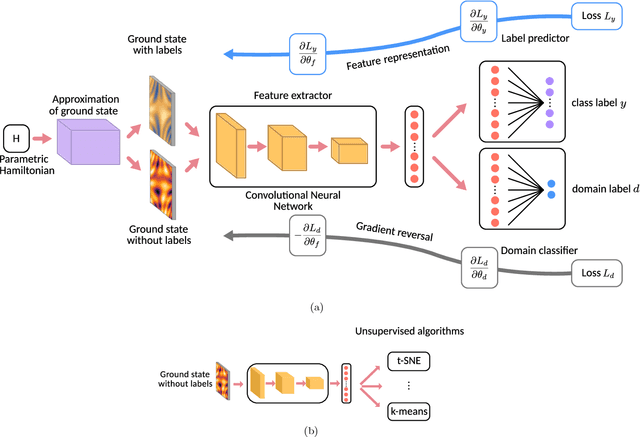
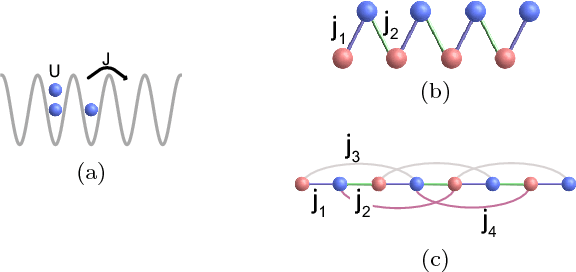
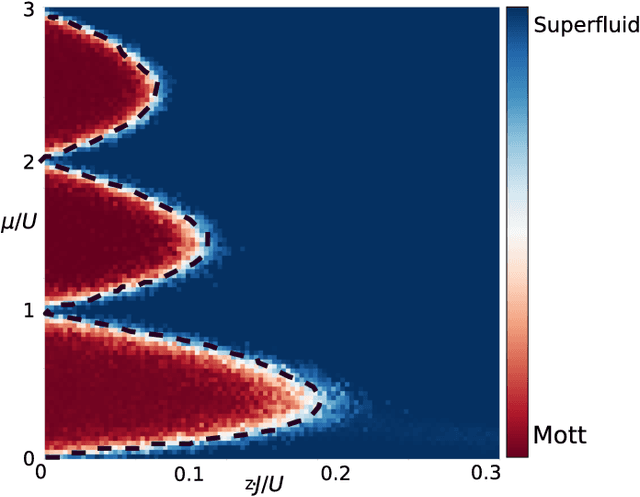
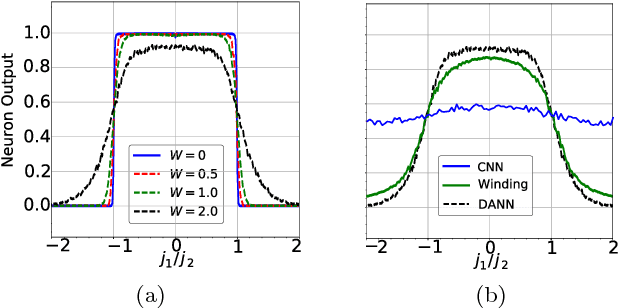
The identification of phases of matter is a challenging task, especially in quantum mechanics, where the complexity of the ground state appears to grow exponentially with the size of the system. We address this problem with state-of-the-art deep learning techniques: adversarial domain adaptation. We derive the phase diagram of the whole parameter space starting from a fixed and known subspace using unsupervised learning. The input data set contains both labeled and unlabeled data instances. The first kind is a system that admits an accurate analytical or numerical solution, and one can recover its phase diagram. The second type is the physical system with an unknown phase diagram. Adversarial domain adaptation uses both types of data to create invariant feature extracting layers in a deep learning architecture. Once these layers are trained, we can attach an unsupervised learner to the network to find phase transitions. We show the success of this technique by applying it on several paradigmatic models: the Ising model with different temperatures, the Bose-Hubbard model, and the SSH model with disorder. The input is the ground state without any manual feature engineering, and the dimension of the parameter space is unrestricted. The method finds unknown transitions successfully and predicts transition points in close agreement with standard methods. This study opens the door to the classification of physical systems where the phases boundaries are complex such as the many-body localization problem or the Bose glass phase.
* 10 pages, 8 figures, computational appendix is available at https://github.com/PatrickHuembeli/Adversarial-Domain-Adaptation-for-Identifying-Phase-Transitions