 Add to Chrome
 Add to Firefox
 Add to Edge
The Invisible Hand of Physics: When Video Diffusion Models Know More Than They Show
Jun 03, 2026
Modern video diffusion models generate increasingly realistic and temporally coherent videos, motivating their use as candidate world simulators. Yet it remains unclear whether these models internally encode physical structure, or merely reproduce motion patterns seen during training. We study this question by probing video diffusion models along latent trajectories corresponding to real videos with known physical plausibility. To obtain such trajectories, we approximately invert the deterministic sampling process by integrating the learned velocity field backward from a clean video latent to noise, giving access to the model's intermediate states and attention maps. Using these recovered trajectories, we show that physical plausibility is linearly decodable from diffusion transformer states across IntPhys and InfLevel, reaching around 81.27% average accuracy and outperforming dedicated representation-learning baselines such as V-JEPA and VideoMAE. Surprisingly, this signal is absent from the VAE latent input and emerges inside the denoising transformer itself, despite the model not being trained with a self-supervised predictive objective. These findings suggest that physically meaningful representations can arise as a byproduct of generative denoising.

Probability-Conserving Flow Guidance
May 19, 2026Diffusion and flow-based generative models dominate visual synthesis, with guidance aligning samples to user input and improving perceptual quality. However, Classifier-Free Guidance (CFG) and extrapolation-based methods are heuristic linear combinations of velocities/scores that ignore the generative manifold geometry, breaking probability conservation and driving samples off the learned manifold under strong guidance. We analyse guidance through the continuity equation and show its effect decomposes into a divergence term and a score-parallel term defined invariantly across parameterisations. We prove the divergence term blows up structurally as sampling approaches the data manifold, motivating a time-dependent schedule alongside score-parallel attenuation. The resulting plug-and-play rule, Adaptive Manifold Guidance (AdaMaG), bounds both terms at no additional inference cost. Finally, we show that most empirical heuristics for reducing saturation or improving generation quality correspond directly to the two terms in our decomposition. Across image generation benchmarks, AdaMaG improves realism, reduces hallucinations, and induces controlled desaturation in high-guidance regimes.
Co-STAR: Collaborative Curriculum Self-Training with Adaptive Regularization for Source-Free Video Domain Adaptation
Apr 15, 2025Recent advances in Source-Free Unsupervised Video Domain Adaptation (SFUVDA) leverage vision-language models to enhance pseudo-label generation. However, challenges such as noisy pseudo-labels and over-confident predictions limit their effectiveness in adapting well across domains. We propose Co-STAR, a novel framework that integrates curriculum learning with collaborative self-training between a source-trained teacher and a contrastive vision-language model (CLIP). Our curriculum learning approach employs a reliability-based weight function that measures bidirectional prediction alignment between the teacher and CLIP, balancing between confident and uncertain predictions. This function preserves uncertainty for difficult samples, while prioritizing reliable pseudo-labels when the predictions from both models closely align. To further improve adaptation, we propose Adaptive Curriculum Regularization, which modifies the learning priority of samples in a probabilistic, adaptive manner based on their confidence scores and prediction stability, mitigating overfitting to noisy and over-confident samples. Extensive experiments across multiple video domain adaptation benchmarks demonstrate that Co-STAR consistently outperforms state-of-the-art SFUVDA methods. Code is available at: https://github.com/Plrbear/Co-Star
SEA: State-Exchange Attention for High-Fidelity Physics-Based Transformers
Oct 20, 2024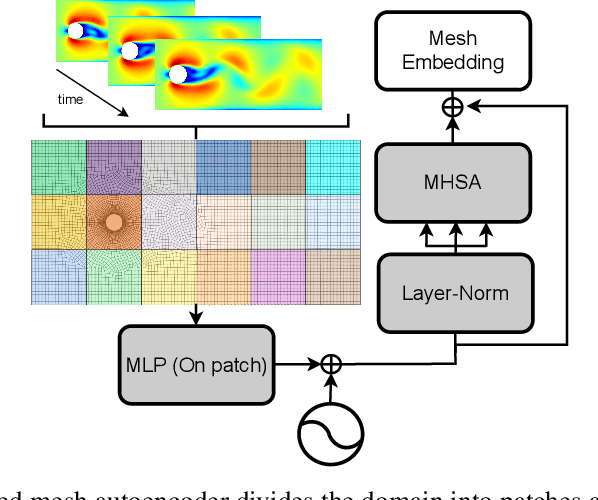

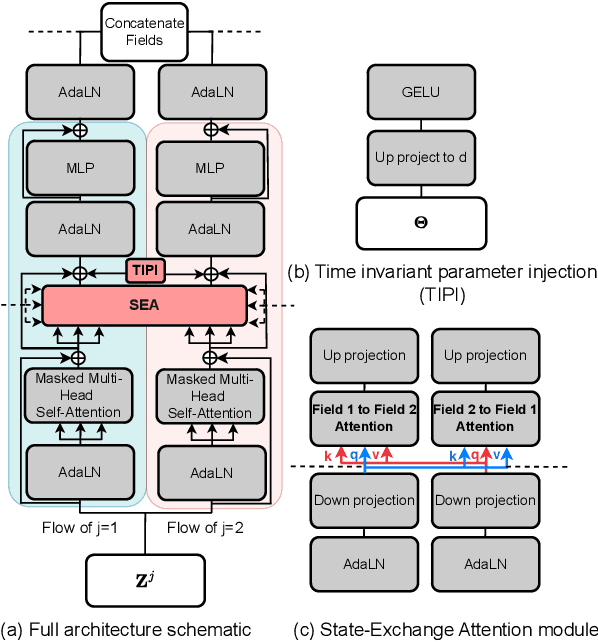
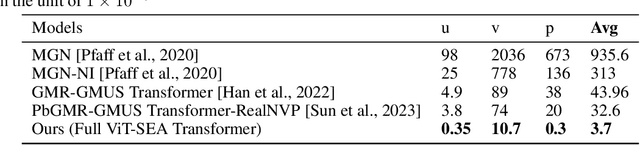
Current approaches using sequential networks have shown promise in estimating field variables for dynamical systems, but they are often limited by high rollout errors. The unresolved issue of rollout error accumulation results in unreliable estimations as the network predicts further into the future, with each step's error compounding and leading to an increase in inaccuracy. Here, we introduce the State-Exchange Attention (SEA) module, a novel transformer-based module enabling information exchange between encoded fields through multi-head cross-attention. The cross-field multidirectional information exchange design enables all state variables in the system to exchange information with one another, capturing physical relationships and symmetries between fields. In addition, we incorporate a ViT-like architecture to generate spatially coherent mesh embeddings, further improving the model's ability to capture spatial dependencies in the data. This enhances the model's ability to represent complex interactions between the field variables, resulting in improved rollout error accumulation. Our results show that the Transformer model integrated with the State-Exchange Attention (SEA) module outperforms competitive baseline models, including the PbGMR-GMUS Transformer-RealNVP and GMR-GMUS Transformer, with a reduction in error of 88\% and 91\%, respectively, achieving state-of-the-art performance. Furthermore, we demonstrate that the SEA module alone can reduce errors by 97\% for state variables that are highly dependent on other states of the system.