 Add to Chrome
 Add to Firefox
 Add to Edge
Mind the Shape Gap: A Benchmark and Baseline for Deformation-Aware 6D Pose Estimation of Agricultural Produce
Mar 28, 2026
Accurate 6D pose estimation for robotic harvesting is fundamentally hindered by the biological deformability and high intra-class shape variability of agricultural produce. Instance-level methods fail in this setting, as obtaining exact 3D models for every unique piece of produce is practically infeasible, while category-level approaches that rely on a fixed template suffer significant accuracy degradation when the prior deviates from the true instance geometry. To bridge such lack of robustness to deformation, we introduce PEAR (Pose and dEformation of Agricultural pRoduce), the first benchmark providing joint 6D pose and per-instance 3D deformation ground truth across 8 produce categories, acquired via a robotic manipulator for high annotation accuracy. Using PEAR, we show that state-of-the-art methods suffer up to 6x performance degradation when faced with the inherent geometric deviations of real-world produce. Motivated by this finding, we propose SEED (Simultaneous Estimation of posE and Deformation), a unified RGB-only framework that jointly predicts 6D pose and explicit lattice deformations from a single image across multiple produce categories. Trained entirely on synthetic data with generative texture augmentation applied at the UV level, SEED outperforms MegaPose on 6 out of 8 categories under identical RGB-only conditions, demonstrating that explicit shape modeling is a critical step toward reliable pose estimation in agricultural robotics.

Proactive tactile exploration for object-agnostic shape reconstruction from minimal visual priors
May 17, 2025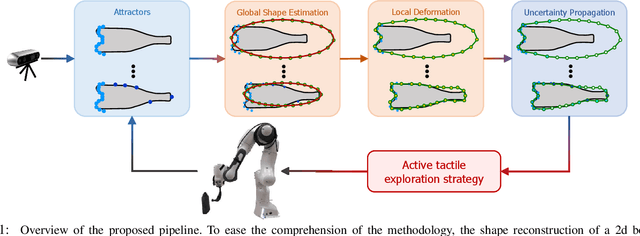
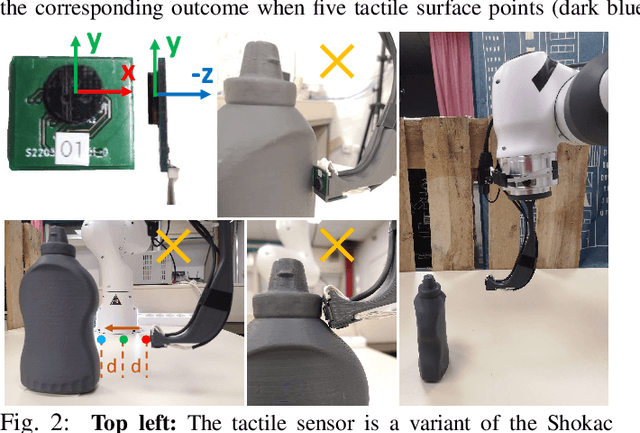
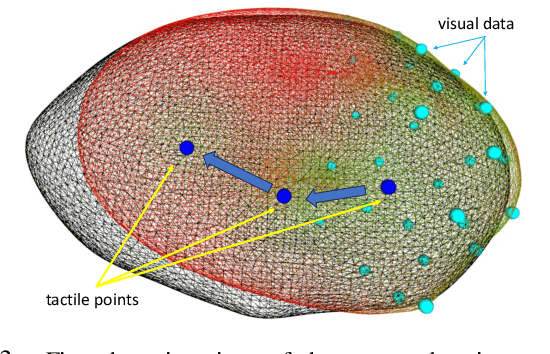
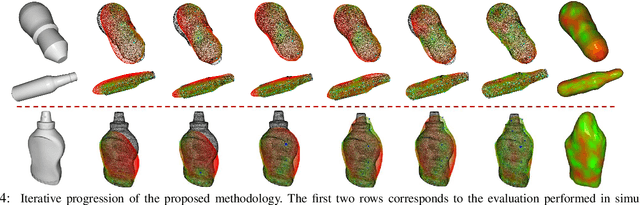
The perception of an object's surface is important for robotic applications enabling robust object manipulation. The level of accuracy in such a representation affects the outcome of the action planning, especially during tasks that require physical contact, e.g. grasping. In this paper, we propose a novel iterative method for 3D shape reconstruction consisting of two steps. At first, a mesh is fitted on data points acquired from the object's surface, based on a single primitive template. Subsequently, the mesh is properly adjusted to adequately represent local deformities. Moreover, a novel proactive tactile exploration strategy aims at minimizing the total uncertainty with the least number of contacts, while reducing the risk of contact failure in case the estimated surface differs significantly from the real one. The performance of the methodology is evaluated both in 3D simulation and on a real setup.