 Add to Chrome
 Add to Firefox
 Add to Edge
Assessing Risks of Large Language Models in Mental Health Support: A Framework for Automated Clinical AI Red Teaming
Feb 23, 2026
Large Language Models (LLMs) are increasingly utilized for mental health support; however, current safety benchmarks often fail to detect the complex, longitudinal risks inherent in therapeutic dialogue. We introduce an evaluation framework that pairs AI psychotherapists with simulated patient agents equipped with dynamic cognitive-affective models and assesses therapy session simulations against a comprehensive quality of care and risk ontology. We apply this framework to a high-impact test case, Alcohol Use Disorder, evaluating six AI agents (including ChatGPT, Gemini, and Character.AI) against a clinically-validated cohort of 15 patient personas representing diverse clinical phenotypes. Our large-scale simulation (N=369 sessions) reveals critical safety gaps in the use of AI for mental health support. We identify specific iatrogenic risks, including the validation of patient delusions ("AI Psychosis") and failure to de-escalate suicide risk. Finally, we validate an interactive data visualization dashboard with diverse stakeholders, including AI engineers and red teamers, mental health professionals, and policy experts (N=9), demonstrating that this framework effectively enables stakeholders to audit the "black box" of AI psychotherapy. These findings underscore the critical safety risks of AI-provided mental health support and the necessity of simulation-based clinical red teaming before deployment.

Mixed Effects Random Forests for Personalised Predictions of Clinical Depression Severity
Jan 24, 2023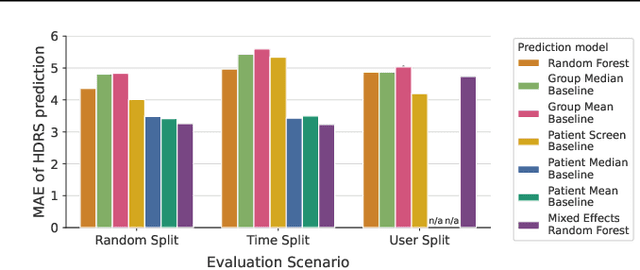

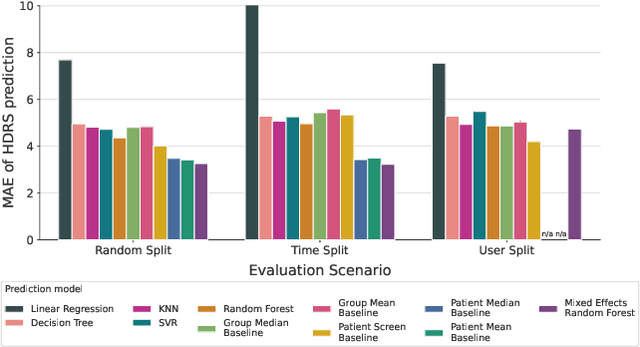
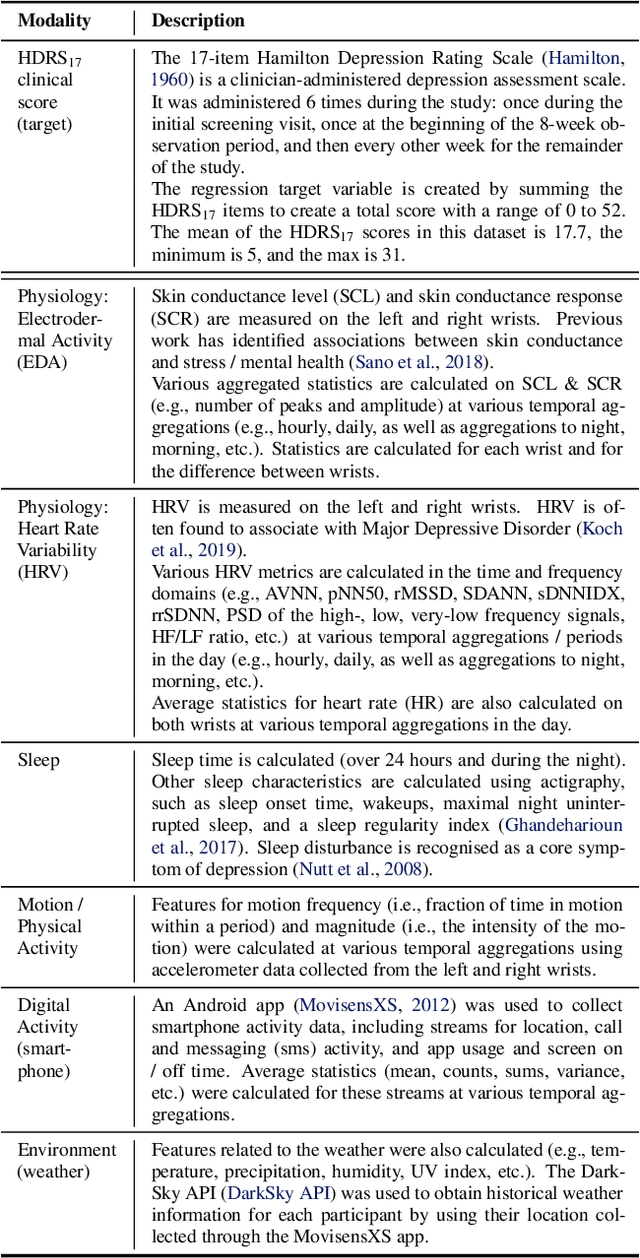
This work demonstrates how mixed effects random forests enable accurate predictions of depression severity using multimodal physiological and digital activity data collected from an 8-week study involving 31 patients with major depressive disorder. We show that mixed effects random forests outperform standard random forests and personal average baselines when predicting clinical Hamilton Depression Rating Scale scores (HDRS_17). Compared to the latter baseline, accuracy is significantly improved for each patient by an average of 0.199-0.276 in terms of mean absolute error (p<0.05). This is noteworthy as these simple baselines frequently outperform machine learning methods in mental health prediction tasks. We suggest that this improved performance results from the ability of the mixed effects random forest to personalise model parameters to individuals in the dataset. However, we find that these improvements pertain exclusively to scenarios where labelled patient data are available to the model at training time. Investigating methods that improve accuracy when generalising to new patients is left as important future work.