 Add to Chrome
 Add to Firefox
 Add to Edge
Semantic Context Matters: Analysis of Color Names Across Domains
Jul 19, 2026
Color naming is influenced not only by physical color values but also by the semantic context in which colors are used. This paper investigates context-dependent color naming by mapping color-name datasets from Cosmetics, Crayola, and Car-color vocabularies onto the 86 fuzzy color categories of the COLIBRI color model. Contextual variation is analyzed using category coverage, Shannon entropy, and maximum lift. The results show that the three contexts occupy the COLIBRI color space differently: Cosmetics covers 48 of 86 fuzzy categories, Crayola covers 50, and Car colors cover 40. The results demonstrated that Crayola provides the broadest and most balanced use of the fuzzy color space, Cosmetics is mainly concentrated around warm-tone regions, and Car colors are more specialized around blue and achromatic regions. These findings show that color naming cannot be fully explained by numerical color similarity alone and that semantic context plays an important role in human color interpretation. The proposed framework supports the development of context-aware color models for design analytics, product search, recommendation systems, and human-centered artificial intelligence.

Beyond Color Geometry: Evaluating Human-Like Color Representations in Vision Models
Jul 15, 2026Do vision models see colors the way humans do? Existing evaluations of color representations usually compare them with geometric spaces such as CIELAB or with discrete color labels. These references capture perceptual distance or category membership, but not the graded way in which people organize colors. We evaluate color grounding against a fuzzy perceptual model with 86 graded categories fitted to human survey data. The framework can be applied to any image encoder and measures three complementary properties: category boundaries, category compactness, and graded alignment beyond what color geometry alone can explain. Across eleven Vision Transformer encoders, the category-level results are broadly similar, whereas graded alignment differs substantially. Masked Autoencoders achieve the strongest beyond-geometry alignment, with confidence intervals that do not overlap those of the other encoders. A layer-wise analysis further shows that masked reconstruction preserves this structure toward the output. On natural images, MAE represents surface color globally, while language-supervised models encode color more strongly in relation to the foreground object. These results show that human-like color grounding has several distinct aspects that should not be reduced to a single score.
Not All Color Categories Are Equally Stable: A Multilingual Free Color Naming Experiment
Jul 11, 2026Color naming is an important part of human color perception. Its task is to allow people to describe continuous colors using discrete color categories. However, the boundaries between color categories are often unclear, and some colors may be perceived differently depending on their saturation and brightness. While certain color categories remain recognizable across a wide range of shades, others may be associated with different color names when their appearance changes. This study investigates the consistency of color naming for red, yellow, and green color categories using a free color-naming experiment. A set of 18 color samples was selected from the COLIBRI dataset to represent different shades of these colors. Participants (n = 92) were asked to freely assign color names to each sample in Kazakh, Russian, or English without being limited to predefined categories. The results show that color categories differ in their consistency. Green shades were consistently identified as green despite variations in appearance, whereas yellow shades received a wider variety of names, including gold- and brown-related descriptions. Red shades showed moderate naming consistency. Our findings suggest that some color categories occupy broader perceptual regions than others and may therefore be more robust to visual variations. The study results can be used to develop perceptually meaningful color models and color naming systems.
Perceptual Asymmetry Between Hue Categories: Evidence from Human Color Categorization
May 10, 2026Human color categories are not uniformly distributed in perceptual space, yet most computational color models still assume fixed and evenly structured representations. In this paper, we present a focused analytical extension of the COLIBRI fuzzy color model by investigating perceptual asymmetry between hue categories. Using previously collected large-scale human color categorization data, we introduce quantitative measures of category extent and boundary uncertainty, namely Wideness and Boundary Width, derived from fuzzy membership functions at the α = 0.5 level. The analysis reveals a strong imbalance between the two categories: yellow occupies a compact and sharply constrained region of the hue space, whereas green spans a substantially broader interval and exhibits a more extended transition structure. The results show that perceptual color categories are not only fuzzy, but also highly non-uniform in their geometric organization. This asymmetry suggests that some categories behave as narrow, highly specific perceptual labels, while others function as broad, tolerant regions of human color naming. These findings provide a new perspective on linguistic color categorization and extend the interpretability of the COLIBRI framework for perceptually grounded color modeling.
Fuzzy expert system for the process of collecting and purifying acidic water: a digital twin approach
Jan 27, 2026Purifying sour water is essential for reducing emissions, minimizing corrosion risks, enabling the reuse of treated water in industrial or domestic applications, and ultimately lowering operational costs. Moreover, automating the purification process helps reduce the risk of worker harm by limiting human involvement. Crude oil contains acidic components such as hydrogen sulfide, carbon dioxide, and other chemical compounds. During processing, these substances are partially released into sour water. If not properly treated, sour water poses serious environmental threats and accelerates the corrosion of pipelines and equipment. This paper presents a fuzzy expert system, combined with a custom-generated digital twin, developed from a documented industrial process to maintain key parameters at desired levels by mimicking human reasoning. The control strategy is designed to be simple and intuitive, allowing junior or non-expert personnel to interact with the system effectively. The digital twin was developed using Honeywell UniSim Design R492 to simulate real industrial behavior accurately. Valve dynamics were modeled through system identification in MATLAB, and real-time data exchange between the simulator and controller was established using OPC DA. The fuzzy controller applies split-range control to two valves and was tested under 21 different initial pressure conditions using five distinct defuzzification strategies, resulting in a total of 105 unique test scenarios. System performance was evaluated using both error-based metrics (MSE, RMSE, MAE, IAE, ISE, ITAE) and dynamic response metrics, including overshoot, undershoot, rise time, fall time, settling time, and steady-state error. A web-based simulation interface was developed in Python using the Streamlit framework. Although demonstrated here for sour water treatment, the proposed fuzzy expert system is general-purpose.
Color Models in Image Processing: A Review and Experimental Comparison
Oct 01, 2025Color representation is essential in computer vision and human-computer interaction. There are multiple color models available. The choice of a suitable color model is critical for various applications. This paper presents a review of color models and spaces, analyzing their theoretical foundations, computational properties, and practical applications. We explore traditional models such as RGB, CMYK, and YUV, perceptually uniform spaces like CIELAB and CIELUV, and fuzzy-based approaches as well. Additionally, we conduct a series of experiments to evaluate color models from various perspectives, like device dependency, chromatic consistency, and computational complexity. Our experimental results reveal gaps in existing color models and show that the HS* family is the most aligned with human perception. The review also identifies key strengths and limitations of different models and outlines open challenges and future directions This study provides a reference for researchers in image processing, perceptual computing, digital media, and any other color-related field.
COLIBRI Fuzzy Model: Color Linguistic-Based Representation and Interpretation
Jul 15, 2025Colors are omnipresent in today's world and play a vital role in how humans perceive and interact with their surroundings. However, it is challenging for computers to imitate human color perception. This paper introduces the Human Perception-Based Fuzzy Color Model, COLIBRI (Color Linguistic-Based Representation and Interpretation), designed to bridge the gap between computational color representations and human visual perception. The proposed model uses fuzzy sets and logic to create a framework for color categorization. Using a three-phase experimental approach, the study first identifies distinguishable color stimuli for hue, saturation, and intensity through preliminary experiments, followed by a large-scale human categorization survey involving more than 1000 human subjects. The resulting data are used to extract fuzzy partitions and generate membership functions that reflect real-world perceptual uncertainty. The model incorporates a mechanism for adaptation that allows refinement based on feedback and contextual changes. Comparative evaluations demonstrate the model's alignment with human perception compared to traditional color models, such as RGB, HSV, and LAB. To the best of our knowledge, no previous research has documented the construction of a model for color attribute specification based on a sample of this size or a comparable sample of the human population (n = 2496). Our findings are significant for fields such as design, artificial intelligence, marketing, and human-computer interaction, where perceptually relevant color representation is critical.
Sentiment and Emotion-aware Multi-criteria Fuzzy Group Decision Making System
Aug 21, 2024

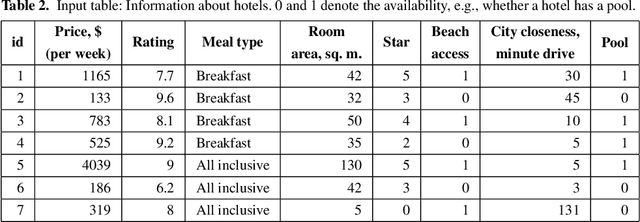

In today's world, making decisions as a group is common, whether choosing a restaurant or deciding on a holiday destination. Group decision-making (GDM) systems play a crucial role by facilitating consensus among participants with diverse preferences. Discussions are one of the main tools people use to make decisions. When people discuss alternatives, they use natural language to express their opinions. Traditional GDM systems generally require participants to provide explicit opinion values to the system. However, in real-life scenarios, participants often express their opinions through some text (e.g., in comments, social media, messengers, etc.). This paper introduces a sentiment and emotion-aware multi-criteria fuzzy GDM system designed to enhance consensus-reaching effectiveness in group settings. This system incorporates natural language processing to analyze sentiments and emotions expressed in textual data, enabling an understanding of participant opinions besides the explicit numerical preference inputs. Once all the experts have provided their preferences for the alternatives, the individual preferences are aggregated into a single collective preference matrix. This matrix represents the collective expert opinion regarding the other options. Then, sentiments, emotions, and preference scores are inputted into a fuzzy inference system to get the overall score. The proposed system was used for a small decision-making process - choosing the hotel for a vacation by a group of friends. Our findings demonstrate that integrating sentiment and emotion analysis into GDM systems allows everyone's feelings and opinions to be considered during discussions and significantly improves consensus among participants.
Tracking Emotional Dynamics in Chat Conversations: A Hybrid Approach using DistilBERT and Emoji Sentiment Analysis
Aug 03, 2024Computer-mediated communication has become more important than face-to-face communication in many contexts. Tracking emotional dynamics in chat conversations can enhance communication, improve services, and support well-being in various contexts. This paper explores a hybrid approach to tracking emotional dynamics in chat conversations by combining DistilBERT-based text emotion detection and emoji sentiment analysis. A Twitter dataset was analyzed using various machine learning algorithms, including SVM, Random Forest, and AdaBoost. We contrasted their performance with DistilBERT. Results reveal DistilBERT's superior performance in emotion recognition. Our approach accounts for emotive expressions conveyed through emojis to better understand participants' emotions during chats. We demonstrate how this approach can effectively capture and analyze emotional shifts in real-time conversations. Our findings show that integrating text and emoji analysis is an effective way of tracking chat emotion, with possible applications in customer service, work chats, and social media interactions.
Image Classification using Fuzzy Pooling in Convolutional Kolmogorov-Arnold Networks
Jul 23, 2024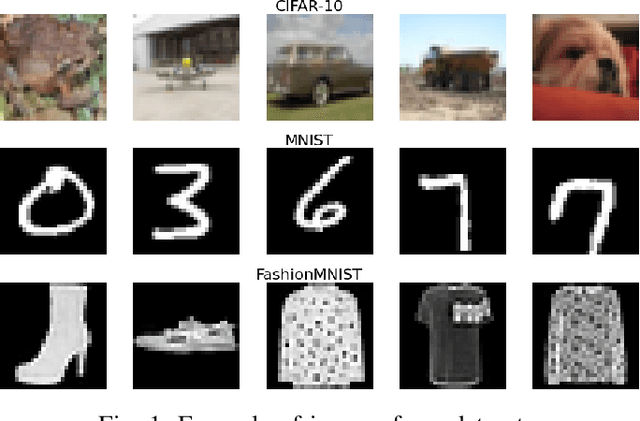

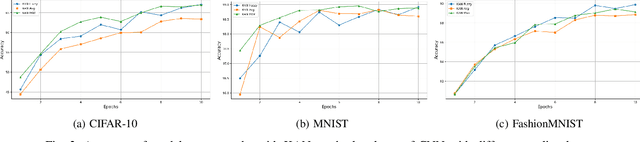
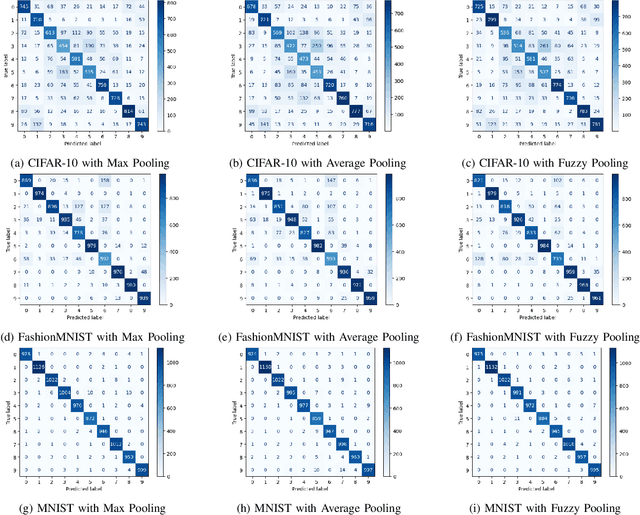
Nowadays, deep learning models are increasingly required to be both interpretable and highly accurate. We present an approach that integrates Kolmogorov-Arnold Network (KAN) classification heads and Fuzzy Pooling into convolutional neural networks (CNNs). By utilizing the interpretability of KAN and the uncertainty handling capabilities of fuzzy logic, the integration shows potential for improved performance in image classification tasks. Our comparative analysis demonstrates that the modified CNN architecture with KAN and Fuzzy Pooling achieves comparable or higher accuracy than traditional models. The findings highlight the effectiveness of combining fuzzy logic and KAN to develop more interpretable and efficient deep learning models. Future work will aim to expand this approach across larger datasets.