 Add to Chrome
 Add to Firefox
 Add to Edge
The Boolean Power of ReLU
Aug 12, 2026
We prove that, on finite simple undirected graphs equipped with a single Boolean node feature, the Boolean queries expressible in $Σ$-MPLang, for any collection $Σ$ of eventually constant activation functions and with arbitrary real coefficients, form a strict subclass of the Boolean queries expressible in ReLU-MPLang. We thereby settle a recently posed open problem: whether ReLU-MPLang is more powerful than trReLU-MPLang when it comes to Boolean queries. In particular, this implies that ReLU-GNNs are strictly more expressive than {TrReLU,id}-GNNs with respect to Boolean queries on Boolean-featured graphs.

ExplAIner: A Declarative Query Language for Explaining Classification Models
Jul 07, 2026The XAI community has studied a wide range of queries and scores for explaining predictions of ML models. From a data management perspective, this proliferation of explanation notions calls for declarative query languages in which such notions can be specified, combined, and analyzed uniformly. In this paper, we develop such a framework for Boolean models. We first revisit FOIL, an interpretability query language for black-box models, and show that it has two fundamental limitations: it cannot express central optimality-based explanation queries, and its evaluation problem over decision trees is hard for every level of the polynomial hierarchy. We then introduce ExplAIner, a query language based on FOIL with an extended vocabulary and a layered structure. We show that ExplAIner can express a broad family of explanation notions, including abductive, contrastive, feature-based, and distance-based queries. We also prove that the evaluation problem for each query in ExplAIner belongs to the Boolean hierarchy over every class of Boolean models for which some basic predicates can be evaluated in polynomial time. In particular, that property holds for deterministic and decomposable Boolean circuits. Finally, we introduce Opt-FOIL, an optimization-oriented fragment of ExplAIner for computing explanations that are minimal with respect to strict partial orders, and prove that its evaluation problem is in $\mathrm{FP}^{\mathrm{NP}}$ under the same tractability assumptions. These complexity results have a direct algorithmic consequence: a fixed ExplAIner query can be evaluated with a fixed number of calls to a SAT solver, while a notion of explanation specified in Opt-FOIL can be computed with a polynomial number of such calls. This is particularly relevant in formal XAI, where SAT solvers have been successfully used to compute explanations for several classes of ML models.
A Logical View of GNN-Style Computation and the Role of Activation Functions
Dec 22, 2025We study the numerical and Boolean expressiveness of MPLang, a declarative language that captures the computation of graph neural networks (GNNs) through linear message passing and activation functions. We begin with A-MPLang, the fragment without activation functions, and give a characterization of its expressive power in terms of walk-summed features. For bounded activation functions, we show that (under mild conditions) all eventually constant activations yield the same expressive power - numerical and Boolean - and that it subsumes previously established logics for GNNs with eventually constant activation functions but without linear layers. Finally, we prove the first expressive separation between unbounded and bounded activations in the presence of linear layers: MPLang with ReLU is strictly more powerful for numerical queries than MPLang with eventually constant activation functions, e.g., truncated ReLU. This hinges on subtle interactions between linear aggregation and eventually constant non-linearities, and it establishes that GNNs using ReLU are more expressive than those restricted to eventually constant activations and linear layers.
Language Generation: Complexity Barriers and Implications for Learning
Nov 07, 2025Kleinberg and Mullainathan showed that, in principle, language generation is always possible: with sufficiently many positive examples, a learner can eventually produce sentences indistinguishable from those of a target language. However, the existence of such a guarantee does not speak to its practical feasibility. In this work, we show that even for simple and well-studied language families -- such as regular and context-free languages -- the number of examples required for successful generation can be extraordinarily large, and in some cases not bounded by any computable function. These results reveal a substantial gap between theoretical possibility and efficient learnability. They suggest that explaining the empirical success of modern language models requires a refined perspective -- one that takes into account structural properties of natural language that make effective generation possible in practice.
How Expressive are Knowledge Graph Foundation Models?
Feb 18, 2025Knowledge Graph Foundation Models (KGFMs) are at the frontier for deep learning on knowledge graphs (KGs), as they can generalize to completely novel knowledge graphs with different relational vocabularies. Despite their empirical success, our theoretical understanding of KGFMs remains very limited. In this paper, we conduct a rigorous study of the expressive power of KGFMs. Specifically, we show that the expressive power of KGFMs directly depends on the motifs that are used to learn the relation representations. We then observe that the most typical motifs used in the existing literature are binary, as the representations are learned based on how pairs of relations interact, which limits the model's expressiveness. As part of our study, we design more expressive KGFMs using richer motifs, which necessitate learning relation representations based on, e.g., how triples of relations interact with each other. Finally, we empirically validate our theoretical findings, showing that the use of richer motifs results in better performance on a wide range of datasets drawn from different domains.
Explaining k-Nearest Neighbors: Abductive and Counterfactual Explanations
Jan 10, 2025Despite the wide use of $k$-Nearest Neighbors as classification models, their explainability properties remain poorly understood from a theoretical perspective. While nearest neighbors classifiers offer interpretability from a "data perspective", in which the classification of an input vector $\bar{x}$ is explained by identifying the vectors $\bar{v}_1, \ldots, \bar{v}_k$ in the training set that determine the classification of $\bar{x}$, we argue that such explanations can be impractical in high-dimensional applications, where each vector has hundreds or thousands of features and it is not clear what their relative importance is. Hence, we focus on understanding nearest neighbor classifications through a "feature perspective", in which the goal is to identify how the values of the features in $\bar{x}$ affect its classification. Concretely, we study abductive explanations such as "minimum sufficient reasons", which correspond to sets of features in $\bar{x}$ that are enough to guarantee its classification, and "counterfactual explanations" based on the minimum distance feature changes one would have to perform in $\bar{x}$ to change its classification. We present a detailed landscape of positive and negative complexity results for counterfactual and abductive explanations, distinguishing between discrete and continuous feature spaces, and considering the impact of the choice of distance function involved. Finally, we show that despite some negative complexity results, Integer Quadratic Programming and SAT solving allow for computing explanations in practice.
Link Prediction with Relational Hypergraphs
Feb 06, 2024Link prediction with knowledge graphs has been thoroughly studied in graph machine learning, leading to a rich landscape of graph neural network architectures with successful applications. Nonetheless, it remains challenging to transfer the success of these architectures to link prediction with relational hypergraphs. The presence of relational hyperedges makes link prediction a task between $k$ nodes for varying choices of $k$, which is substantially harder than link prediction with knowledge graphs, where every relation is binary ($k=2$). In this paper, we propose two frameworks for link prediction with relational hypergraphs and conduct a thorough analysis of the expressive power of the resulting model architectures via corresponding relational Weisfeiler-Leman algorithms, and also via some natural logical formalisms. Through extensive empirical analysis, we validate the power of the proposed model architectures on various relational hypergraph benchmarks. The resulting model architectures substantially outperform every baseline for inductive link prediction, and lead to state-of-the-art results for transductive link prediction. Our study therefore unlocks applications of graph neural networks to fully relational structures.
A neuro-symbolic framework for answering conjunctive queries
Oct 06, 2023The problem of answering logical queries over incomplete knowledge graphs is receiving significant attention in the machine learning community. Neuro-symbolic models are a promising recent approach, showing good performance and allowing for good interpretability properties. These models rely on trained architectures to execute atomic queries, combining them with modules that simulate the symbolic operators in queries. Unfortunately, most neuro-symbolic query processors are limited to the so-called tree-like logical queries that admit a bottom-up execution, where the leaves are constant values or anchors, and the root is the target variable. Tree-like queries, while expressive, fail short to express properties in knowledge graphs that are important in practice, such as the existence of multiple edges between entities or the presence of triangles. We propose a framework for answering arbitrary conjunctive queries over incomplete knowledge graphs. The main idea of our method is to approximate a cyclic query by an infinite family of tree-like queries, and then leverage existing models for the latter. Our approximations achieve strong guarantees: they are complete, i.e. there are no false negatives, and optimal, i.e. they provide the best possible approximation using tree-like queries. Our method requires the approximations to be tree-like queries where the leaves are anchors or existentially quantified variables. Hence, we also show how some of the existing neuro-symbolic models can handle these queries, which is of independent interest. Experiments show that our approximation strategy achieves competitive results, and that including queries with existentially quantified variables tends to improve the general performance of these models, both on tree-like queries and on our approximation strategy.
On the Power of the Weisfeiler-Leman Test for Graph Motif Parameters
Oct 02, 2023Seminal research in the field of graph neural networks (GNNs) has revealed a direct correspondence between the expressive capabilities of GNNs and the $k$-dimensional Weisfeiler-Leman ($k$WL) test, a widely-recognized method for verifying graph isomorphism. This connection has reignited interest in comprehending the specific graph properties effectively distinguishable by the $k$WL test. A central focus of research in this field revolves around determining the least dimensionality $k$, for which $k$WL can discern graphs with different number of occurrences of a pattern graph $P$. We refer to such a least $k$ as the WL-dimension of this pattern counting problem. This inquiry traditionally delves into two distinct counting problems related to patterns: subgraph counting and induced subgraph counting. Intriguingly, despite their initial appearance as separate challenges with seemingly divergent approaches, both of these problems are interconnected components of a more comprehensive problem: "graph motif parameters". In this paper, we provide a precise characterization of the WL-dimension of labeled graph motif parameters. As specific instances of this result, we obtain characterizations of the WL-dimension of the subgraph counting and induced subgraph counting problem for every labeled pattern $P$. We additionally demonstrate that in cases where the $k$WL test distinguishes between graphs with varying occurrences of a pattern $P$, the exact number of occurrences of $P$ can be computed uniformly using only local information of the last layer of a corresponding GNN. We finally delve into the challenge of recognizing the WL-dimension of various graph parameters. We give a polynomial time algorithm for determining the WL-dimension of the subgraph counting problem for given pattern $P$, answering an open question from previous work.
Three iterations of $$-WL test distinguish non isometric clouds of $d$-dimensional points
Mar 28, 2023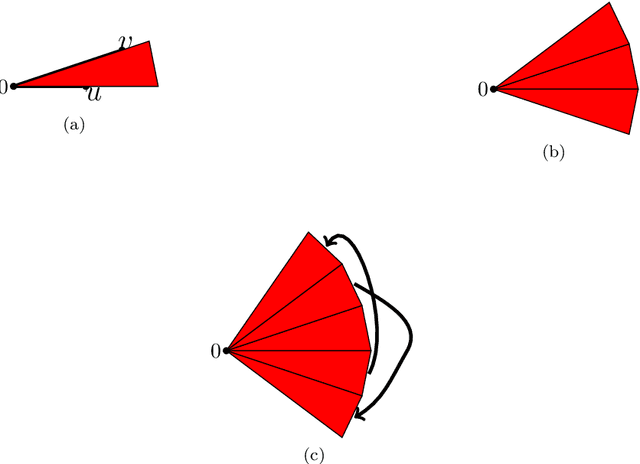
The Weisfeiler--Lehman (WL) test is a fundamental iterative algorithm for checking isomorphism of graphs. It has also been observed that it underlies the design of several graph neural network architectures, whose capabilities and performance can be understood in terms of the expressive power of this test. Motivated by recent developments in machine learning applications to datasets involving three-dimensional objects, we study when the WL test is {\em complete} for clouds of euclidean points represented by complete distance graphs, i.e., when it can distinguish, up to isometry, any arbitrary such cloud. Our main result states that the $(d-1)$-dimensional WL test is complete for point clouds in $d$-dimensional Euclidean space, for any $d\ge 2$, and that only three iterations of the test suffice. Our result is tight for $d = 2, 3$. We also observe that the $d$-dimensional WL test only requires one iteration to achieve completeness.