 Add to Chrome
 Add to Firefox
 Add to Edge
Dead-Direction Signatures: A Cheap Spectral Reading of Singular Complexity
Jun 19, 2026
Singular learning theory characterises the complexity of a deep network through the geometry of its loss singularities. The local learning coefficient (LLC), the standard estimator of Watanabe's real log canonical threshold (RLCT, $λ$), reads this geometry as an integrated Bayesian scalar through SGLD, which needs per-task calibration and $10^4$-$10^6$ forward-backward passes per checkpoint. We introduce Dead-Direction Signatures (DDS), a family of cheap closed-form spectral readings of singular structure: each reads a network's activation matrix or per-sample-gradient Fisher-Gram at a chosen layer, replacing the SGLD posterior chain with spectral linear algebra. The readings rest on a dead-direction framework that predicts a structural correlation between activation- and Fisher-side spectra at any singular minimum, and a rank-multiplicative volume identity that single-eigenvalue monitors cannot produce: the active-volume $\log\det^{+}(G)$ slope counts the dead directions, tracking the rank-deficit $r$ across $r \in \{1,2,3,4\}$ (slope ratios $2.0, 3.1, 4.0$ at $r{=}2,3,4$ against the predicted $2,3,4$), where the smallest eigenvalue is rank-blind. On reduced-rank regression with closed-form $λ$, calibrated LLC recovers $λ$ at $99\%$ mean and the DDS observables rank-track it at the framework-predicted sign; on a non-linear modular-addition transformer DDS separates $d_{\mathrm{model}}$ across eighteen orders of magnitude where calibrated LLC at the protocol budget is rank-flat. Complementary to LLC's integrated posterior reading, DDS gives a directional, layer-local handle on a network's dead directions, read in closed form from its activation and gradient spectra.

Algebraic Dead Directions in LayerNorm Transformers: A Forward-Pass-Only Diagnostic at LLM Scale
Jun 17, 2026Pretrained transformers sit near singular minima of the loss, where the Fisher information metric degenerates along dead directions: directions in parameter space along which the directional Fisher vanishes. Locating such a direction normally needs a forward pass and an eigendecomposition of activations, or a sampling-based complexity estimate; none returns a direction computable from the network's parameters alone. We give one, for LayerNorm transformers. The inverse-scale direction $γ^{-1}/\|γ^{-1}\|$ of the LayerNorm affine is an exact algebraic kernel of the post-final-norm centred activation covariance, for any input distribution, and induces a corresponding dead direction in parameter space. It is read from the LN scale parameter alone, with no forward or backward pass and no eigensolve: the cheapest dead-direction read, specific to LayerNorm. We test it on $14$ pretrained transformers ($9$ LayerNorm, $5$ RMSNorm; $160$M-$35$B; language and vision objectives). At random initialisation the predicted direction matches the measured bottom singular direction (one forward pass, direct SVD) to four decimal places on $9/9$ LayerNorm models, and is correctly absent on $5/5$ RMSNorm models, which lack the mean-subtraction projector that creates it. On the trained checkpoint the covariance eigenvalue along this direction deepens by ${\sim}10^3\times$ and further dead directions open; the random-init-to-trained gap is a one-forward-pass, per-checkpoint readout of singular structure along the predicted coordinate. Two consequences follow in closed form: the residual stream's smallest singular value is preserved block-to-block on $13/14$ transformers measured on their own input distribution, the one exception (Gemma$4$-$31$B) a genuine dead direction the same read pinpoints; and the kernel direction's presence classifies a transformer's normalisation from the parameters alone.
LightHeadEd: Relightable & Editable Head Avatars from a Smartphone
Apr 13, 2025Creating photorealistic, animatable, and relightable 3D head avatars traditionally requires expensive Lightstage with multiple calibrated cameras, making it inaccessible for widespread adoption. To bridge this gap, we present a novel, cost-effective approach for creating high-quality relightable head avatars using only a smartphone equipped with polaroid filters. Our approach involves simultaneously capturing cross-polarized and parallel-polarized video streams in a dark room with a single point-light source, separating the skin's diffuse and specular components during dynamic facial performances. We introduce a hybrid representation that embeds 2D Gaussians in the UV space of a parametric head model, facilitating efficient real-time rendering while preserving high-fidelity geometric details. Our learning-based neural analysis-by-synthesis pipeline decouples pose and expression-dependent geometrical offsets from appearance, decomposing the surface into albedo, normal, and specular UV texture maps, along with the environment maps. We collect a unique dataset of various subjects performing diverse facial expressions and head movements.
GSN: Generalisable Segmentation in Neural Radiance Field
Feb 07, 2024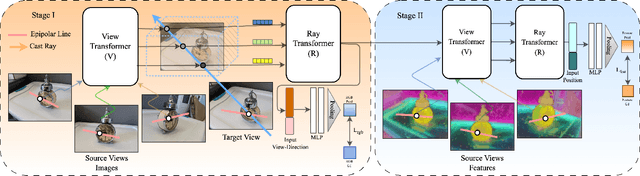
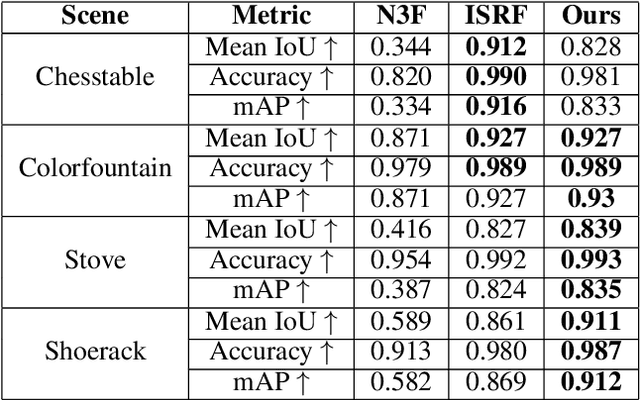
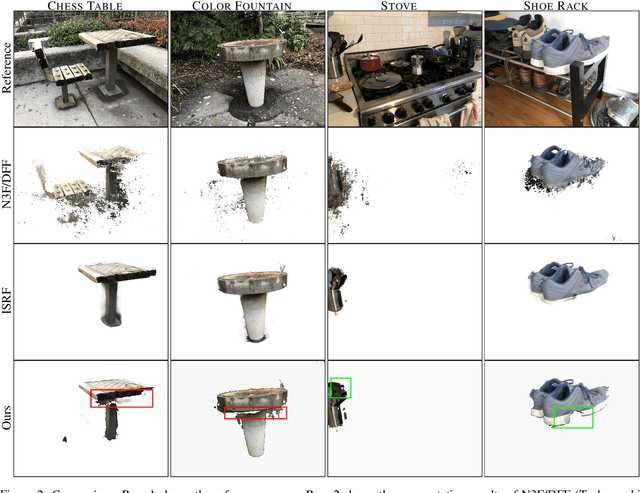
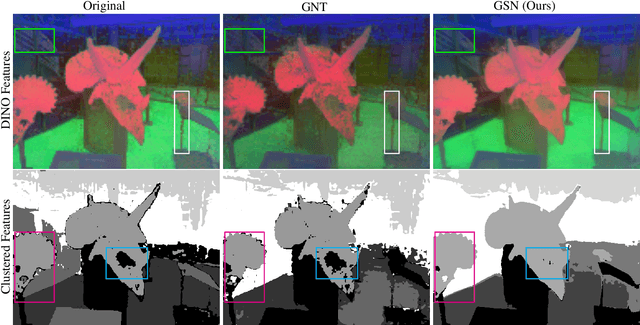
Traditional Radiance Field (RF) representations capture details of a specific scene and must be trained afresh on each scene. Semantic feature fields have been added to RFs to facilitate several segmentation tasks. Generalised RF representations learn the principles of view interpolation. A generalised RF can render new views of an unknown and untrained scene, given a few views. We present a way to distil feature fields into the generalised GNT representation. Our GSN representation generates new views of unseen scenes on the fly along with consistent, per-pixel semantic features. This enables multi-view segmentation of arbitrary new scenes. We show different semantic features being distilled into generalised RFs. Our multi-view segmentation results are on par with methods that use traditional RFs. GSN closes the gap between standard and generalisable RF methods significantly. Project Page: https://vinayak-vg.github.io/GSN/
StyleTRF: Stylizing Tensorial Radiance Fields
Dec 19, 2022Stylized view generation of scenes captured casually using a camera has received much attention recently. The geometry and appearance of the scene are typically captured as neural point sets or neural radiance fields in the previous work. An image stylization method is used to stylize the captured appearance by training its network jointly or iteratively with the structure capture network. The state-of-the-art SNeRF method trains the NeRF and stylization network in an alternating manner. These methods have high training time and require joint optimization. In this work, we present StyleTRF, a compact, quick-to-optimize strategy for stylized view generation using TensoRF. The appearance part is fine-tuned using sparse stylized priors of a few views rendered using the TensoRF representation for a few iterations. Our method thus effectively decouples style-adaption from view capture and is much faster than the previous methods. We show state-of-the-art results on several scenes used for this purpose.
Casual Indoor HDR Radiance Capture from Omnidirectional Images
Aug 16, 2022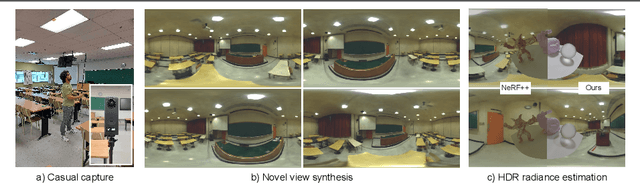
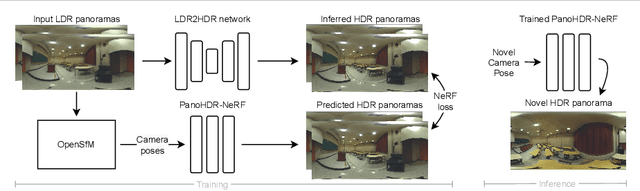
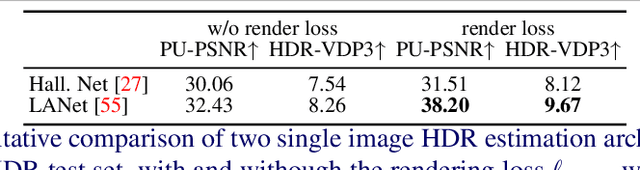

We present PanoHDR-NeRF, a novel pipeline to casually capture a plausible full HDR radiance field of a large indoor scene without elaborate setups or complex capture protocols. First, a user captures a low dynamic range (LDR) omnidirectional video of the scene by freely waving an off-the-shelf camera around the scene. Then, an LDR2HDR network uplifts the captured LDR frames to HDR, subsequently used to train a tailored NeRF++ model. The resulting PanoHDR-NeRF pipeline can estimate full HDR panoramas from any location of the scene. Through experiments on a novel test dataset of a variety of real scenes with the ground truth HDR radiance captured at locations not seen during training, we show that PanoHDR-NeRF predicts plausible radiance from any scene point. We also show that the HDR images produced by PanoHDR-NeRF can synthesize correct lighting effects, enabling the augmentation of indoor scenes with synthetic objects that are lit correctly.
SHARP: Shape-Aware Reconstruction of People in Loose Clothing
May 24, 2022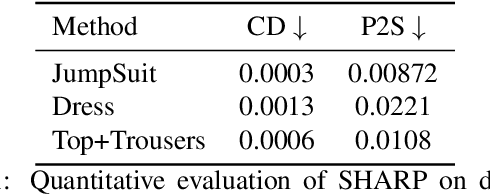
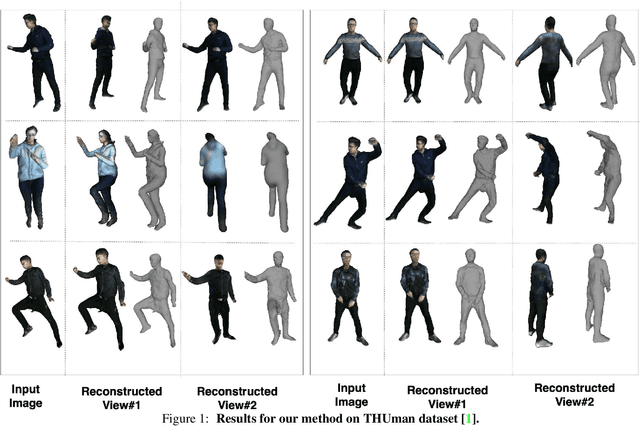
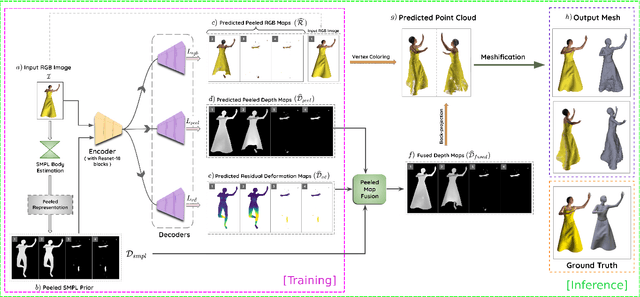
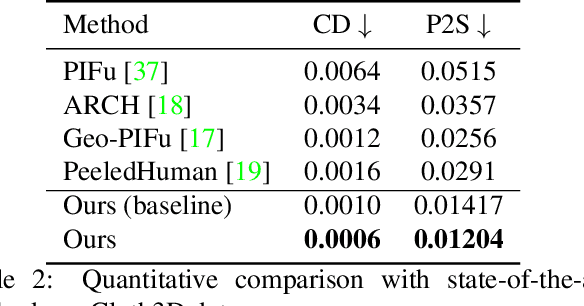
Recent advancements in deep learning have enabled 3D human body reconstruction from a monocular image, which has broad applications in multiple domains. In this paper, we propose SHARP (SHape Aware Reconstruction of People in loose clothing), a novel end-to-end trainable network that accurately recovers the 3D geometry and appearance of humans in loose clothing from a monocular image. SHARP uses a sparse and efficient fusion strategy to combine parametric body prior with a non-parametric 2D representation of clothed humans. The parametric body prior enforces geometrical consistency on the body shape and pose, while the non-parametric representation models loose clothing and handle self-occlusions as well. We also leverage the sparseness of the non-parametric representation for faster training of our network while using losses on 2D maps. Another key contribution is 3DHumans, our new life-like dataset of 3D human body scans with rich geometrical and textural details. We evaluate SHARP on 3DHumans and other publicly available datasets and show superior qualitative and quantitative performance than existing state-of-the-art methods.
Appearance Editing with Free-viewpoint Neural Rendering
Oct 14, 2021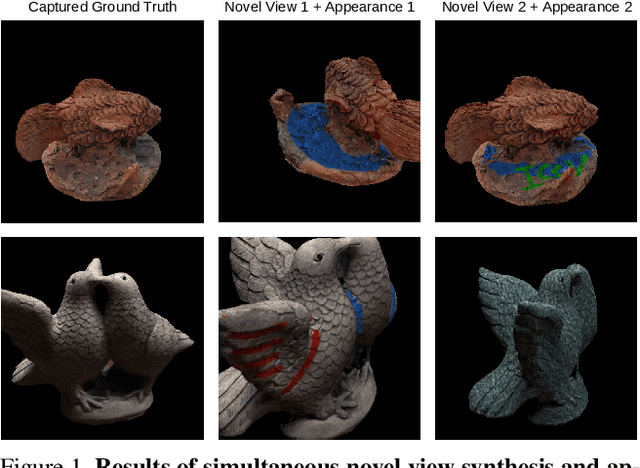
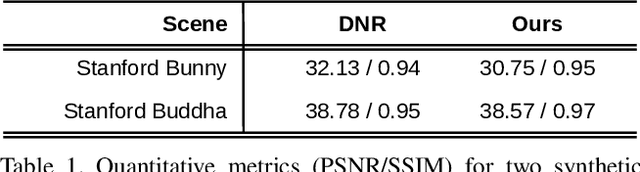
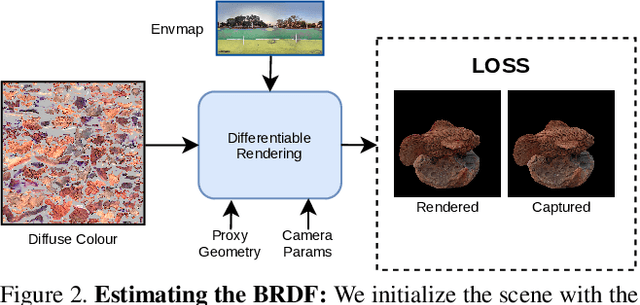
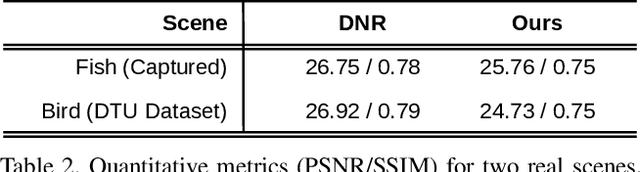
We present a neural rendering framework for simultaneous view synthesis and appearance editing of a scene from multi-view images captured under known environment illumination. Existing approaches either achieve view synthesis alone or view synthesis along with relighting, without direct control over the scene's appearance. Our approach explicitly disentangles the appearance and learns a lighting representation that is independent of it. Specifically, we independently estimate the BRDF and use it to learn a lighting-only representation of the scene. Such disentanglement allows our approach to generalize to arbitrary changes in appearance while performing view synthesis. We show results of editing the appearance of a real scene, demonstrating that our approach produces plausible appearance editing. The performance of our view synthesis approach is demonstrated to be at par with state-of-the-art approaches on both real and synthetic data.
SHARP: Shape-Aware Reconstruction of People In Loose Clothing
Jun 17, 20213D human body reconstruction from monocular images is an interesting and ill-posed problem in computer vision with wider applications in multiple domains. In this paper, we propose SHARP, a novel end-to-end trainable network that accurately recovers the detailed geometry and appearance of 3D people in loose clothing from a monocular image. We propose a sparse and efficient fusion of a parametric body prior with a non-parametric peeled depth map representation of clothed models. The parametric body prior constraints our model in two ways: first, the network retains geometrically consistent body parts that are not occluded by clothing, and second, it provides a body shape context that improves prediction of the peeled depth maps. This enables SHARP to recover fine-grained 3D geometrical details with just L1 losses on the 2D maps, given an input image. We evaluate SHARP on publicly available Cloth3D and THuman datasets and report superior performance to state-of-the-art approaches.
Geometric Scene Refocusing
Dec 20, 2020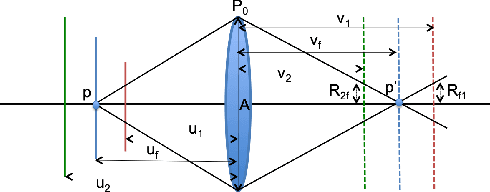
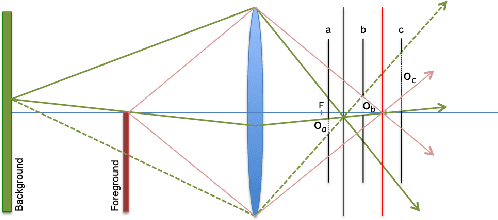

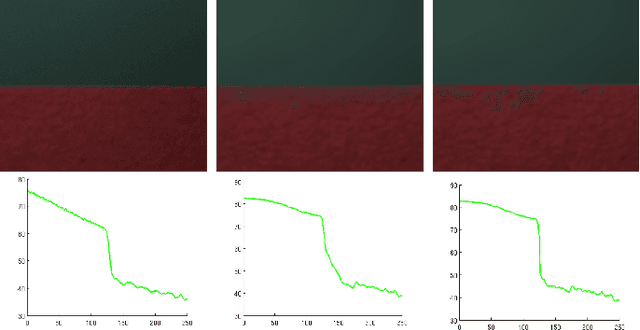
An image captured with a wide-aperture camera exhibits a finite depth-of-field, with focused and defocused pixels. A compact and robust representation of focus and defocus helps analyze and manipulate such images. In this work, we study the fine characteristics of images with a shallow depth-of-field in the context of focal stacks. We present a composite measure for focus that is a combination of existing measures. We identify in-focus pixels, dual-focus pixels, pixels that exhibit bokeh and spatially-varying blur kernels between focal slices. We use these to build a novel representation that facilitates easy manipulation of focal stacks. We present a comprehensive algorithm for post-capture refocusing in a geometrically correct manner. Our approach can refocus the scene at high fidelity while preserving fine aspects of focus and defocus blur.