 Add to Chrome
 Add to Firefox
 Add to Edge
A PPA-Driven 3D-IC Partitioning Selection Framework with Surrogate Models
Apr 20, 2026
3D-IC netlist partitioning is commonly optimized using proxy objectives, while final PPA is treated as a costly evaluation rather than an optimization signal. This proxy-driven paradigm makes it difficult to reliably translate additional PPA evaluations into better PPA outcomes. To bridge this gap, we present DOPP (D-Optimal PPA-driven partitioning selection), an approach that bridges the gap between proxies and true PPA metrics. Across eight 3D-IC designs, our framework improves PPA over Open3DBench (average relative improvements of 9.99% congestion, 7.87% routed wirelength, 7.75% WNS, 21.85% TNS, and 1.18% power). Compared with exhaustive evaluation over the full candidate set, DOPP achieves comparable best-found PPA while evaluating only a small fraction of candidates, substantially reducing evaluation cost. By parallelizing evaluations, our method delivers these gains while maintaining wall-clock runtime comparable to traditional baselines.

Expected Work Search: Combining Win Rate and Proof Size Estimation
May 09, 2024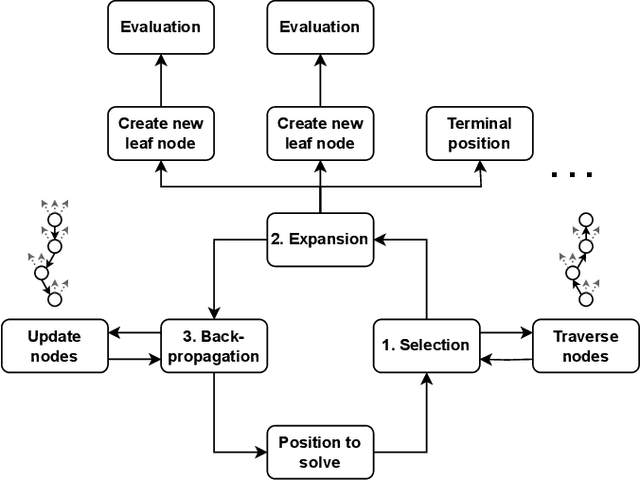

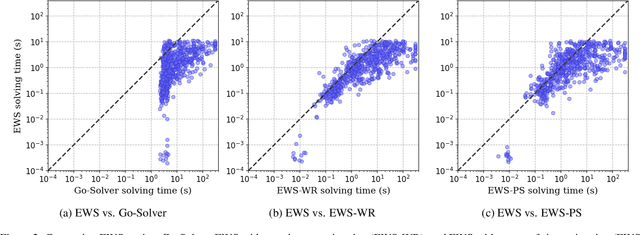
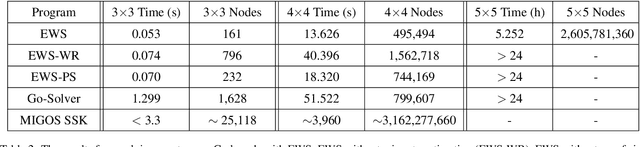
We propose Expected Work Search (EWS), a new game solving algorithm. EWS combines win rate estimation, as used in Monte Carlo Tree Search, with proof size estimation, as used in Proof Number Search. The search efficiency of EWS stems from minimizing a novel notion of Expected Work, which predicts the expected computation required to solve a position. EWS outperforms traditional solving algorithms on the games of Go and Hex. For Go, we present the first solution to the empty 5x5 board with the commonly used positional superko ruleset. For Hex, our algorithm solves the empty 8x8 board in under 4 minutes. Experiments show that EWS succeeds both with and without extensive domain-specific knowledge.