 Add to Chrome
 Add to Firefox
 Add to Edge
MCPShield: A Security Cognition Layer for Adaptive Trust Calibration in Model Context Protocol Agents
Feb 15, 2026
The Model Context Protocol (MCP) standardizes tool use for LLM-based agents and enable third-party servers. This openness introduces a security misalignment: agents implicitly trust tools exposed by potentially untrusted MCP servers. However, despite its excellent utility, existing agents typically offer limited validation for third-party MCP servers. As a result, agents remain vulnerable to MCP-based attacks that exploit the misalignment between agents and servers throughout the tool invocation lifecycle. In this paper, we propose MCPShield as a plug-in security cognition layer that mitigates this misalignment and ensures agent security when invoking MCP-based tools. Drawing inspiration from human experience-driven tool validation, MCPShield assists agent forms security cognition with metadata-guided probing before invocation. Our method constrains execution within controlled boundaries while cognizing runtime events, and subsequently updates security cognition by reasoning over historical traces after invocation, building on human post-use reflection on tool behavior. Experiments demonstrate that MCPShield exhibits strong generalization in defending against six novel MCP-based attack scenarios across six widely used agentic LLMs, while avoiding false positives on benign servers and incurring low deployment overhead. Overall, our work provides a practical and robust security safeguard for MCP-based tool invocation in open agent ecosystems.

Integrating Digital Twin and Advanced Intelligent Technologies to Realize the Metaverse
Oct 03, 2022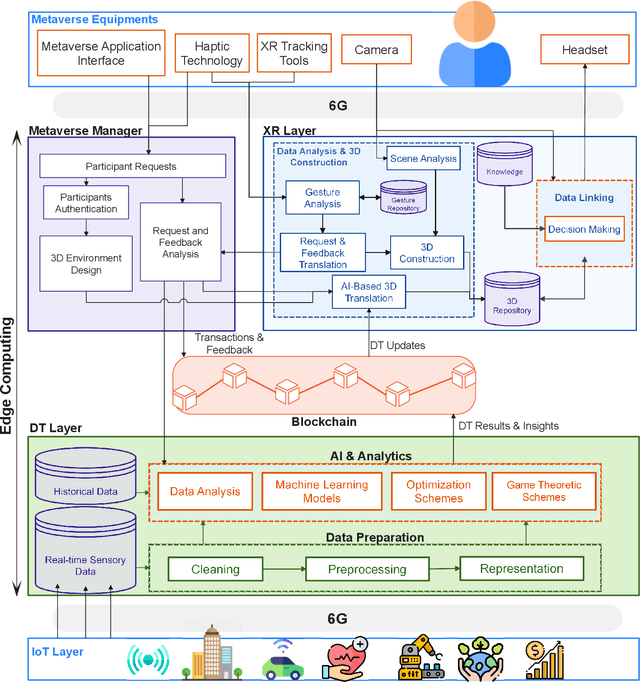
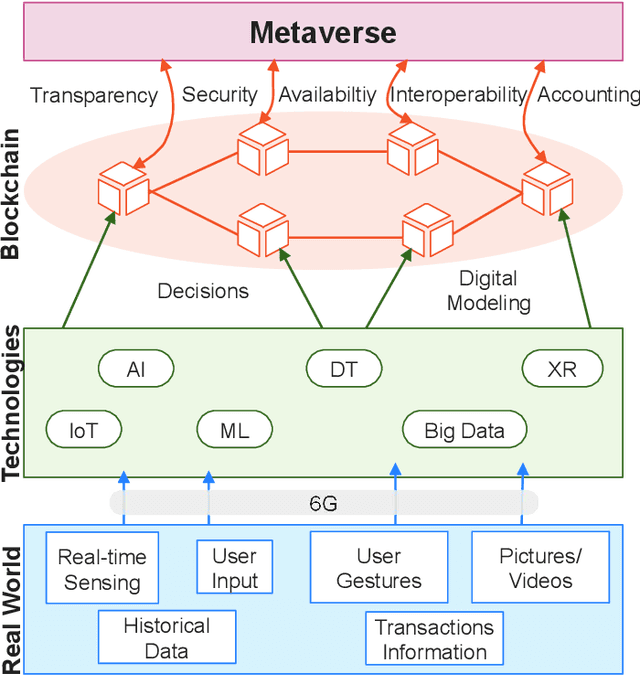
The advances in Artificial Intelligence (AI) have led to technological advancements in a plethora of domains. Healthcare, education, and smart city services are now enriched with AI capabilities. These technological advancements would not have been realized without the assistance of fast, secure, and fault-tolerant communication media. Traditional processing, communication and storage technologies cannot maintain high levels of scalability and user experience for immersive services. The metaverse is an immersive three-dimensional (3D) virtual world that integrates fantasy and reality into a virtual environment using advanced virtual reality (VR) and augmented reality (AR) devices. Such an environment is still being developed and requires extensive research in order for it to be realized to its highest attainable levels. In this article, we discuss some of the key issues required in order to attain realization of metaverse services. We propose a framework that integrates digital twin (DT) with other advanced technologies such as the sixth generation (6G) communication network, blockchain, and AI, to maintain continuous end-to-end metaverse services. This article also outlines requirements for an integrated, DT-enabled metaverse framework and provides a look ahead into the evolving topic.