 Add to Chrome
 Add to Firefox
 Add to Edge
A Terrain-Adaptive epsilon-Constraint MPC for Uneven Terrain Kinodynamic Planning
May 20, 2026
Kinodynamic planning for car-like vehicles on uneven terrain requires simultaneously optimizing competing objectives such as path efficiency and pose stability. This work presents an adaptive epsilon-constraint method integrated into a Model Predictive Control (MPC) framework, where the epsilon bounds are dynamically adjusted based on terrain descriptors to explore the Pareto front in real time. To capture vehicle-terrain dynamics, we develop a semi-parametric model combining analytical vehicle dynamics with a Sparse Gaussian Process (SGP) trained on the same terrain descriptors. The proposed epsilon-MPC is evaluated against MPPI and GAKD baselines, achieving a 94% navigation success rate while reducing maximum orientation deviation by 24% and improving multi-objective trade-off quality by 23%.

A Genetic Approach to Gradient-Free Kinodynamic Planning in Uneven Terrains
Apr 17, 2025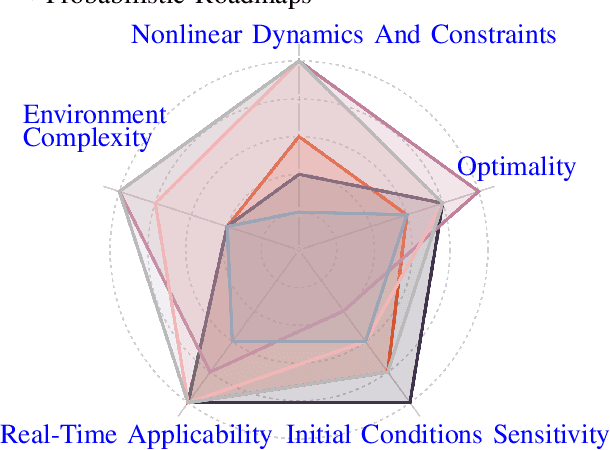
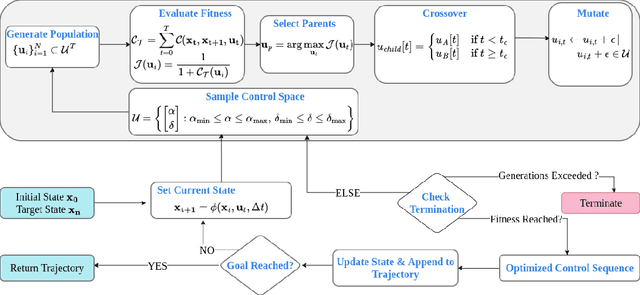
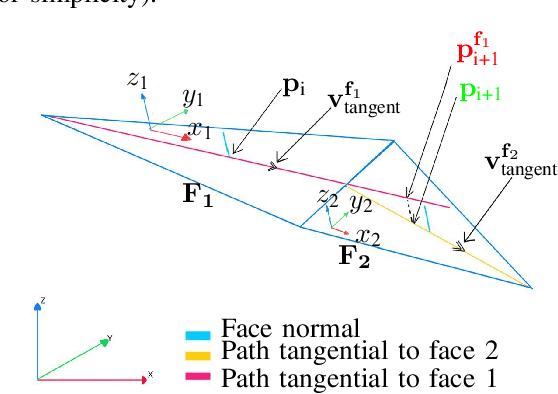
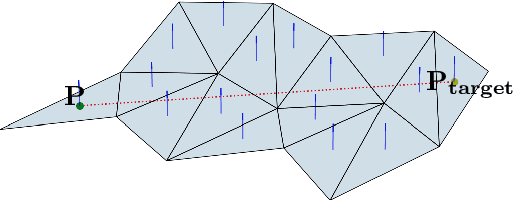
This paper proposes a genetic algorithm-based kinodynamic planning algorithm (GAKD) for car-like vehicles navigating uneven terrains modeled as triangular meshes. The algorithm's distinct feature is trajectory optimization over a fixed-length receding horizon using a genetic algorithm with heuristic-based mutation, ensuring the vehicle's controls remain within its valid operational range. By addressing challenges posed by uneven terrain meshes, such as changing face normals, GAKD offers a practical solution for path planning in complex environments. Comparative evaluations against Model Predictive Path Integral (MPPI) and log-MPPI methods show that GAKD achieves up to 20 percent improvement in traversability cost while maintaining comparable path length. These results demonstrate GAKD's potential in improving vehicle navigation on challenging terrains.