 Add to Chrome
 Add to Firefox
 Add to Edge
RL Bootstrapping of OpenVLA-OFT for a Novel Robot Embodiment
Aug 02, 2026
Adapting a pretrained vision-language-action (VLA) policy to a new robot usually assumes embodiment-specific demonstrations. This assumption is especially restrictive for custom robots whose morphology differs strongly from the manipulators seen in large robot datasets. We study a harder setting: zero-demo embodiment alignment of OpenVLA-OFT on a cable-driven parallel robot (CDPR) with a simple gripper and a previously unseen control interface. Instead of supervised fine-tuning, we use reinforcement learning in simulation with dense geometric rewards computed from simulator state. The training is performed in two stages: a PPO stage for directional motion primitives, followed by GRPO continuation from the PPO checkpoint with an expanded instruction space that includes object-conditioned commands. On the four shared directional instructions, the average held-out success rate improves from 34.25\% after PPO to 53.50\% after PPO$\rightarrow$GRPO, with especially large gains on \texttt{move left} and \texttt{move backward}. In the GRPO stage we additionally introduce \texttt{move to <object>} over eight target objects and obtain 39/400 = 9.75\% strict success, while qualitative rollouts frequently show correct target-directed approach behavior before late-stage instability. Compared with prior OpenVLA and OpenVLA-OFT results, which rely on demonstration datasets and mostly standard rigid-arm embodiments, our method uses no embodiment-specific dataset at all. The results do not yet establish robust manipulation, but they provide stronger evidence that RL-only bootstrapping can create the first usable language-conditioned controller for a genuinely novel embodiment.

A Genetic Approach to Gradient-Free Kinodynamic Planning in Uneven Terrains
Apr 17, 2025
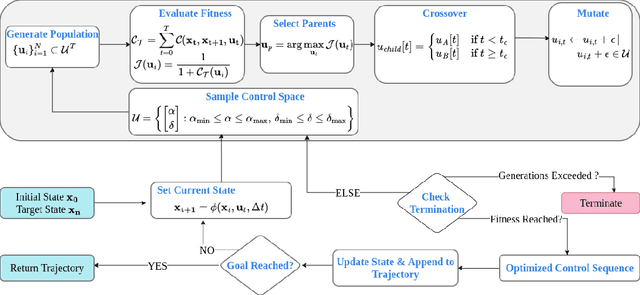
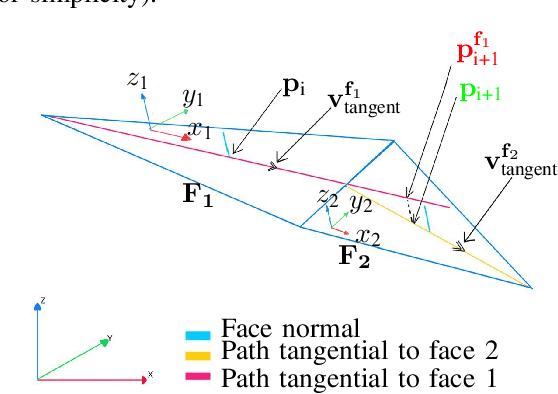
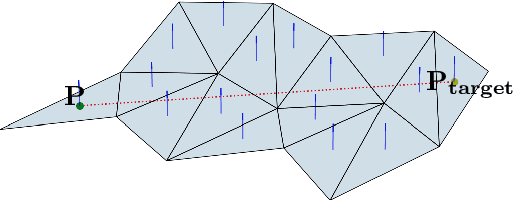
This paper proposes a genetic algorithm-based kinodynamic planning algorithm (GAKD) for car-like vehicles navigating uneven terrains modeled as triangular meshes. The algorithm's distinct feature is trajectory optimization over a fixed-length receding horizon using a genetic algorithm with heuristic-based mutation, ensuring the vehicle's controls remain within its valid operational range. By addressing challenges posed by uneven terrain meshes, such as changing face normals, GAKD offers a practical solution for path planning in complex environments. Comparative evaluations against Model Predictive Path Integral (MPPI) and log-MPPI methods show that GAKD achieves up to 20 percent improvement in traversability cost while maintaining comparable path length. These results demonstrate GAKD's potential in improving vehicle navigation on challenging terrains.