 Add to Chrome
 Add to Firefox
 Add to Edge
Detecting Transportation Mode Using Dense Smartphone GPS Trajectories and Transformer Models
Feb 27, 2026
Transportation mode detection is an important topic within GeoAI and transportation research. In this study, we introduce SpeedTransformer, a novel Transformer-based model that relies solely on speed inputs to infer transportation modes from dense smartphone GPS trajectories. In benchmark experiments, SpeedTransformer outperformed traditional deep learning models, such as the Long Short-Term Memory (LSTM) network. Moreover, the model demonstrated strong flexibility in transfer learning, achieving high accuracy across geographical regions after fine-tuning with small datasets. Finally, we deployed the model in a real-world experiment, where it consistently outperformed baseline models under complex built environments and high data uncertainty. These findings suggest that Transformer architectures, when combined with dense GPS trajectories, hold substantial potential for advancing transportation mode detection and broader mobility-related research.

Tracking Progress Towards Sustainable Development Goal 6 Using Satellite Imagery
Nov 28, 2024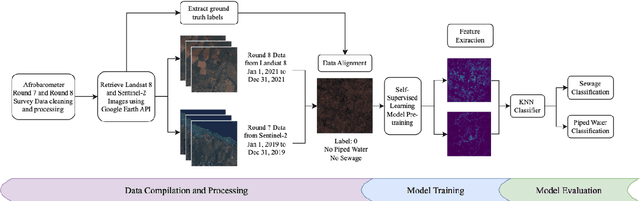


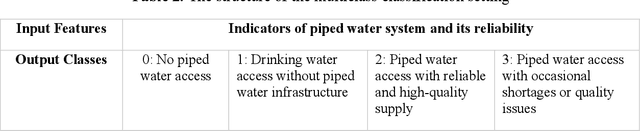
Clean water and sanitation are essential for health, well-being, and sustainable development, yet significant global disparities remain. Although the United Nations' Sustainable Development Goal 6 has clear targets for universal access to clean water and sanitation, data coverage and openness remain obstacles for tracking progress in many countries. Nontraditional data sources are needed to fill this gap. This study incorporated Afrobarometer survey data, satellite imagery (Landsat 8 and Sentinel-2), and deep learning techniques (Meta's DINO model) to develop a modelling framework for evaluating access to piped water and sewage systems across diverse African regions. The modelling framework demonstrated high accuracy, achieving over 96% and 97% accuracy in identifying areas with piped water access and sewage system access respectively using satellite imagery. It can serve as a screening tool for policymakers and stakeholders to potentially identify regions for more targeted and prioritized efforts to improve water and sanitation infrastructure. When coupled with spatial population data, the modelling framework can also estimate and track the national-level percentages of the population with access to piped water and sewage systems. In the future, this approach could potentially be extended to evaluate other SDGs, particularly those related to critical infrastructure.