 Add to Chrome
 Add to Firefox
 Add to Edge
Systematic LLM Translation of Legacy Scientific Code to Differentiable Frameworks: Application to a Land Surface Model
Jun 04, 2026
Differentiable programming offers transformative capabilities for scientific modeling, enabling gradient-based parameter estimation, sensitivity analysis, and data assimilation. Yet, migrating legacy codebases into differentiable frameworks remains a challenge. We present a five-phase LLM-based agentic pipeline that translates legacy Fortran into JAX: static dependency analysis determines module translation order from the full call graph; iterative compile-repair loops correct errors autonomously; and a Fortran reference oracle enforces numerical parity at the module level before integration and gradient verification. We instantiate and evaluate the pipeline on CLM-ml-v2, a 19,000-line Fortran land surface model, and analyze agent behavior across 73 module translation tasks. The resulting differentiable model computes the complete Jacobian in a single backward pass, recovers physical parameters in eight times fewer steps than gradient-free optimization, and achieves a 24 times wall-clock speedup over sequential Fortran at ensemble size N=2,048. Both the translated model and pipeline infrastructure are released as a reusable framework for differentiating other Earth system model components.

Tracking Progress Towards Sustainable Development Goal 6 Using Satellite Imagery
Nov 28, 2024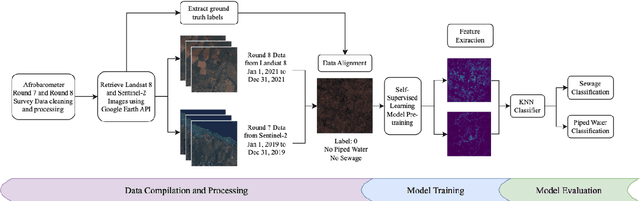


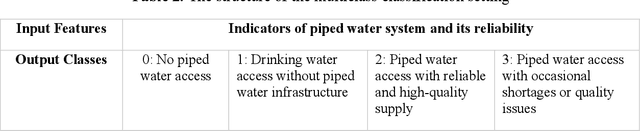
Clean water and sanitation are essential for health, well-being, and sustainable development, yet significant global disparities remain. Although the United Nations' Sustainable Development Goal 6 has clear targets for universal access to clean water and sanitation, data coverage and openness remain obstacles for tracking progress in many countries. Nontraditional data sources are needed to fill this gap. This study incorporated Afrobarometer survey data, satellite imagery (Landsat 8 and Sentinel-2), and deep learning techniques (Meta's DINO model) to develop a modelling framework for evaluating access to piped water and sewage systems across diverse African regions. The modelling framework demonstrated high accuracy, achieving over 96% and 97% accuracy in identifying areas with piped water access and sewage system access respectively using satellite imagery. It can serve as a screening tool for policymakers and stakeholders to potentially identify regions for more targeted and prioritized efforts to improve water and sanitation infrastructure. When coupled with spatial population data, the modelling framework can also estimate and track the national-level percentages of the population with access to piped water and sewage systems. In the future, this approach could potentially be extended to evaluate other SDGs, particularly those related to critical infrastructure.