 Add to Chrome
 Add to Firefox
 Add to Edge
Investigating Inductive Biases for Machine Learning Emulation of Sudden Stratospheric Warmings in Idealised Isca Simulations
Jun 17, 2026
Machine-learning emulators are increasingly used for weather prediction and have the potential to extend skill on subseasonal-to-seasonal timescales by learning dynamically important sources of predictability. A key challenge is whether the models can exploit predictability anchors, such as stratospheric variability, that influence tropospheric circulation beyond short lead times. We test how architectural inductive bias affects emulation of sudden stratospheric warming (SSW) dynamics using paired idealised Isca simulations that differ only in an imposed wave-2 heating perturbation. Across convolutional, transformer, and graph-based architectures trained for one-step prediction, model differences are modest when the stratosphere is dynamically quiet but widen substantially when SSW-like variability is active. Our results identify explicit three-dimensional vertical coupling as a key inductive bias for machine-learning emulation of stratospheric dynamics. However, Eliassen-Palm flux diagnostics show that low forecast error does not guarantee physically faithful wave-mean-flow interaction, with coherent errors remaining in stratospheric wave-driving structure.

Climate Surrogates for Scalable Multi-Agent Reinforcement Learning: A Case Study with CICERO-SCM
Oct 09, 2025Climate policy studies require models that capture the combined effects of multiple greenhouse gases on global temperature, but these models are computationally expensive and difficult to embed in reinforcement learning. We present a multi-agent reinforcement learning (MARL) framework that integrates a high-fidelity, highly efficient climate surrogate directly in the environment loop, enabling regional agents to learn climate policies under multi-gas dynamics. As a proof of concept, we introduce a recurrent neural network architecture pretrained on ($20{,}000$) multi-gas emission pathways to surrogate the climate model CICERO-SCM. The surrogate model attains near-simulator accuracy with global-mean temperature RMSE $\approx 0.0004 \mathrm{K}$ and approximately $1000\times$ faster one-step inference. When substituted for the original simulator in a climate-policy MARL setting, it accelerates end-to-end training by $>\!100\times$. We show that the surrogate and simulator converge to the same optimal policies and propose a methodology to assess this property in cases where using the simulator is intractable. Our work allows to bypass the core computational bottleneck without sacrificing policy fidelity, enabling large-scale multi-agent experiments across alternative climate-policy regimes with multi-gas dynamics and high-fidelity climate response.
Learning traffic flows: Graph Neural Networks for Metamodelling Traffic Assignment
May 16, 2025
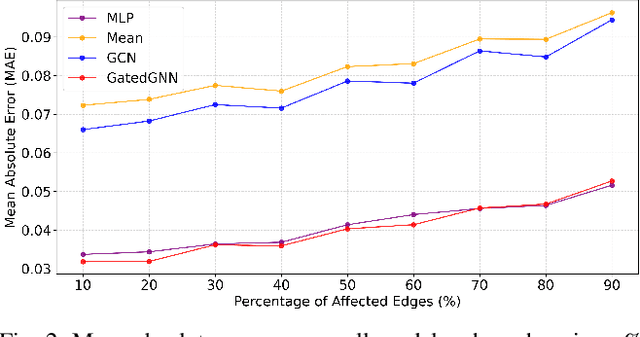
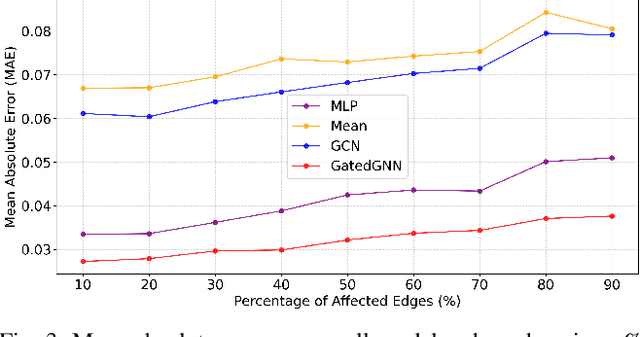
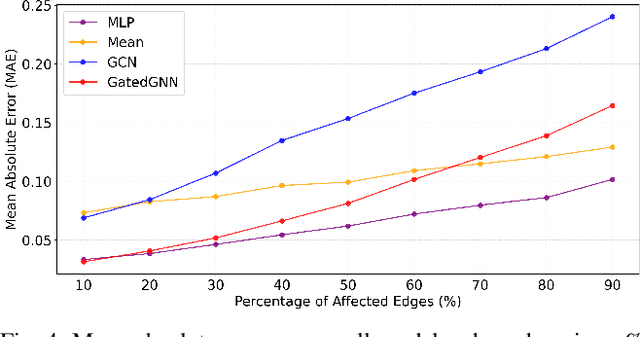
The Traffic Assignment Problem is a fundamental, yet computationally expensive, task in transportation modeling, especially for large-scale networks. Traditional methods require iterative simulations to reach equilibrium, making real-time or large-scale scenario analysis challenging. In this paper, we propose a learning-based approach using Message-Passing Neural Networks as a metamodel to approximate the equilibrium flow of the Stochastic User Equilibrium assignment. Our model is designed to mimic the algorithmic structure used in conventional traffic simulators allowing it to better capture the underlying process rather than just the data. We benchmark it against other conventional deep learning techniques and evaluate the model's robustness by testing its ability to predict traffic flows on input data outside the domain on which it was trained. This approach offers a promising solution for accelerating out-of-distribution scenario assessments, reducing computational costs in large-scale transportation planning, and enabling real-time decision-making.