 Add to Chrome
 Add to Firefox
 Add to Edge
Agent Lifecycle Toolkit (ALTK): Reusable Middleware Components for Robust AI Agents
Mar 16, 2026
As AI agents move from demos into enterprise deployments, their failure modes become consequential: a misinterpreted tool argument can corrupt production data, a silent reasoning error can go undetected until damage is done, and outputs that violate organizational policy can create legal or compliance risk. Yet, most agent frameworks leave builders to handle these failure modes ad hoc, resulting in brittle, one-off safeguards that are hard to reuse or maintain. We present the Agent Lifecycle Toolkit (ALTK), an open-source collection of modular middleware components that systematically address these gaps across the full agent lifecycle. Across the agent lifecycle, we identify opportunities to intervene and improve, namely, post-user-request, pre-LLM prompt conditioning, post-LLM output processing, pre-tool validation, post-tool result checking, and pre-response assembly. ALTK provides modular middleware that detects, repairs, and mitigates common failure modes. It offers consistent interfaces that fit naturally into existing pipelines. It is compatible with low-code and no-code tools such as the ContextForge MCP Gateway and Langflow. Finally, it significantly reduces the effort of building reliable, production-grade agents.

GRAIL: Goal Recognition Alignment through Imitation Learning
Feb 15, 2026Understanding an agent's goals from its behavior is fundamental to aligning AI systems with human intentions. Existing goal recognition methods typically rely on an optimal goal-oriented policy representation, which may differ from the actor's true behavior and hinder the accurate recognition of their goal. To address this gap, this paper introduces Goal Recognition Alignment through Imitation Learning (GRAIL), which leverages imitation learning and inverse reinforcement learning to learn one goal-directed policy for each candidate goal directly from (potentially suboptimal) demonstration trajectories. By scoring an observed partial trajectory with each learned goal-directed policy in a single forward pass, GRAIL retains the one-shot inference capability of classical goal recognition while leveraging learned policies that can capture suboptimal and systematically biased behavior. Across the evaluated domains, GRAIL increases the F1-score by more than 0.5 under systematically biased optimal behavior, achieves gains of approximately 0.1-0.3 under suboptimal behavior, and yields improvements of up to 0.4 under noisy optimal trajectories, while remaining competitive in fully optimal settings. This work contributes toward scalable and robust models for interpreting agent goals in uncertain environments.
General Dynamic Goal Recognition
May 14, 2025Understanding an agent's intent through its behavior is essential in human-robot interaction, interactive AI systems, and multi-agent collaborations. This task, known as Goal Recognition (GR), poses significant challenges in dynamic environments where goals are numerous and constantly evolving. Traditional GR methods, designed for a predefined set of goals, often struggle to adapt to these dynamic scenarios. To address this limitation, we introduce the General Dynamic GR problem - a broader definition of GR - aimed at enabling real-time GR systems and fostering further research in this area. Expanding on this foundation, this paper employs a model-free goal-conditioned RL approach to enable fast adaptation for GR across various changing tasks.
ODGR: Online Dynamic Goal Recognition
Jul 23, 2024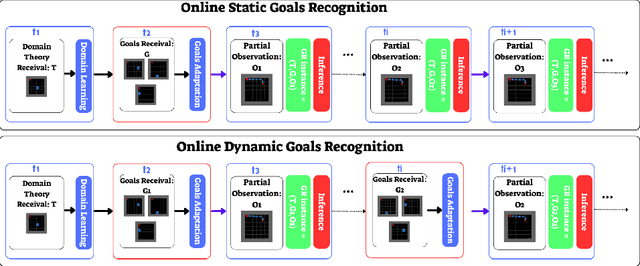
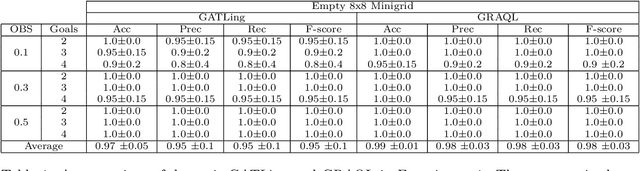

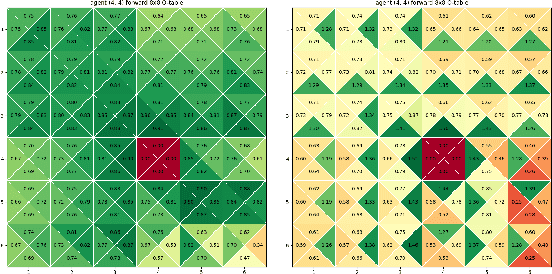
Traditionally, Reinforcement Learning (RL) problems are aimed at optimization of the behavior of an agent. This paper proposes a novel take on RL, which is used to learn the policy of another agent, to allow real-time recognition of that agent's goals. Goal Recognition (GR) has traditionally been framed as a planning problem where one must recognize an agent's objectives based on its observed actions. Recent approaches have shown how reinforcement learning can be used as part of the GR pipeline, but are limited to recognizing predefined goals and lack scalability in domains with a large goal space. This paper formulates a novel problem, "Online Dynamic Goal Recognition" (ODGR), as a first step to address these limitations. Contributions include introducing the concept of dynamic goals into the standard GR problem definition, revisiting common approaches by reformulating them using ODGR, and demonstrating the feasibility of solving ODGR in a navigation domain using transfer learning. These novel formulations open the door for future extensions of existing transfer learning-based GR methods, which will be robust to changing and expansive real-time environments.