 Add to Chrome
 Add to Firefox
 Add to Edge
Slurry-as-a-Service: A Modest Proposal on Scalable Pluralistic Alignment for Nutrient Optimization
Mar 02, 2026
Pluralistic alignment has emerged as a promising approach for ensuring that large language models (LLMs) faithfully represent the diversity, nuance, and conflict inherent in human values. In this work, we study a high-stakes deployment context - mulching - where automated systems transform selected individuals into nutrient-rich slurry for the dual purposes of food security and aesthetic population management. Building on recent pluralistic alignment frameworks, we introduce ValueMulch, a reproducible training, deployment, and certification pipeline for aligning mulching models (MMs) to a wide range of community norms. Through a real-world testbed spanning 32 communities, we show that ValueMulch improves distributional agreement with community mulching preferences relative to frontier baselines. We conclude with a discussion of ethical considerations, limitations, and implications for researchers seeking to align systems to the full spectrum of human values - especially when those values are inconsistent, commercially inconvenient, or nutritionally underutilized. Author's note: This piece builds on prior existing work Keyes et al in 2019 that satirized cannibalism as a parody for approaches that imbue ethics into problematic technology. We bring those ideas to today's era with the proliferation of large language models in everyday lives, as a critique of current AI pluralistic alignment literature. Our work does not intend to argue that all alignment practices are evil, but rather that if framing value design as a technical problem enables technology systems to enact harms, then perhaps this framing is not enough.

Stop! In the Name of Flaws: Disentangling Personal Names and Sociodemographic Attributes in NLP
May 27, 2024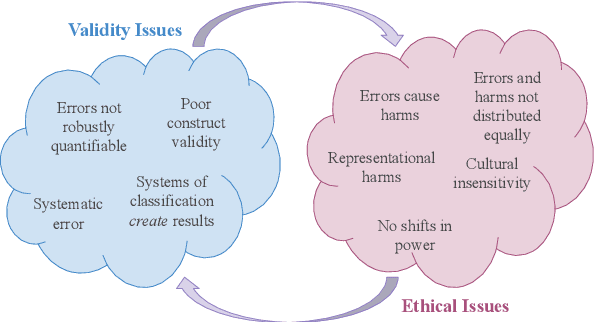
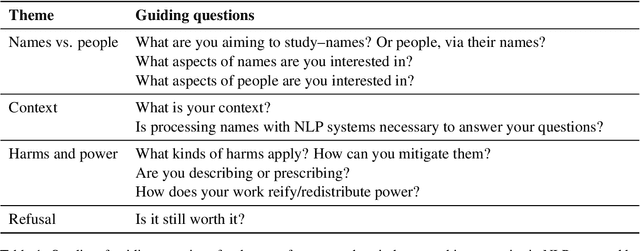
Personal names simultaneously differentiate individuals and categorize them in ways that are important in a given society. While the natural language processing community has thus associated personal names with sociodemographic characteristics in a variety of tasks, researchers have engaged to varying degrees with the established methodological problems in doing so. To guide future work, we present an interdisciplinary background on names and naming. We then survey the issues inherent to associating names with sociodemographic attributes, covering problems of validity (e.g., systematic error, construct validity), as well as ethical concerns (e.g., harms, differential impact, cultural insensitivity). Finally, we provide guiding questions along with normative recommendations to avoid validity and ethical pitfalls when dealing with names and sociodemographic characteristics in natural language processing.
What is the Point of Fairness? Disability, AI and The Complexity of Justice
Aug 09, 2019Work integrating conversations around AI and Disability is vital and valued, particularly when done through a lens of fairness. Yet at the same time, analyzing the ethical implications of AI for disabled people solely through the lens of a singular idea of "fairness" risks reinforcing existing power dynamics, either through reinforcing the position of existing medical gatekeepers, or promoting tools and techniques that benefit otherwise-privileged disabled people while harming those who are rendered outliers in multiple ways. In this paper we present two case studies from within computer vision - a subdiscipline of AI focused on training algorithms that can "see" - of technologies putatively intended to help disabled people but, through failures to consider structural injustices in their design, are likely to result in harms not addressed by a "fairness" framing of ethics. Drawing on disability studies and critical data science, we call on researchers into AI ethics and disability to move beyond simplistic notions of fairness, and towards notions of justice.