 Add to Chrome
 Add to Firefox
 Add to Edge
TimeLens: On-Device Artifact Recognition with Retrieval-Augmented Question Answering for the Grand Egyptian Museum
Jun 11, 2026
TimeLens is an AI-powered bilingual mobile guide for the Grand Egyptian Museum (GEM). Pointing a phone at an exhibit, a visitor sees the artifact recognized in real time and can ask follow-up questions answered in English or Arabic. The work addresses three problems specific to in-gallery deployment: fine-grained visual similarity among 51 catalogued artifacts (many near-identical Ramesside statues), the gap between curated training data and handheld camera conditions, and the risk of an AI guide stating unsupported historical facts. Two engineering contributions are reported. First, an on-device artifact detector was developed through a data-quality-driven iteration study -- from foundation-model auto-annotation (YOLO-World), through spatial label-cleaning rules, to a fully hand-annotated dataset -- isolating label quality as the decisive factor: the final YOLOv8n model resolves every previously failing class while remaining a 5.97 MB TensorFlow Lite asset that runs in real time on a mid-range phone (mAP@0.5 = 0.995, mAP@0.5:0.95 = 0.924). Second, a bilingual Retrieval-Augmented Generation (RAG) guide, grounded in a 108-record ChromaDB knowledge base, was benchmarked across seven candidate language models, with Gemma 4 E2B (Q4 K M) selected; ten targeted optimizations reduce end-to-end latency from over 30 s to approximately 10 s. Both subsystems are integrated in a production Flutter application with bilingual interface, museum location gating, and text-to-speech support.

MVD:A Novel Methodology and Dataset for Acoustic Vehicle Type Classification
Sep 07, 2023Rising urban populations have led to a surge in vehicle use and made traffic monitoring and management indispensable. Acoustic traffic monitoring (ATM) offers a cost-effective and efficient alternative to more computationally expensive methods of monitoring traffic such as those involving computer vision technologies. In this paper, we present MVD and MVDA: two open datasets for the development of acoustic traffic monitoring and vehicle-type classification algorithms, which contain audio recordings of moving vehicles. The dataset contain four classes- Trucks, Cars, Motorbikes, and a No-vehicle class. Additionally, we propose a novel and efficient way to accurately classify these acoustic signals using cepstrum and spectrum based local and global audio features, and a multi-input neural network. Experimental results show that our methodology improves upon the established baselines of previous works and achieves an accuracy of 91.98% and 96.66% on MVD and MVDA Datasets, respectively. Finally, the proposed model was deployed through an Android application to make it accessible for testing and demonstrate its efficacy.
ANER: Arabic and Arabizi Named Entity Recognition using Transformer-Based Approach
Aug 28, 2023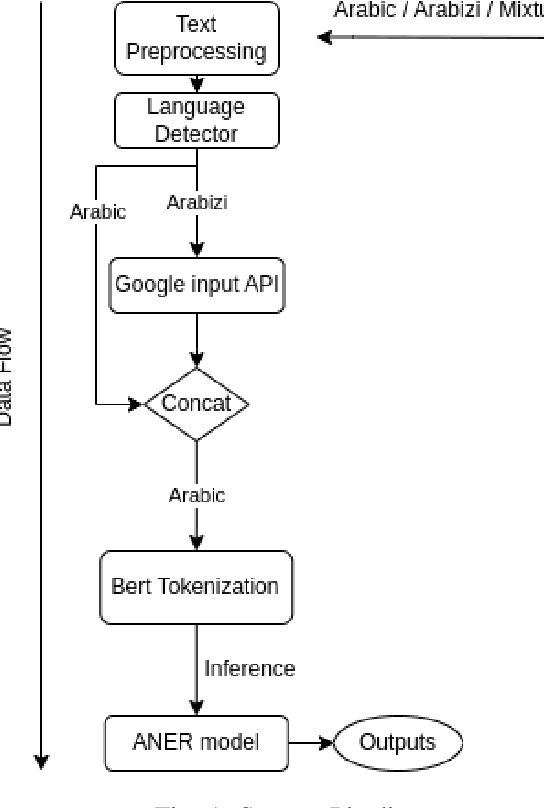
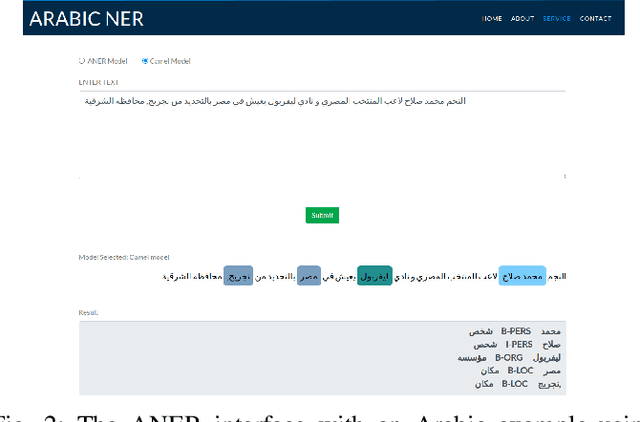
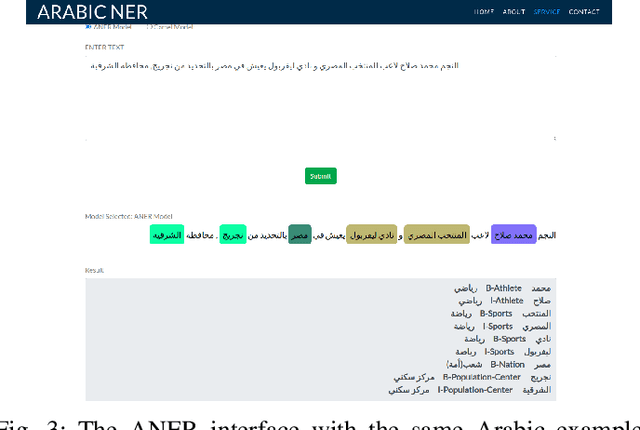
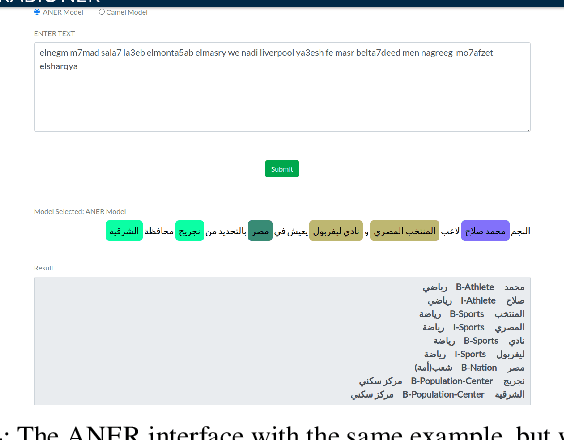
One of the main tasks of Natural Language Processing (NLP), is Named Entity Recognition (NER). It is used in many applications and also can be used as an intermediate step for other tasks. We present ANER, a web-based named entity recognizer for the Arabic, and Arabizi languages. The model is built upon BERT, which is a transformer-based encoder. It can recognize 50 different entity classes, covering various fields. We trained our model on the WikiFANE\_Gold dataset which consists of Wikipedia articles. We achieved an F1 score of 88.7\%, which beats CAMeL Tools' F1 score of 83\% on the ANERcorp dataset, which has only 4 classes. We also got an F1 score of 77.7\% on the NewsFANE\_Gold dataset which contains out-of-domain data from News articles. The system is deployed on a user-friendly web interface that accepts users' inputs in Arabic, or Arabizi. It allows users to explore the entities in the text by highlighting them. It can also direct users to get information about entities through Wikipedia directly. We added the ability to do NER using our model, or CAMeL Tools' model through our website. ANER is publicly accessible at \url{http://www.aner.online}. We also deployed our model on HuggingFace at https://huggingface.co/boda/ANER, to allow developers to test and use it.