 Add to Chrome
 Add to Firefox
 Add to Edge
TimeLens: On-Device Artifact Recognition with Retrieval-Augmented Question Answering for the Grand Egyptian Museum
Jun 11, 2026
TimeLens is an AI-powered bilingual mobile guide for the Grand Egyptian Museum (GEM). Pointing a phone at an exhibit, a visitor sees the artifact recognized in real time and can ask follow-up questions answered in English or Arabic. The work addresses three problems specific to in-gallery deployment: fine-grained visual similarity among 51 catalogued artifacts (many near-identical Ramesside statues), the gap between curated training data and handheld camera conditions, and the risk of an AI guide stating unsupported historical facts. Two engineering contributions are reported. First, an on-device artifact detector was developed through a data-quality-driven iteration study -- from foundation-model auto-annotation (YOLO-World), through spatial label-cleaning rules, to a fully hand-annotated dataset -- isolating label quality as the decisive factor: the final YOLOv8n model resolves every previously failing class while remaining a 5.97 MB TensorFlow Lite asset that runs in real time on a mid-range phone (mAP@0.5 = 0.995, mAP@0.5:0.95 = 0.924). Second, a bilingual Retrieval-Augmented Generation (RAG) guide, grounded in a 108-record ChromaDB knowledge base, was benchmarked across seven candidate language models, with Gemma 4 E2B (Q4 K M) selected; ten targeted optimizations reduce end-to-end latency from over 30 s to approximately 10 s. Both subsystems are integrated in a production Flutter application with bilingual interface, museum location gating, and text-to-speech support.

An End-to-End OCR Framework for Robust Arabic-Handwriting Recognition using a Novel Transformers-based Model and an Innovative 270 Million-Words Multi-Font Corpus of Classical Arabic with Diacritics
Aug 26, 2022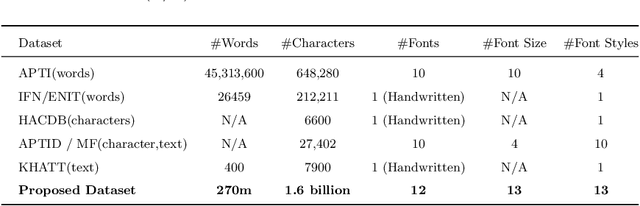
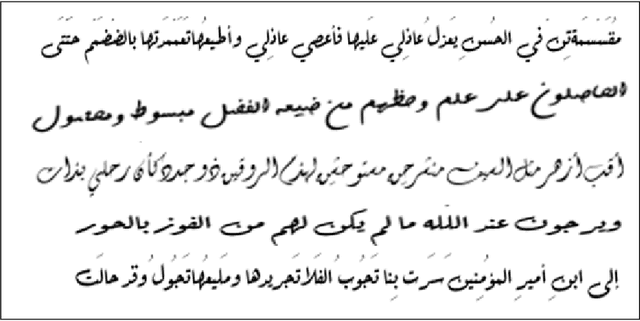
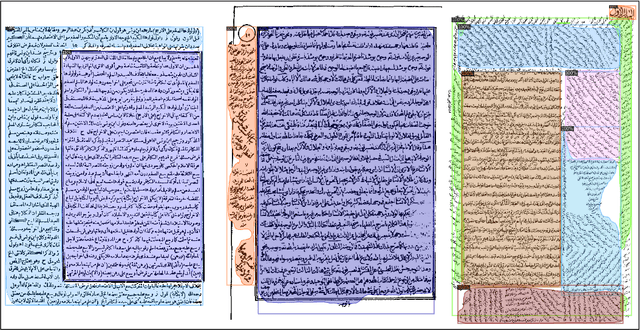
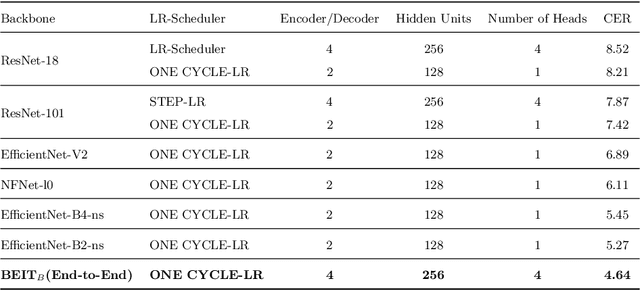
This research is the second phase in a series of investigations on developing an Optical Character Recognition (OCR) of Arabic historical documents and examining how different modeling procedures interact with the problem. The first research studied the effect of Transformers on our custom-built Arabic dataset. One of the downsides of the first research was the size of the training data, a mere 15000 images from our 30 million images, due to lack of resources. Also, we add an image enhancement layer, time and space optimization, and Post-Correction layer to aid the model in predicting the correct word for the correct context. Notably, we propose an end-to-end text recognition approach using Vision Transformers as an encoder, namely BEIT, and vanilla Transformer as a decoder, eliminating CNNs for feature extraction and reducing the model's complexity. The experiments show that our end-to-end model outperforms Convolutions Backbones. The model attained a CER of 4.46%.