 Add to Chrome
 Add to Firefox
 Add to Edge
Assessing the Generalization of Graph Neural Networks for Fault Location Across Increasing Distributed Energy Resource Penetration Levels
Jul 31, 2026
Accurate fault location is critical for distribution network reliability. However, increasing distributed energy resource (DER) penetration complicates fault location due to intermittent generation and bidirectional power flows that reshape fault signatures. Spatio-Temporal Graph Neural Networks (STGNNs) have shown promise by jointly modeling spatial and temporal dependencies, but their behavior under increasing DER penetration has not been studied rigorously. In this paper, we (i) systematically benchmark spatio-temporal graph attention network (STGATv2) against purely temporal (gated recurrent unit, GRU), purely spatial (GATv2) and traditional machine learning baselines, and (ii) evaluate how well models generalize across increasing DER penetration levels (10%, 25%, 50%) on a reconfigured IEEE 123-bus feeder with multiple DER injection points and moderate-to-high impedance faults. Results show that STGATv2 consistently outperforms neural baselines, achieving 92-94% macro F1 in-distribution. Notably, generalization across penetration levels is asymmetric: training at 50% penetration retains near in-distribution F1 score at lower levels, whereas training at 10% degrades considerably at 50% - with STGATv2 retaining 81-84% F1 under these drastic shifts, substantially higher than GATv2 and GRU which drop to 69-74% F1 and 73-75% F1 respectively. Under realistic measurement noise, STGATv2 maintains > 85% F1, while GRU drops as low as 33.5% F1, highlighting the critical role of topological awareness for robust fault location in active distribution networks.

Revisiting data-driven dynamic security assessment with a tabular foundation model
Jul 17, 2026Data-driven pre-fault dynamic security assessment (DSA) rapidly evaluates the dynamic risk of credible contingencies on a power system using machine learning. Existing approaches face two limitations. First, they require a large labelled database for training, with a separate model trained, tuned, and maintained for each contingency in a potentially long list of credible contingencies. Second, the trained models generalize poorly to unseen contingencies. This work addresses the limitations by using a tabular foundation model (TFM) that assesses stability through in-context learning, requiring no retraining or hyperparameter optimization. A single TFM can assess many contingencies at once, removing the need for one model per classifier. We also characterize when the use of electrical distance coordinates (EDC) as continuous features enables generalization of TFM to unseen contingencies and when they do not, demonstrating how a few labelled samples can reliably improve generalization. Through comprehensive case studies on the IEEE 68-bus system, we show that a single TFM attains an average Macro F1 score of about 90% with only 120 labelled samples per contingency, roughly two orders of magnitude fewer than conventionally assumed, without any model retraining or hyperparameter tuning. For new/unseen contingencies, we show that using just 10 labelled samples of the new contingency with EDC encoding matches the best achievable transfer learning oracle model, which requires fully labelled data and is not deployable in practice. Overall, this initial study paves the way towards developing and deploying foundation models for power system operations, with possible applications across multiple operational tasks.
Towards Generalization of Graph Neural Networks for AC Optimal Power Flow
Oct 08, 2025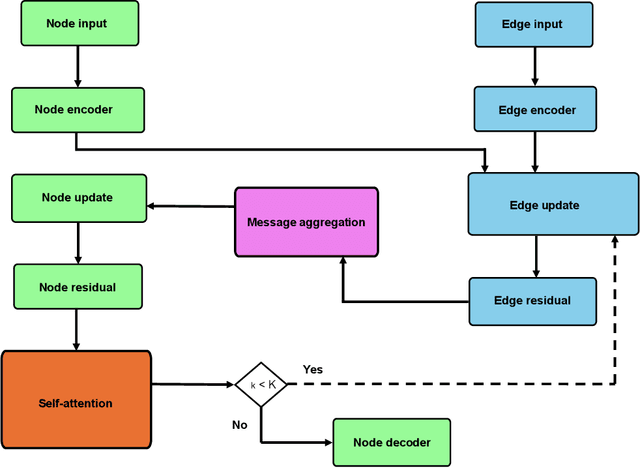
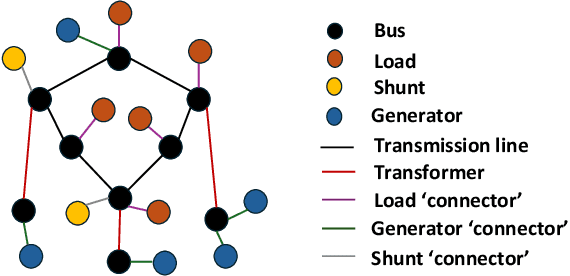
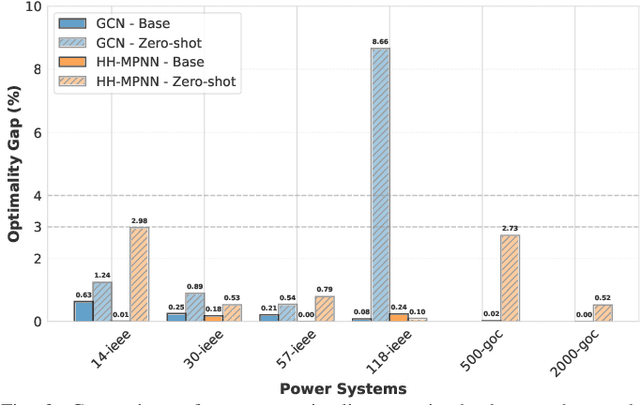
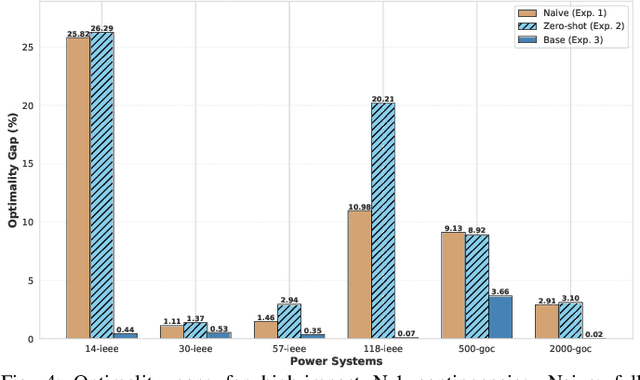
AC Optimal Power Flow (ACOPF) is computationally expensive for large-scale power systems, with conventional solvers requiring prohibitive solution times. Machine learning approaches offer computational speedups but struggle with scalability and topology adaptability without expensive retraining. To enable scalability across grid sizes and adaptability to topology changes, we propose a Hybrid Heterogeneous Message Passing Neural Network (HH-MPNN). HH-MPNN models buses, generators, loads, shunts, transmission lines and transformers as distinct node or edge types, combined with a scalable transformer model for handling long-range dependencies. On grids from 14 to 2,000 buses, HH-MPNN achieves less than 1% optimality gap on default topologies. Applied zero-shot to thousands of unseen topologies, HH-MPNN achieves less than 3% optimality gap despite training only on default topologies. Pre-training on smaller grids also improves results on a larger grid. Computational speedups reach 1,000x to 10,000x compared to interior point solvers. These results advance practical, generalizable machine learning for real-time power system operations.
Image Augmentation for Satellite Images
Jul 29, 2022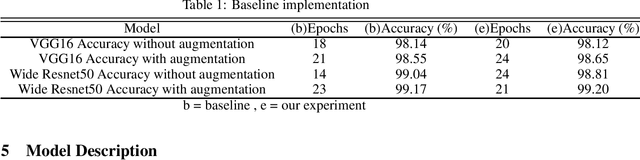
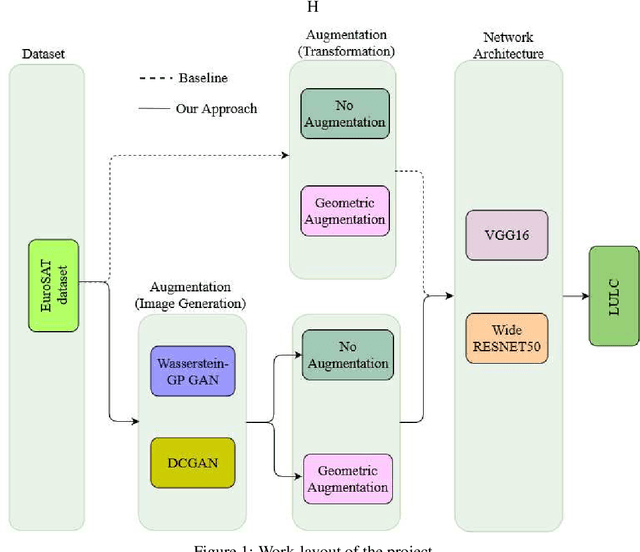
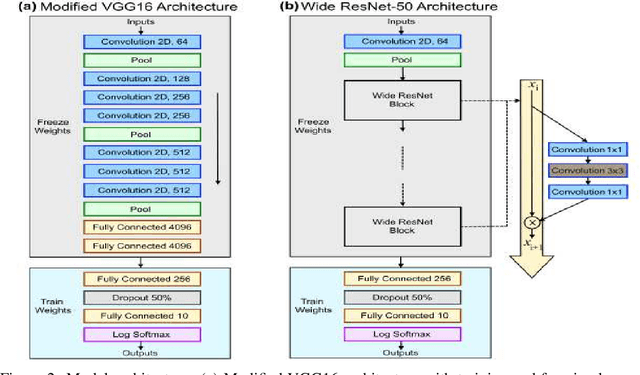
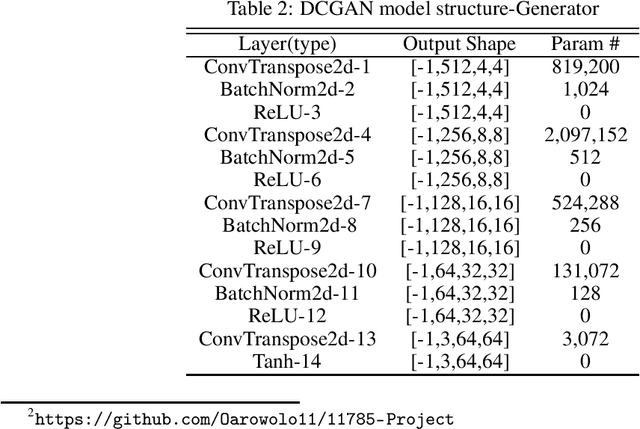
This study proposes the use of generative models (GANs) for augmenting the EuroSAT dataset for the Land Use and Land Cover (LULC) Classification task. We used DCGAN and WGAN-GP to generate images for each class in the dataset. We then explored the effect of augmenting the original dataset by about 10% in each case on model performance. The choice of GAN architecture seems to have no apparent effect on the model performance. However, a combination of geometric augmentation and GAN-generated images improved baseline results. Our study shows that GANs augmentation can improve the generalizability of deep classification models on satellite images.