 Add to Chrome
 Add to Firefox
 Add to Edge
Revisiting data-driven dynamic security assessment with a tabular foundation model
Jul 17, 2026
Data-driven pre-fault dynamic security assessment (DSA) rapidly evaluates the dynamic risk of credible contingencies on a power system using machine learning. Existing approaches face two limitations. First, they require a large labelled database for training, with a separate model trained, tuned, and maintained for each contingency in a potentially long list of credible contingencies. Second, the trained models generalize poorly to unseen contingencies. This work addresses the limitations by using a tabular foundation model (TFM) that assesses stability through in-context learning, requiring no retraining or hyperparameter optimization. A single TFM can assess many contingencies at once, removing the need for one model per classifier. We also characterize when the use of electrical distance coordinates (EDC) as continuous features enables generalization of TFM to unseen contingencies and when they do not, demonstrating how a few labelled samples can reliably improve generalization. Through comprehensive case studies on the IEEE 68-bus system, we show that a single TFM attains an average Macro F1 score of about 90% with only 120 labelled samples per contingency, roughly two orders of magnitude fewer than conventionally assumed, without any model retraining or hyperparameter tuning. For new/unseen contingencies, we show that using just 10 labelled samples of the new contingency with EDC encoding matches the best achievable transfer learning oracle model, which requires fully labelled data and is not deployable in practice. Overall, this initial study paves the way towards developing and deploying foundation models for power system operations, with possible applications across multiple operational tasks.

MxGPS: Multiplex Graph Transformers for a Power Grid Foundation Model
Jul 15, 2026Single-task fine-tuning of graph neural networks (GNNs) for power grid problems exhibits a systematic failure mode: models that achieve the lowest in-distribution error degrade the most under topology shift. We term this topology overfitting: the tendency of task-specific gradient signals to encode relational structure particular to the training topologies rather than the underlying physics, causing models to fail on unseen grids despite strong in-distribution performance. To expose and address this failure mode, we introduce MxGPS (Multiplex GPS), a multiplex graph transformer that runs K task-specialised GPS branches over a shared node encoder, jointly trained on Static State Estimation (SSE) and AC Power Flow (PF) via a self-supervised pre-training and multi-task fine-tuning protocol, with a cross-branch attention module evaluated in ablation. The joint SSE+PF objective forces the shared encoder to simultaneously satisfy complementary gradient signals, preventing it from overfitting to topology-specific relational structure. Under a 3-fold sliding-window cross-validation spanning four unseen topologies (14-, 24-, 162-, and 300-bus), MxGPS attains 0% boundary violation rate (BVR) on all four zero-shot Power Flow topologies. Critically, models with substantially lower in-distribution PF error degrade by 190% to 1400% under topology shift, whereas MxGPS degrades by only 39%, an inversion that directly implicates topology overfitting as the failure mechanism rather than insufficient model capacity. With only 1.6M parameters (12x fewer than the GridFM reference baseline), MxGPS demonstrates that multi-task joint training is a principled and parameter-efficient mechanism for topology-agnostic generalisation in power grid foundation models.
Residual Power Flow for Neural Solvers
Jan 14, 2026The energy transition challenges operational tasks based on simulations and optimisation. These computations need to be fast and flexible as the grid is ever-expanding, and renewables' uncertainty requires a flexible operational environment. Learned approximations, proxies or surrogates -- we refer to them as Neural Solvers -- excel in terms of evaluation speed, but are inflexible with respect to adjusting to changing tasks. Hence, neural solvers are usually applicable to highly specific tasks, which limits their usefulness in practice; a widely reusable, foundational neural solver is required. Therefore, this work proposes the Residual Power Flow (RPF) formulation. RPF formulates residual functions based on Kirchhoff's laws to quantify the infeasibility of an operating condition. The minimisation of the residuals determines the voltage solution; an additional slack variable is needed to achieve AC-feasibility. RPF forms a natural, foundational subtask of tasks subject to power flow constraints. We propose to learn RPF with neural solvers to exploit their speed. Furthermore, RPF improves learning performance compared to common power flow formulations. To solve operational tasks, we integrate the neural solver in a Predict-then-Optimise (PO) approach to combine speed and flexibility. The case study investigates the IEEE 9-bus system and three tasks (AC Optimal Power Flow (OPF), power-flow and quasi-steady state power flow) solved by PO. The results demonstrate the accuracy and flexibility of learning with RPF.
Learning a Reward Function for User-Preferred Appliance Scheduling
Oct 11, 2023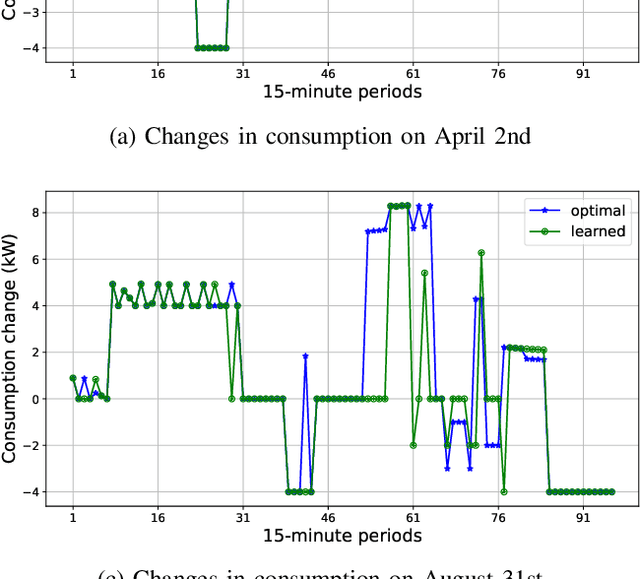
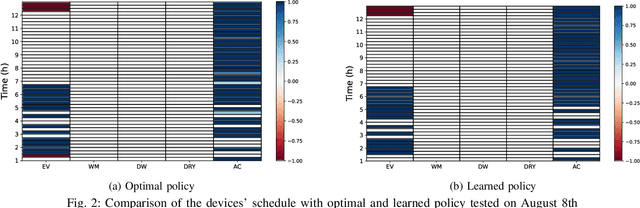
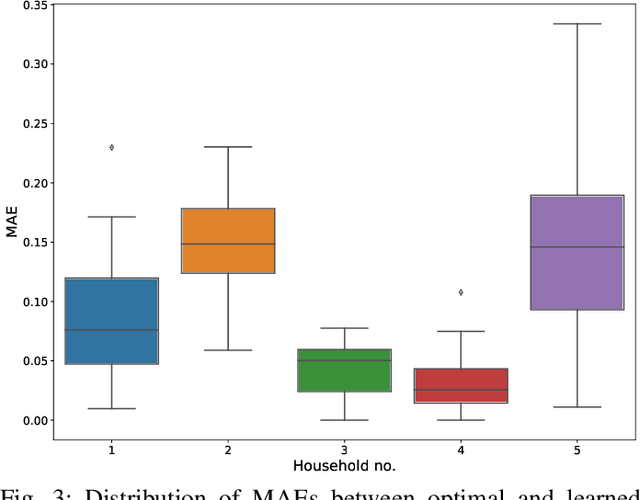
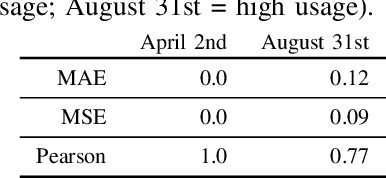
Accelerated development of demand response service provision by the residential sector is crucial for reducing carbon-emissions in the power sector. Along with the infrastructure advancement, encouraging the end users to participate is crucial. End users highly value their privacy and control, and want to be included in the service design and decision-making process when creating the daily appliance operation schedules. Furthermore, unless they are financially or environmentally motivated, they are generally not prepared to sacrifice their comfort to help balance the power system. In this paper, we present an inverse-reinforcement-learning-based model that helps create the end users' daily appliance schedules without asking them to explicitly state their needs and wishes. By using their past consumption data, the end consumers will implicitly participate in the creation of those decisions and will thus be motivated to continue participating in the provision of demand response services.