 Add to Chrome
 Add to Firefox
 Add to Edge
Bypassing the CSI Bottleneck: MARL-Driven Spatial Control for Reflector Arrays
Apr 06, 2026
Reconfigurable Intelligent Surfaces (RIS) are pivotal for next-generation smart radio environments, yet their practical deployment is severely bottlenecked by the intractable computational overhead of Channel State Information (CSI) estimation. To bypass this fundamental physical-layer barrier, we propose an AI-native, data-driven paradigm that replaces complex channel modeling with spatial intelligence. This paper presents a fully autonomous Multi-Agent Reinforcement Learning (MARL) framework to control mechanically adjustable metallic reflector arrays. By mapping high-dimensional mechanical constraints to a reduced-order virtual focal point space, we deploy a Centralized Training with Decentralized Execution (CTDE) architecture. Using Multi-Agent Proximal Policy Optimization (MAPPO), our decentralized agents learn cooperative beam-focusing strategies relying on user coordinates, achieving CSI-free operation. High-fidelity ray-tracing simulations in dynamic non-line-of-sight (NLOS) environments demonstrate that this multi-agent approach rapidly adapts to user mobility, yielding up to a 26.86 dB enhancement over static flat reflectors and outperforming single-agent and hardware-constrained DRL baselines in both spatial selectivity and temporal stability. Crucially, the learned policies exhibit good deployment resilience, sustaining stable signal coverage even under 1.0-meter localization noise. These results validate the efficacy of MARL-driven spatial abstractions as a scalable, highly practical pathway toward AI-empowered wireless networks.

Learning to Focus: CSI-Free Hierarchical MARL for Reconfigurable Reflectors
Apr 06, 2026Reconfigurable Intelligent Surfaces (RIS) has a potential to engineer smart radio environments for next-generation millimeter-wave (mmWave) networks. However, the prohibitive computational overhead of Channel State Information (CSI) estimation and the dimensionality explosion inherent in centralized optimization severely hinder practical large-scale deployments. To overcome these bottlenecks, we introduce a ``CSI-free" paradigm powered by a Hierarchical Multi-Agent Reinforcement Learning (HMARL) architecture to control mechanically reconfigurable reflective surfaces. By substituting pilot-based channel estimation with accessible user localization data, our framework leverages spatial intelligence for macro-scale wave propagation management. The control problem is decomposed into a two-tier neural architecture: a high-level controller executes temporally extended, discrete user-to-reflector allocations, while low-level controllers autonomously optimize continuous focal points utilizing Multi-Agent Proximal Policy Optimization (MAPPO) under a Centralized Training with Decentralized Execution (CTDE) scheme. Comprehensive deterministic ray-tracing evaluations demonstrate that this hierarchical framework achieves massive RSSI improvements of up to 7.79 dB over centralized baselines. Furthermore, the system exhibits robust multi-user scalability and maintains highly resilient beam-focusing performance under practical sub-meter localization tracking errors. By eliminating CSI overhead while maintaining high-fidelity signal redirection, this work establishes a scalable and cost-effective blueprint for intelligent wireless environments.
Signal Whisperers: Enhancing Wireless Reception Using DRL-Guided Reflector Arrays
Jan 25, 2025
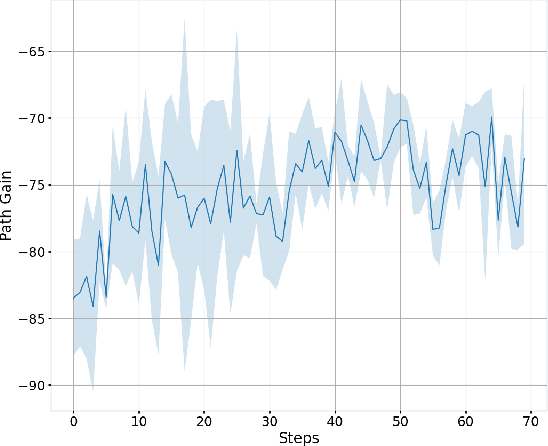
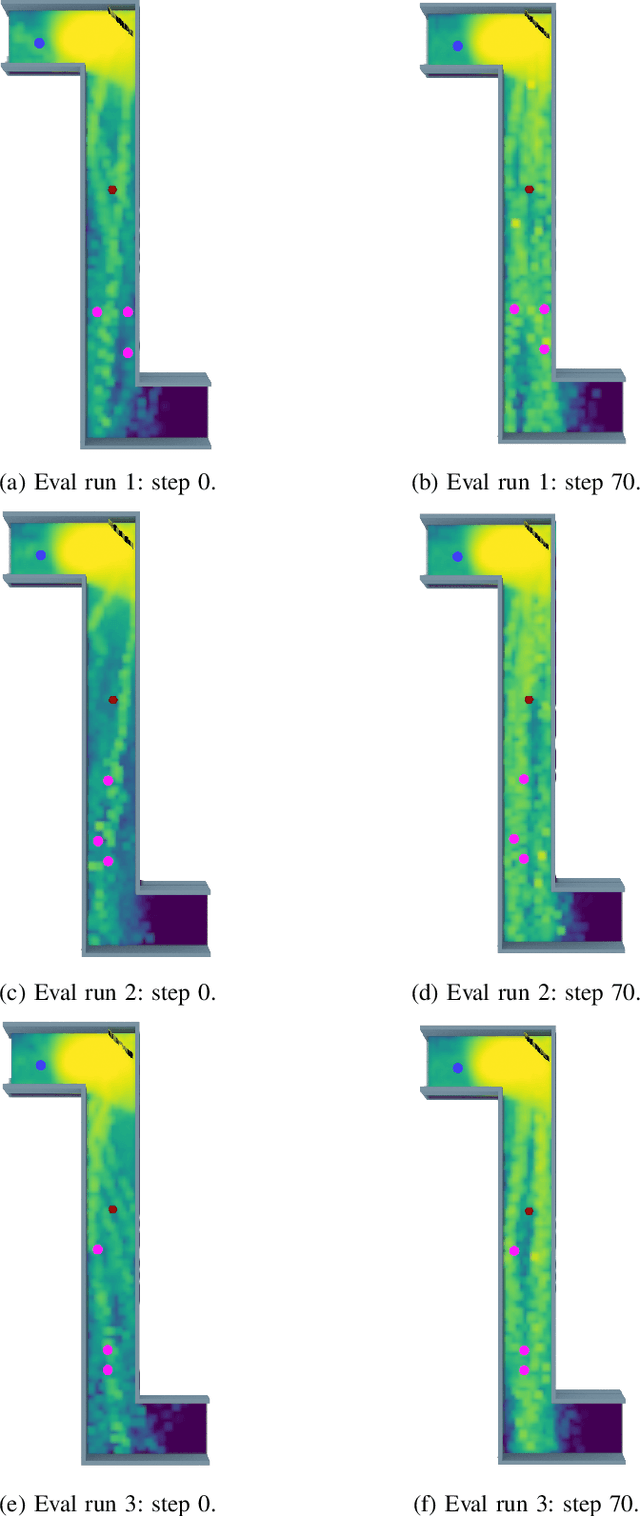

This paper presents a novel approach for enhancing wireless signal reception through self-adjustable metallic surfaces, termed reflectors, which are guided by deep reinforcement learning (DRL). The designed reflector system aims to improve signal quality for multiple users in scenarios where a direct line-of-sight (LOS) from the access point (AP) and reflector to users is not guaranteed. Utilizing DRL techniques, the reflector autonomously modifies its configuration to optimize beam allocation from the AP to user equipment (UE), thereby maximizing path gain. Simulation results indicate substantial improvements in the average path gain for all UEs compared to baseline configurations, highlighting the potential of DRL-driven reflectors in creating adaptive communication environments.
Guiding Wireless Signals with Arrays of Metallic Linear Fresnel Reflectors: A Low-cost, Frequency-versatile, and Practical Approach
Jul 27, 2024This study presents a novel mechanical metallic reflector array to guide wireless signals to the point of interest, thereby enhancing received signal quality. Comprised of numerous individual units, this device, which acts as a linear Fresnel reflector (LFR), facilitates the reflection of incoming signals to a desired location. Leveraging geometric principles, we present a systematic approach for redirecting beams from an Access Point (AP) toward User Equipment (UE) positions. This methodology is geared towards optimizing beam allocation, thereby maximizing the number of beams directed towards the UE. Ray tracing simulations conducted for two 3D wireless communication scenarios demonstrate significant increases in path gains and received signal strengths (RSS) by at least 50dB with strategically positioned devices.