 Add to Chrome
 Add to Firefox
 Add to Edge
Physics Informed Deep Unfolded Full Waveform Inversion for Edema Detection
Mar 04, 2026
Edema is a potential indicator of underlying pathological changes. However, its low-contrast signature is often masked in conventional B-mode imaging by strong scatterers, making reliable detection challenging. Ultrasound (US) provides a non-invasive, non-ionizing, and cost-efficient imaging option that is widely used. Conventional techniques, which rely on beamforming, often lack sufficient physical interpretability. Quantitative US (QUS) can estimate physical properties such as the speed of sound (SoS) and density by solving a physics-based inverse problem directly on the measured US wavefields, i.e., the raw per-element channel data (CD), to recover their spatial distribution. However, state-of-the-art physics-based inversion methods, including full waveform inversion (FWI) and model-based quantitative radar and US (MB-QRUS), are computationally intensive and susceptible to local minima, which constrains their clinical utility. We introduce deep unfolded FWI (DUFWI), a physics-faithful unfolded iterative inversion method that exhibits FWI-like refinement behavior while learning the update rule from data, requiring only a small number of iterations for real-time SoS reconstruction. Across both simulated datasets and hardware measurements acquired with a Verasonics US system, the DUFWI significantly outperforms classical FWI and MB-QRUS in reconstruction quality while maintaining high computational efficiency. These results demonstrate real-time edema diagnosis in both simulation and hardware experiments, with phantom-based validation using cylindrical rods, supporting practical deployment under typical US imaging setting.

Robust Phantom-Assisted Framework for Multi-Person Localization and Vital Signs Monitoring Using MIMO FMCW Radar
Jan 12, 2025With the rising prevalence of cardiovascular and respiratory disorders and an aging global population, healthcare systems face increasing pressure to adopt efficient, non-contact vital sign monitoring (NCVSM) solutions. This study introduces a robust framework for multi-person localization and vital signs monitoring, using multiple-input-multiple-output frequency-modulated continuous wave radar, addressing challenges in real-world, cluttered environments. Two key contributions are presented. First, a custom hardware phantom was developed to simulate multi-person NCVSM scenarios, utilizing recorded thoracic impedance signals to replicate realistic cardiopulmonary dynamics. The phantom's design facilitates repeatable and rapid validation of radar systems and algorithms under diverse conditions to accelerate deployment in human monitoring. Second, aided by the phantom, we designed a robust algorithm for multi-person localization utilizing joint sparsity and cardiopulmonary properties, alongside harmonics-resilient dictionary-based vital signs estimation, to mitigate interfering respiration harmonics. Additionally, an adaptive signal refinement procedure is introduced to enhance the accuracy of continuous NCVSM by leveraging the continuity of the estimates. Performance was validated and compared to existing techniques through 12 phantom trials and 12 human trials, including both single- and multi-person scenarios, demonstrating superior localization and NCVSM performance. For example, in multi-person human trials, our method achieved average respiration rate estimation accuracies of 94.14%, 98.12%, and 98.69% within error thresholds of 2, 3, and 4 breaths per minute, respectively, and heart rate accuracies of 87.10%, 94.12%, and 95.54% within the same thresholds. These results highlight the potential of this framework for reliable multi-person NCVSM in healthcare and IoT applications.
Hardware Implementation of Task-based Quantization in Multi-user Signal Recovery
Jan 27, 2023Quantization plays a critical role in digital signal processing systems, allowing the representation of continuous amplitude signals with a finite number of bits. However, accurately representing signals requires a large number of quantization bits, which causes severe cost, power consumption, and memory burden. A promising way to address this issue is task-based quantization. By exploiting the task information for the overall system design, task-based quantization can achieve satisfying performance with low quantization costs. In this work, we apply task-based quantization to multi-user signal recovery and present a hardware prototype implementation. The prototype consists of a tailored configurable combining board, and a software-based processing and demonstration system. Through experiments, we verify that with proper design, the task-based quantization achieves a reduction of 25 fold in memory by reducing from 16 receivers with 16 bits each to 2 receivers with 5 bits each, without compromising signal recovery performance.
ORCEA: Object Recognition by Continuous Evidence Assimilation
May 11, 2021

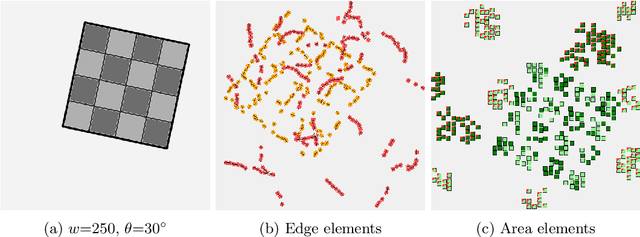

ORCEA is a novel object recognition method applicable for objects describable by a generative model. The primary goal of ORCEA is to maintain a probability density distribution of possible matches over the object parameter space, while continuously updating it with incoming evidence; detection and regression are by-products of this process. ORCEA can project primitive evidence of various types (edge element, area patches etc.) directly on the object parameter space; this made possible by the study phase where ORCEA builds a probabilistic model, for each evidence type, that links evidence and the object-parameters under which they were created. The detection phase consists of building the joint distribution of possible matches resulting from the set of given evidence, including possible grouping to signal/noise; no additional algorithmic steps are needed, as the resulting PDF encapsulates all knowledge about possible solutions. ORCEA represents the match distribution over the parameter space as a set of Gaussian distributions, each representing a concrete probabilistic hypothesis about the object, which can be used outside its scope as well. ORCEA was tested on synthetic images with varying levels of complexity and noise, and shows satisfactory results.