 Add to Chrome
 Add to Firefox
 Add to Edge
Nemotron 3 Nano Omni: Efficient and Open Multimodal Intelligence
Apr 27, 2026
We introduce Nemotron 3 Nano Omni, the latest model in the Nemotron multimodal series and the first to natively support audio inputs alongside text, images, and video. Nemotron 3 Nano Omni delivers consistent accuracy improvements over its predecessor, Nemotron Nano V2 VL, across all modalities, enabled by advances in architecture, training data and recipes. In particular, Nemotron 3 delivers leading results in real-world document understanding, long audio-video comprehension, and agentic computer use. Built on the highly efficient Nemotron 3 Nano 30B-A3B backbone, Nemotron 3 Nano Omni further incorporates innovative multimodal token-reduction techniques to deliver substantially lower inference latency and higher throughput than other models of similar size. We are releasing model checkpoints in BF16, FP8, and FP4 formats, along with portions of the training data and codebase to facilitate further research and development.

Reducing the Offline-Streaming Gap for Unified ASR Transducer with Consistency Regularization
Apr 21, 2026Unification of automatic speech recognition (ASR) systems reduces development and maintenance costs, but training a single model to perform well in both offline and low-latency streaming settings remains challenging. We present a Unified ASR framework for Transducer (RNNT) training that supports both offline and streaming decoding within a single model, using chunk-limited attention with right context and dynamic chunked convolutions. To further close the gap between offline and streaming performance, we introduce an efficient Triton implementation of mode-consistency regularization for RNNT (MCR-RNNT), which encourages agreement across training modes. Experiments show that the proposed approach improves streaming accuracy at low latency while preserving offline performance and scaling to larger model sizes and training datasets. The proposed Unified ASR framework and the English model checkpoint are open-sourced.
Canary-1B-v2 & Parakeet-TDT-0.6B-v3: Efficient and High-Performance Models for Multilingual ASR and AST
Sep 17, 2025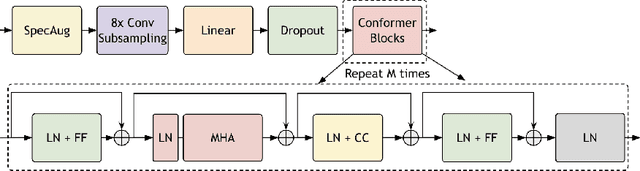
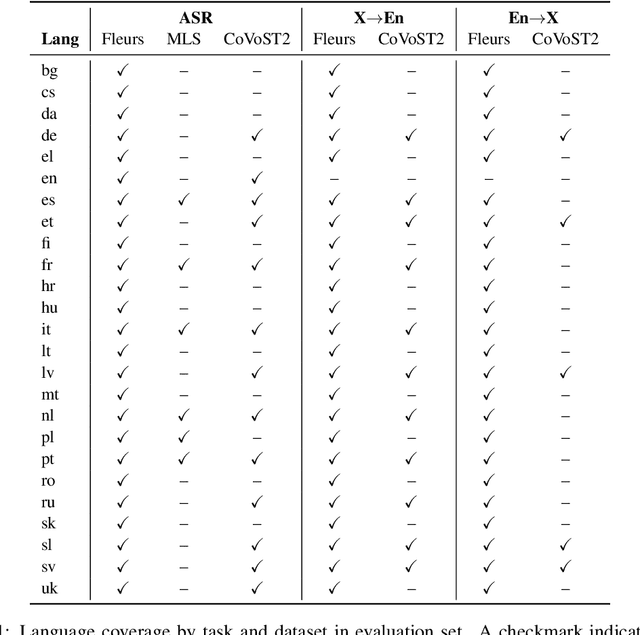
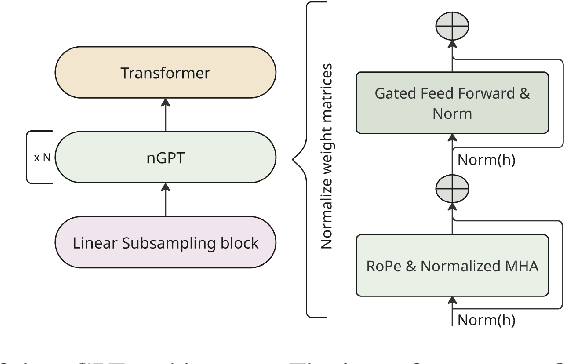

This report introduces Canary-1B-v2, a fast, robust multilingual model for Automatic Speech Recognition (ASR) and Speech-to-Text Translation (AST). Built with a FastConformer encoder and Transformer decoder, it supports 25 languages primarily European. The model was trained on 1.7M hours of total data samples, including Granary and NeMo ASR Set 3.0, with non-speech audio added to reduce hallucinations for ASR and AST. We describe its two-stage pre-training and fine-tuning process with dynamic data balancing, as well as experiments with an nGPT encoder. Results show nGPT scales well with massive data, while FastConformer excels after fine-tuning. For timestamps, Canary-1B-v2 uses the NeMo Forced Aligner (NFA) with an auxiliary CTC model, providing reliable segment-level timestamps for ASR and AST. Evaluations show Canary-1B-v2 outperforms Whisper-large-v3 on English ASR while being 10x faster, and delivers competitive multilingual ASR and AST performance against larger models like Seamless-M4T-v2-large and LLM-based systems. We also release Parakeet-TDT-0.6B-v3, a successor to v2, offering multilingual ASR across the same 25 languages with just 600M parameters.
Unified Semi-Supervised Pipeline for Automatic Speech Recognition
Jun 09, 2025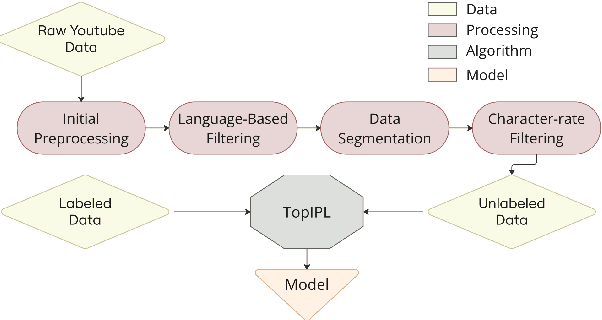
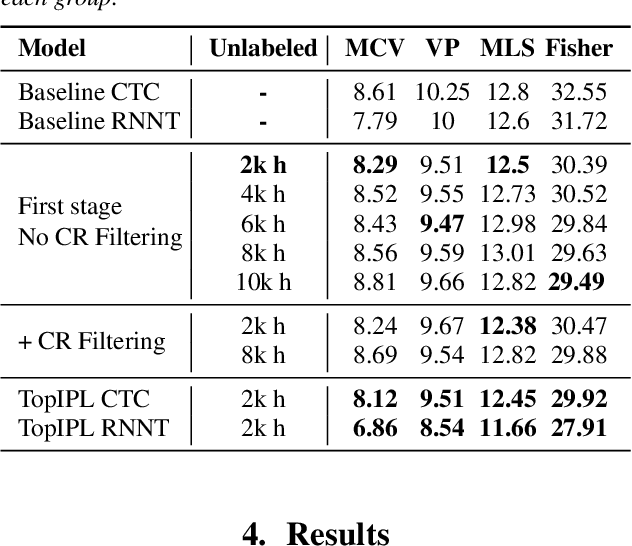
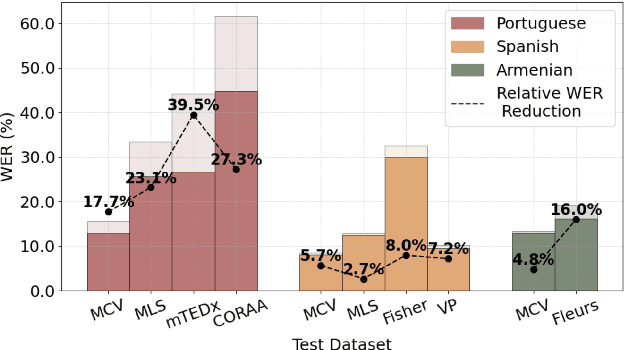
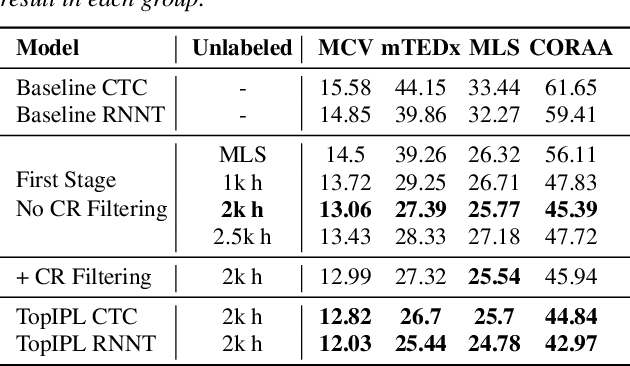
Automatic Speech Recognition has been a longstanding research area, with substantial efforts dedicated to integrating semi-supervised learning due to the scarcity of labeled datasets. However, most prior work has focused on improving learning algorithms using existing datasets, without providing a complete public framework for large-scale semi-supervised training across new datasets or languages. In this work, we introduce a fully open-source semi-supervised training framework encompassing the entire pipeline: from unlabeled data collection to pseudo-labeling and model training. Our approach enables scalable dataset creation for any language using publicly available speech data under Creative Commons licenses. We also propose a novel pseudo-labeling algorithm, TopIPL, and evaluate it in both low-resource (Portuguese, Armenian) and high-resource (Spanish) settings. Notably, TopIPL achieves relative WER improvements of 18-40% for Portuguese, 5-16% for Armenian, and 2-8% for Spanish.