 Add to Chrome
 Add to Firefox
 Add to Edge
In-Field 3D Wheat Head Instance Segmentation From TLS Point Clouds Using Deep Learning Without Manual Labels
Mar 15, 2026
3D instance segmentation for laser scanning (LiDAR) point clouds remains a challenge in many remote sensing-related domains. Successful solutions typically rely on supervised deep learning and manual annotations, and consequently focus on objects that can be well delineated through visual inspection and manual labeling of point clouds. However, for tasks with more complex and cluttered scenes, such as in-field plant phenotyping in agriculture, such approaches are often infeasible. In this study, we tackle the task of in-field wheat head instance segmentation directly from terrestrial laser scanning (TLS) point clouds. To address the problem and circumvent the need for manual annotations, we propose a novel two-stage pipeline. To obtain the initial 3D instance proposals, the first stage uses 3D-to-2D multi-view projections, the Grounded SAM pipeline for zero-shot 2D object-centric segmentation, and multi-view label fusion. The second stage uses these initial proposals as noisy pseudo-labels to train a supervised 3D panoptic-style segmentation neural network. Our results demonstrate the feasibility of the proposed approach and show performance improvementsrelative to Wheat3DGS, a recent alternative solution for in-field wheat head instance segmentation without manual 3D annotations based on multi-view RGB images and 3D Gaussian Splatting, showcasing TLS as a competitive sensing alternative. Moreover, the results show that both stages of the proposed pipeline can deliver usable 3D instance segmentation without manual annotations, indicating promising, low-effort transferability to other comparable TLS-based point cloud segmentation tasks.

Wheat3DGS: In-field 3D Reconstruction, Instance Segmentation and Phenotyping of Wheat Heads with Gaussian Splatting
Apr 09, 2025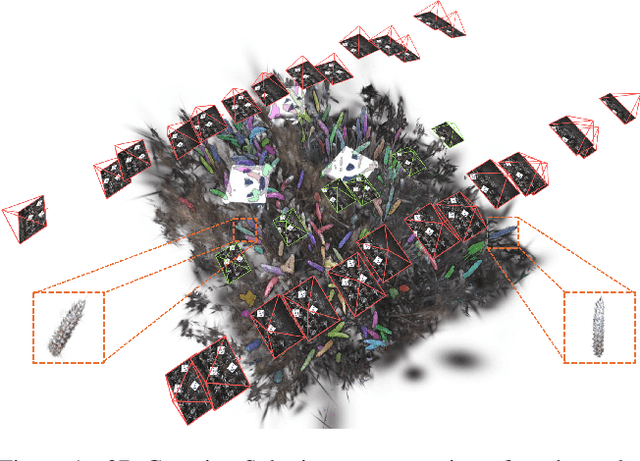
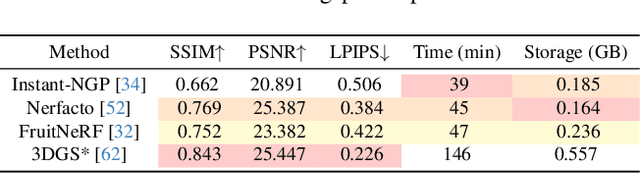
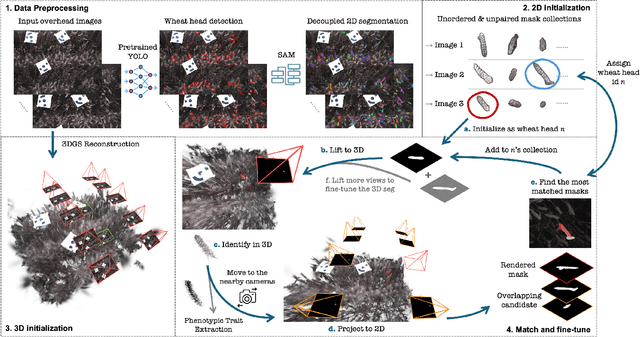

Automated extraction of plant morphological traits is crucial for supporting crop breeding and agricultural management through high-throughput field phenotyping (HTFP). Solutions based on multi-view RGB images are attractive due to their scalability and affordability, enabling volumetric measurements that 2D approaches cannot directly capture. While advanced methods like Neural Radiance Fields (NeRFs) have shown promise, their application has been limited to counting or extracting traits from only a few plants or organs. Furthermore, accurately measuring complex structures like individual wheat heads-essential for studying crop yields-remains particularly challenging due to occlusions and the dense arrangement of crop canopies in field conditions. The recent development of 3D Gaussian Splatting (3DGS) offers a promising alternative for HTFP due to its high-quality reconstructions and explicit point-based representation. In this paper, we present Wheat3DGS, a novel approach that leverages 3DGS and the Segment Anything Model (SAM) for precise 3D instance segmentation and morphological measurement of hundreds of wheat heads automatically, representing the first application of 3DGS to HTFP. We validate the accuracy of wheat head extraction against high-resolution laser scan data, obtaining per-instance mean absolute percentage errors of 15.1%, 18.3%, and 40.2% for length, width, and volume. We provide additional comparisons to NeRF-based approaches and traditional Muti-View Stereo (MVS), demonstrating superior results. Our approach enables rapid, non-destructive measurements of key yield-related traits at scale, with significant implications for accelerating crop breeding and improving our understanding of wheat development.