 Add to Chrome
 Add to Firefox
 Add to Edge
Limits of Learning Linear Dynamics from Experiments
May 12, 2026
Learning governing dynamics from data is a common goal across the sciences, yet it is only well-posed when the underlying mechanisms are identifiable. In practice, many data-driven methods implicitly assume identifiability; when this assumption fails, estimated models can yield spurious predictions and invalid mechanistic conclusions. Classical identifiability guarantees for controlled linear time-invariant (LTI) systems provide sufficient conditions -- controllability and persistent excitation -- but leave open whether identifiability holds when these conditions fail, and which parts of the system remain identifiable without full identifiability. We show that the experimental setup, i.e., the realized initial state and control input, dictates a fundamental limit on the information recoverable from the observed trajectory. We develop a geometric characterization of this limit and derive a closed-form description of all systems consistent with the experimental setup. Crucially, we prove that even when the full system is not identifiable, the restricted dynamics on the subspace reachable by the experiment remain uniquely determined.

Conservative Continuous-Time Treatment Optimization
Mar 17, 2026We develop a conservative continuous-time stochastic control framework for treatment optimization from irregularly sampled patient trajectories. The unknown patient dynamics are modeled as a controlled stochastic differential equation with treatment as a continuous-time control. Naive model-based optimization can exploit model errors and propose out-of-support controls, so optimizing the estimated dynamics may not optimize the true dynamics. To limit extrapolation, we add a consistent signature-based MMD regularizer on path space that penalizes treatment plans whose induced trajectory distribution deviates from observed trajectories. The resulting objective minimizes a computable upper bound on the true cost. Experiments on benchmark datasets show improved robustness and performance compared to non-conservative baselines.
Generative Intervention Models for Causal Perturbation Modeling
Nov 21, 2024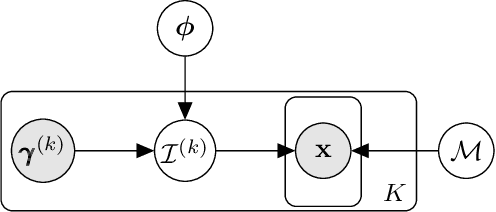
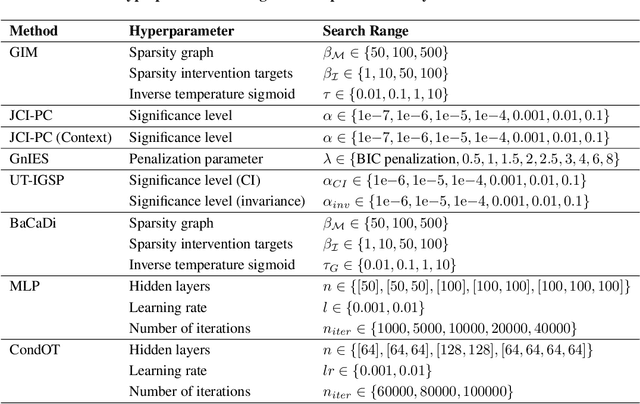

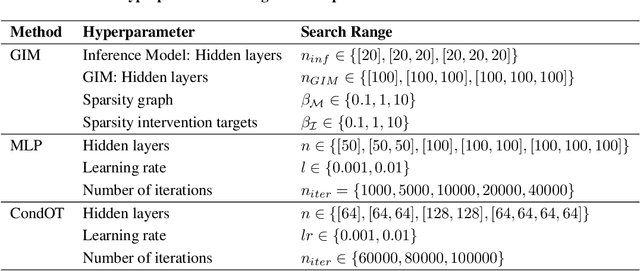
We consider the problem of predicting perturbation effects via causal models. In many applications, it is a priori unknown which mechanisms of a system are modified by an external perturbation, even though the features of the perturbation are available. For example, in genomics, some properties of a drug may be known, but not their causal effects on the regulatory pathways of cells. We propose a generative intervention model (GIM) that learns to map these perturbation features to distributions over atomic interventions in a jointly-estimated causal model. Contrary to prior approaches, this enables us to predict the distribution shifts of unseen perturbation features while gaining insights about their mechanistic effects in the underlying data-generating process. On synthetic data and scRNA-seq drug perturbation data, GIMs achieve robust out-of-distribution predictions on par with unstructured approaches, while effectively inferring the underlying perturbation mechanisms, often better than other causal inference methods.
Anchor Data Augmentation
Nov 27, 2023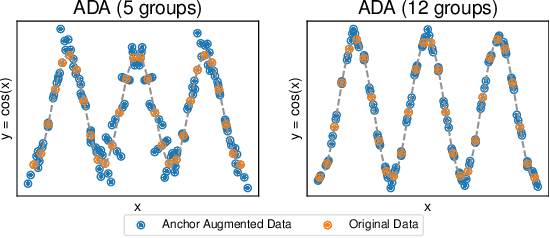

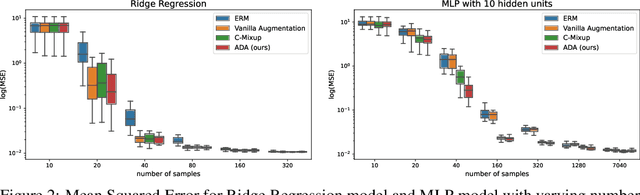
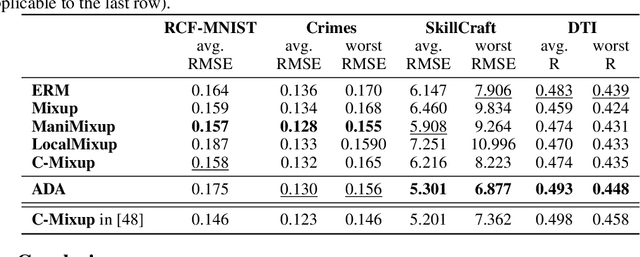
We propose a novel algorithm for data augmentation in nonlinear over-parametrized regression. Our data augmentation algorithm borrows from the literature on causality and extends the recently proposed Anchor regression (AR) method for data augmentation, which is in contrast to the current state-of-the-art domain-agnostic solutions that rely on the Mixup literature. Our Anchor Data Augmentation (ADA) uses several replicas of the modified samples in AR to provide more training examples, leading to more robust regression predictions. We apply ADA to linear and nonlinear regression problems using neural networks. ADA is competitive with state-of-the-art C-Mixup solutions.