 Add to Chrome
 Add to Firefox
 Add to Edge
Conservative Continuous-Time Treatment Optimization
Mar 17, 2026
We develop a conservative continuous-time stochastic control framework for treatment optimization from irregularly sampled patient trajectories. The unknown patient dynamics are modeled as a controlled stochastic differential equation with treatment as a continuous-time control. Naive model-based optimization can exploit model errors and propose out-of-support controls, so optimizing the estimated dynamics may not optimize the true dynamics. To limit extrapolation, we add a consistent signature-based MMD regularizer on path space that penalizes treatment plans whose induced trajectory distribution deviates from observed trajectories. The resulting objective minimizes a computable upper bound on the true cost. Experiments on benchmark datasets show improved robustness and performance compared to non-conservative baselines.

An Asymmetric Independence Model for Causal Discovery on Path Spaces
Mar 12, 2025We develop the theory linking 'E-separation' in directed mixed graphs (DMGs) with conditional independence relations among coordinate processes in stochastic differential equations (SDEs), where causal relationships are determined by "which variables enter the governing equation of which other variables". We prove a global Markov property for cyclic SDEs, which naturally extends to partially observed cyclic SDEs, because our asymmetric independence model is closed under marginalization. We then characterize the class of graphs that encode the same set of independence relations, yielding a result analogous to the seminal 'same skeleton and v-structures' result for directed acyclic graphs (DAGs). In the fully observed case, we show that each such equivalence class of graphs has a greatest element as a parsimonious representation and develop algorithms to identify this greatest element from data. We conjecture that a greatest element also exists under partial observations, which we verify computationally for graphs with up to four nodes.
Signature Kernel Conditional Independence Tests in Causal Discovery for Stochastic Processes
Feb 28, 2024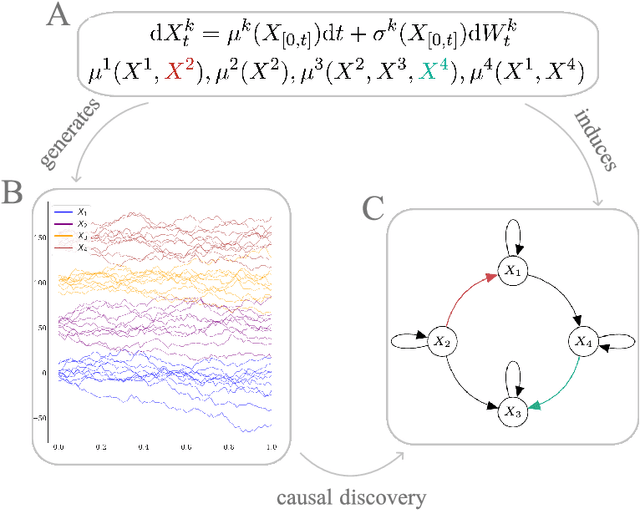

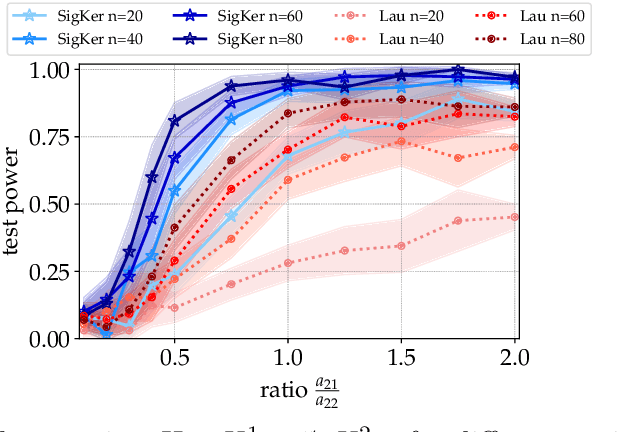
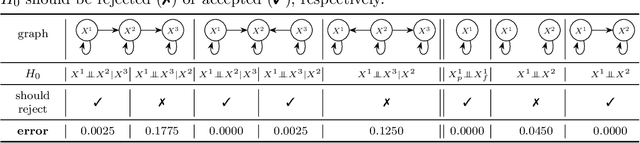
Inferring the causal structure underlying stochastic dynamical systems from observational data holds great promise in domains ranging from science and health to finance. Such processes can often be accurately modeled via stochastic differential equations (SDEs), which naturally imply causal relationships via "which variables enter the differential of which other variables". In this paper, we develop a kernel-based test of conditional independence (CI) on "path-space" -- solutions to SDEs -- by leveraging recent advances in signature kernels. We demonstrate strictly superior performance of our proposed CI test compared to existing approaches on path-space. Then, we develop constraint-based causal discovery algorithms for acyclic stochastic dynamical systems (allowing for loops) that leverage temporal information to recover the entire directed graph. Assuming faithfulness and a CI oracle, our algorithm is sound and complete. We empirically verify that our developed CI test in conjunction with the causal discovery algorithm reliably outperforms baselines across a range of settings.