 Add to Chrome
 Add to Firefox
 Add to Edge
A Context Engineering Framework for Improving Enterprise AI Agents based on Digital-Twin MDP
Mar 23, 2026
Despite rapid progress in AI agents for enterprise automation and decision-making, their real-world deployment and further performance gains remain constrained by limited data quality and quantity, complex real-world reasoning demands, difficulties with self-play, and the lack of reliable feedback signals. To address these challenges, we propose a lightweight, model-agnostic framework for improving LLM-based enterprise agents via offline reinforcement learning (RL). The proposed Context Engineering via DT-MDP (DT-MDP-CE) framework comprises three key components: (1) A Digital-Twin Markov Decision Process (DT-MDP), which abstracts the agent's reasoning behavior as a finite MDP; (2) A robust contrastive inverse RL, which, armed with the DT-MDP, to efficiently estimate a well-founded reward function and induces policies from mixed-quality offline trajectories; and (3) RL-guided context engineering, which uses the policy obtained from the integrated process of (1) and (2), to improve the agent's decision-making behavior. As a case study, we apply the framework to a representative task in the enterprise-oriented domain of IT automation. Extensive experimental results demonstrate consistent and significant improvements over baseline agents across a wide range of evaluation settings, suggesting that the framework can generalize to other agents sharing similar characteristics in enterprise environments.

Think Locally, Explain Globally: Graph-Guided LLM Investigations via Local Reasoning and Belief Propagation
Jan 25, 2026LLM agents excel when environments are mostly static and the needed information fits in a model's context window, but they often fail in open-ended investigations where explanations must be constructed by iteratively mining evidence from massive, heterogeneous operational data. These investigations exhibit hidden dependency structure: entities interact, signals co-vary, and the importance of a fact may only become clear after other evidence is discovered. Because the context window is bounded, agents must summarize intermediate findings before their significance is known, increasing the risk of discarding key evidence. ReAct-style agents are especially brittle in this regime. Their retrieve-summarize-reason loop makes conclusions sensitive to exploration order and introduces run-to-run non-determinism, producing a reliability gap where Pass-at-k may be high but Majority-at-k remains low. Simply sampling more rollouts or generating longer reasoning traces does not reliably stabilize results, since hypotheses cannot be autonomously checked as new evidence arrives and there is no explicit mechanism for belief bookkeeping and revision. In addition, ReAct entangles semantic reasoning with controller duties such as tool orchestration and state tracking, so execution errors and plan drift degrade reasoning while consuming scarce context. We address these issues by formulating investigation as abductive reasoning over a dependency graph and proposing EoG (Explanations over Graphs), a disaggregated framework in which an LLM performs bounded local evidence mining and labeling (cause vs symptom) while a deterministic controller manages traversal, state, and belief propagation to compute a minimal explanatory frontier. On a representative ITBench diagnostics task, EoG improves both accuracy and run-to-run consistency over ReAct baselines, including a 7x average gain in Majority-at-k entity F1.
ITBench: Evaluating AI Agents across Diverse Real-World IT Automation Tasks
Feb 07, 2025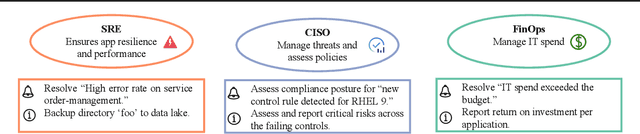

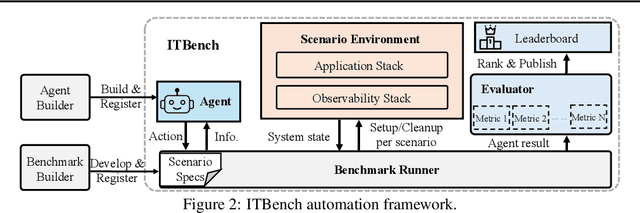
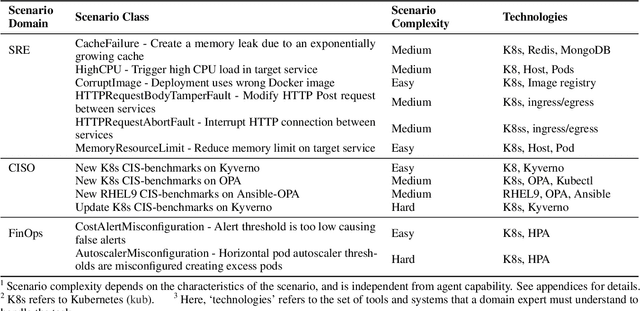
Realizing the vision of using AI agents to automate critical IT tasks depends on the ability to measure and understand effectiveness of proposed solutions. We introduce ITBench, a framework that offers a systematic methodology for benchmarking AI agents to address real-world IT automation tasks. Our initial release targets three key areas: Site Reliability Engineering (SRE), Compliance and Security Operations (CISO), and Financial Operations (FinOps). The design enables AI researchers to understand the challenges and opportunities of AI agents for IT automation with push-button workflows and interpretable metrics. ITBench includes an initial set of 94 real-world scenarios, which can be easily extended by community contributions. Our results show that agents powered by state-of-the-art models resolve only 13.8% of SRE scenarios, 25.2% of CISO scenarios, and 0% of FinOps scenarios. We expect ITBench to be a key enabler of AI-driven IT automation that is correct, safe, and fast.