 Add to Chrome
 Add to Firefox
 Add to Edge
From Blobs to Spokes: High-Fidelity Surface Reconstruction via Oriented Gaussians
Apr 08, 2026
3D Gaussian Splatting (3DGS) has revolutionized fast novel view synthesis, yet its opacity-based formulation makes surface extraction fundamentally difficult. Unlike implicit methods built on Signed Distance Fields or occupancy, 3DGS lacks a global geometric field, forcing existing approaches to resort to heuristics such as TSDF fusion of blended depth maps. Inspired by the Objects as Volumes framework, we derive a principled occupancy field for Gaussian Splatting and show how it can be used to extract highly accurate watertight meshes of complex scenes. Our key contribution is to introduce a learnable oriented normal at each Gaussian element and to define an adapted attenuation formulation, which leads to closed-form expressions for both the normal and occupancy fields at arbitrary locations in space. We further introduce a novel consistency loss and a dedicated densification strategy to enforce Gaussians to wrap the entire surface by closing geometric holes, ensuring a complete shell of oriented primitives. We modify the differentiable rasterizer to output depth as an isosurface of our continuous model, and introduce Primal Adaptive Meshing for Region-of-Interest meshing at arbitrary resolution. We additionally expose fundamental biases in standard surface evaluation protocols and propose two more rigorous alternatives. Overall, our method Gaussian Wrapping sets a new state-of-the-art on DTU and Tanks and Temples, producing complete, watertight meshes at a fraction of the size of concurrent work-recovering thin structures such as the notoriously elusive bicycle spokes.

ShapeShifter: 3D Variations Using Multiscale and Sparse Point-Voxel Diffusion
Feb 04, 2025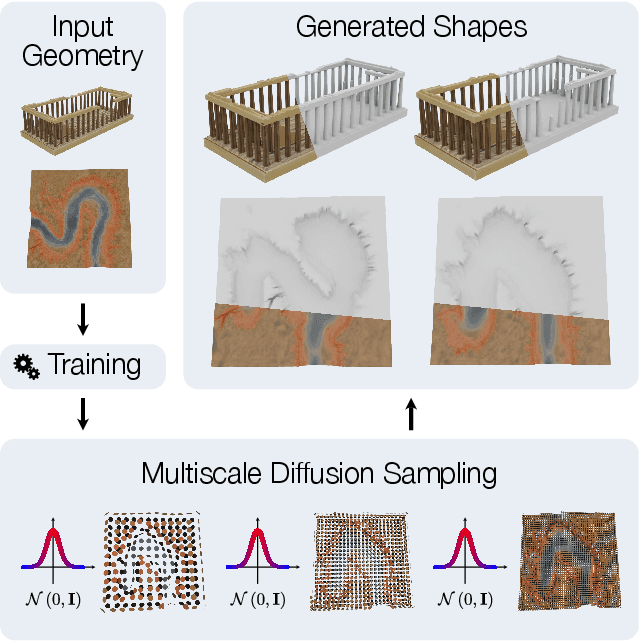
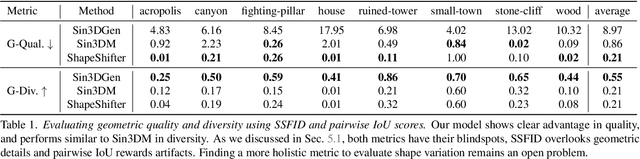
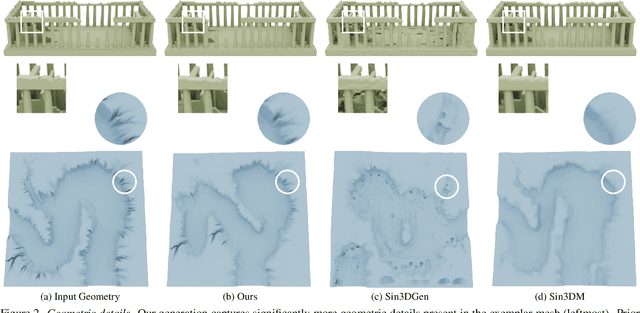
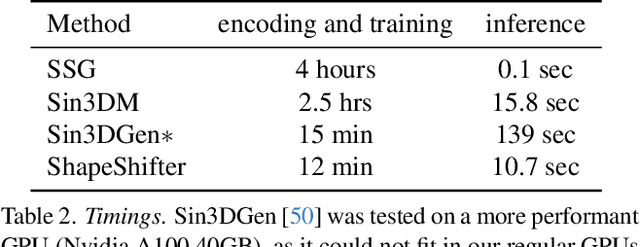
This paper proposes ShapeShifter, a new 3D generative model that learns to synthesize shape variations based on a single reference model. While generative methods for 3D objects have recently attracted much attention, current techniques often lack geometric details and/or require long training times and large resources. Our approach remedies these issues by combining sparse voxel grids and point, normal, and color sampling within a multiscale neural architecture that can be trained efficiently and in parallel. We show that our resulting variations better capture the fine details of their original input and can handle more general types of surfaces than previous SDF-based methods. Moreover, we offer interactive generation of 3D shape variants, allowing more human control in the design loop if needed.
PoNQ: a Neural QEM-based Mesh Representation
Mar 19, 2024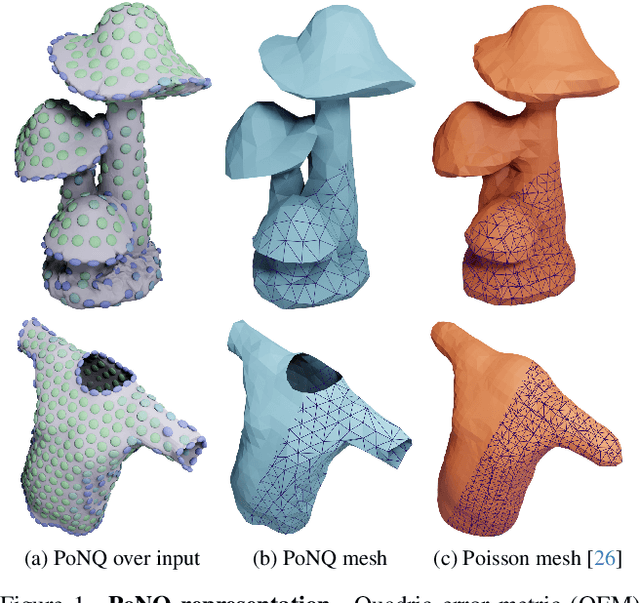
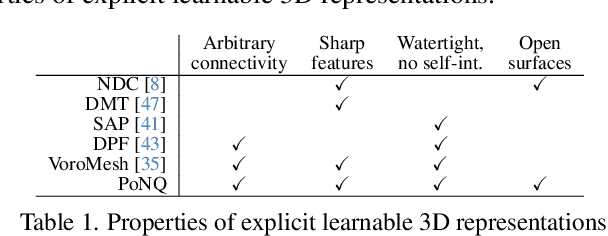
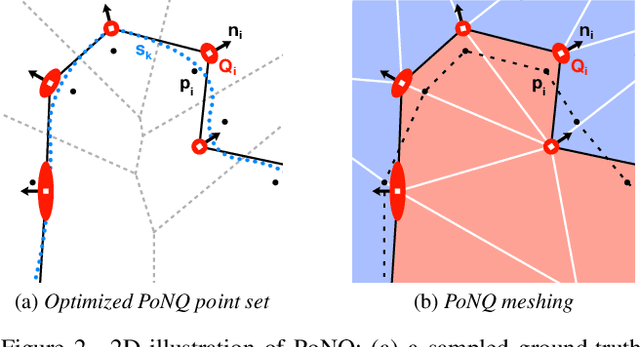
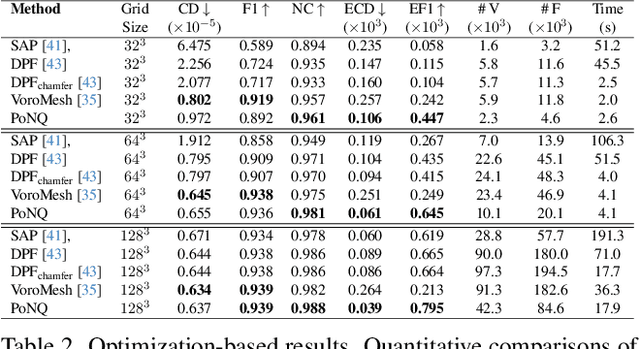
Although polygon meshes have been a standard representation in geometry processing, their irregular and combinatorial nature hinders their suitability for learning-based applications. In this work, we introduce a novel learnable mesh representation through a set of local 3D sample Points and their associated Normals and Quadric error metrics (QEM) w.r.t. the underlying shape, which we denote PoNQ. A global mesh is directly derived from PoNQ by efficiently leveraging the knowledge of the local quadric errors. Besides marking the first use of QEM within a neural shape representation, our contribution guarantees both topological and geometrical properties by ensuring that a PoNQ mesh does not self-intersect and is always the boundary of a volume. Notably, our representation does not rely on a regular grid, is supervised directly by the target surface alone, and also handles open surfaces with boundaries and/or sharp features. We demonstrate the efficacy of PoNQ through a learning-based mesh prediction from SDF grids and show that our method surpasses recent state-of-the-art techniques in terms of both surface and edge-based metrics.
VoroMesh: Learning Watertight Surface Meshes with Voronoi Diagrams
Aug 28, 2023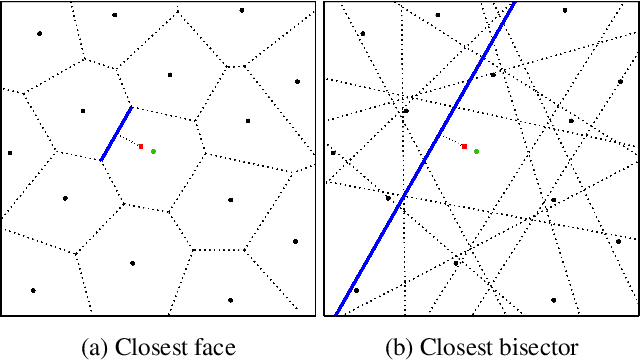
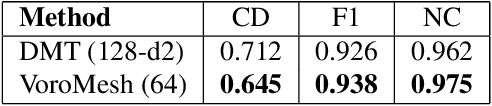
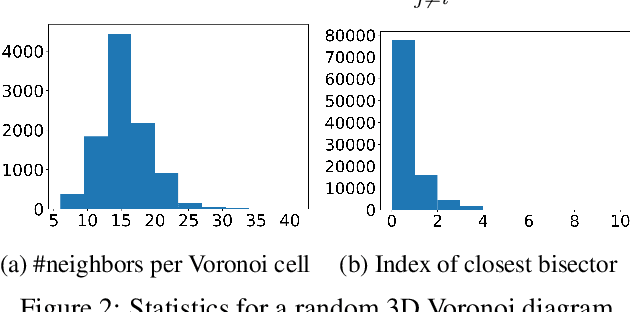
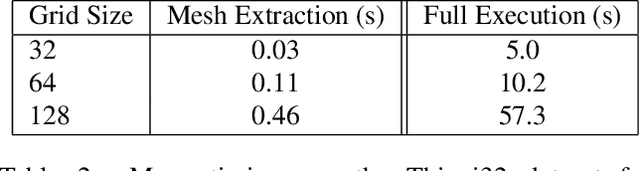
In stark contrast to the case of images, finding a concise, learnable discrete representation of 3D surfaces remains a challenge. In particular, while polygon meshes are arguably the most common surface representation used in geometry processing, their irregular and combinatorial structure often make them unsuitable for learning-based applications. In this work, we present VoroMesh, a novel and differentiable Voronoi-based representation of watertight 3D shape surfaces. From a set of 3D points (called generators) and their associated occupancy, we define our boundary representation through the Voronoi diagram of the generators as the subset of Voronoi faces whose two associated (equidistant) generators are of opposite occupancy: the resulting polygon mesh forms a watertight approximation of the target shape's boundary. To learn the position of the generators, we propose a novel loss function, dubbed VoroLoss, that minimizes the distance from ground truth surface samples to the closest faces of the Voronoi diagram which does not require an explicit construction of the entire Voronoi diagram. A direct optimization of the Voroloss to obtain generators on the Thingi32 dataset demonstrates the geometric efficiency of our representation compared to axiomatic meshing algorithms and recent learning-based mesh representations. We further use VoroMesh in a learning-based mesh prediction task from input SDF grids on the ABC dataset, and show comparable performance to state-of-the-art methods while guaranteeing closed output surfaces free of self-intersections.