 Add to Chrome
 Add to Firefox
 Add to Edge
B-MoE: A Body-Part-Aware Mixture-of-Experts "All Parts Matter" Approach to Micro-Action Recognition
Mar 25, 2026
Micro-actions, fleeting and low-amplitude motions, such as glances, nods, or minor posture shifts, carry rich social meaning but remain difficult for current action recognition models to recognize due to their subtlety, short duration, and high inter-class ambiguity. In this paper, we introduce B-MoE, a Body-part-aware Mixture-of-Experts framework designed to explicitly model the structured nature of human motion. In B-MoE, each expert specializes in a distinct body region (head, body, upper limbs, lower limbs), and is based on the lightweight Macro-Micro Motion Encoder (M3E) that captures long-range contextual structure and fine-grained local motion. A cross-attention routing mechanism learns inter-region relationships and dynamically selects the most informative regions for each micro-action. B-MoE uses a dual-stream encoder that fuses these region-specific semantic cues with global motion features to jointly capture spatially localized cues and temporally subtle variations that characterize micro-actions. Experiments on three challenging benchmarks (MA-52, SocialGesture, and MPII-GroupInteraction) show consistent state-of-theart gains, with improvements in ambiguous, underrepresented, and low amplitude classes.

Self-supervised Auxiliary Learning for Texture and Model-based Hybrid Robust and Fair Featuring in Face Analysis
Sep 29, 2024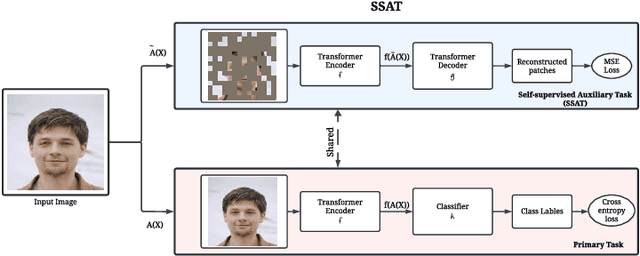


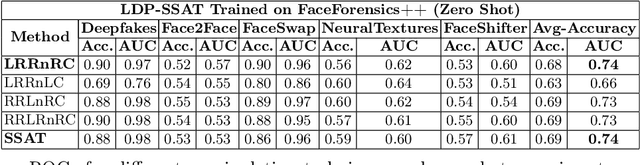
In this work, we explore Self-supervised Learning (SSL) as an auxiliary task to blend the texture-based local descriptors into feature modelling for efficient face analysis. Combining a primary task and a self-supervised auxiliary task is beneficial for robust representation. Therefore, we used the SSL task of mask auto-encoder (MAE) as an auxiliary task to reconstruct texture features such as local patterns along with the primary task for robust and unbiased face analysis. We experimented with our hypothesis on three major paradigms of face analysis: face attribute and face-based emotion analysis, and deepfake detection. Our experiment results exhibit that better feature representation can be gleaned from our proposed model for fair and bias-less face analysis.