 Add to Chrome
 Add to Firefox
 Add to Edge
Governance by Construction for Generalist Agents
May 20, 2026
Enterprise agents are increasingly expected to operate autonomously across tools and interfaces, yet production deployments require governance by construction. Systems must specify which actions are allowed, when human oversight is required, and what information may be exposed, without rebuilding the agent for each domain. This demo presents CUGA's policy system, a modular policy-as-code layer that composes with a generalist LLM agent to deliver predictable, auditable, and compliance-aware behavior in compound workflows without model fine-tuning. We present a runtime governance architecture that enforces policy interventions at every critical stage of execution. Rather than passively constraining behavior, policies intercept the agent at five structural checkpoints: upstream of planning (Intent Guard), within the system prompt to steer reasoning (Playbook), at the tool-call boundary to enforce proper usage (Tool Guide), outside the reasoning loop as a Human-in-the-Loop gate for high-risk actions (Tool Approvals), and at the output stage to filter and structure the final response (Output Formatter). Together, these stages embed governance continuously across the agent's execution pipeline rather than treating it as an afterthought. Using a healthcare scenario and a multi-layered enforcement intervention, the demo shows dynamic playbook injection for structured tool-sequence enforcement, intent guards that block malicious or accidental harmful requests, and human-in-the-loop tool approval checkpoints for potentially destructive actions. The artifact illustrates how typed governance primitives enable faster, safer deployment of enterprise agentic systems while improving policy adherence and execution consistency.

TabAgent: A Framework for Replacing Agentic Generative Components with Tabular-Textual Classifiers
Feb 18, 2026Agentic systems, AI architectures that autonomously execute multi-step workflows to achieve complex goals, are often built using repeated large language model (LLM) calls for closed-set decision tasks such as routing, shortlisting, gating, and verification. While convenient, this design makes deployments slow and expensive due to cumulative latency and token usage. We propose TabAgent, a framework for replacing generative decision components in closed-set selection tasks with a compact textual-tabular classifier trained on execution traces. TabAgent (i) extracts structured schema, state, and dependency features from trajectories (TabSchema), (ii) augments coverage with schema-aligned synthetic supervision (TabSynth), and (iii) scores candidates with a lightweight classifier (TabHead). On the long-horizon AppWorld benchmark, TabAgent maintains task-level success while eliminating shortlist-time LLM calls, reducing latency by approximately 95% and inference cost by 85-91%. Beyond tool shortlisting, TabAgent generalizes to other agentic decision heads, establishing a paradigm for learned discriminative replacements of generative bottlenecks in production agent architectures.
Textual Planning with Explicit Latent Transitions
Feb 04, 2026Planning with LLMs is bottlenecked by token-by-token generation and repeated full forward passes, making multi-step lookahead and rollout-based search expensive in latency and compute. We propose EmbedPlan, which replaces autoregressive next-state generation with a lightweight transition model operating in a frozen language embedding space. EmbedPlan encodes natural language state and action descriptions into vectors, predicts the next-state embedding, and retrieves the next state by nearest-neighbor similarity, enabling fast planning computation without fine-tuning the encoder. We evaluate next-state prediction across nine classical planning domains using six evaluation protocols of increasing difficulty: interpolation, plan-variant, extrapolation, multi-domain, cross-domain, and leave-one-out. Results show near-perfect interpolation performance but a sharp degradation when generalization requires transfer to unseen problems or unseen domains; plan-variant evaluation indicates generalization to alternative plans rather than memorizing seen trajectories. Overall, frozen embeddings support within-domain dynamics learning after observing a domain's transitions, while transfer across domain boundaries remains a bottleneck.
SNAP: Semantic Stories for Next Activity Prediction
Jan 28, 2024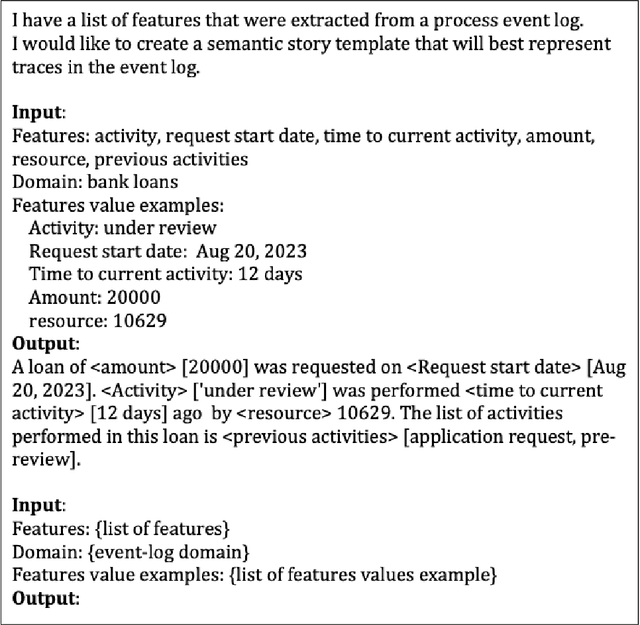
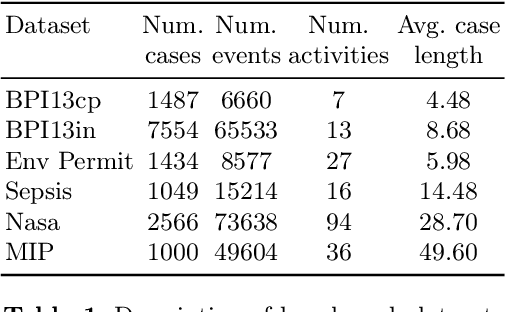
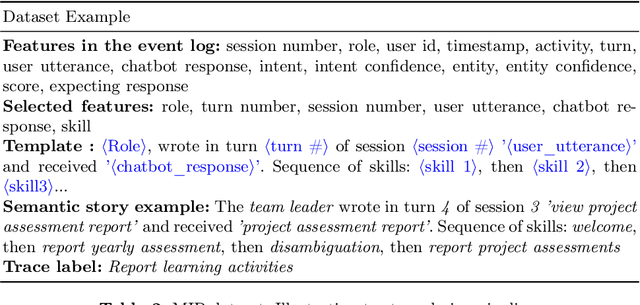
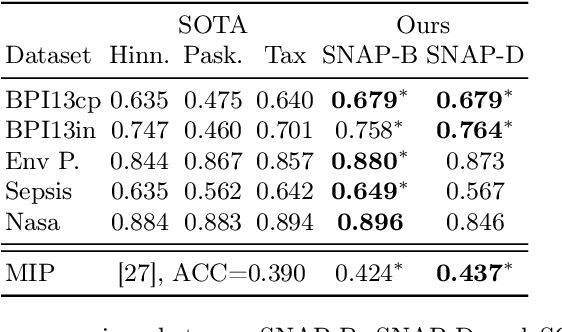
Predicting the next activity in an ongoing process is one of the most common classification tasks in the business process management (BPM) domain. It allows businesses to optimize resource allocation, enhance operational efficiency, and aids in risk mitigation and strategic decision-making. This provides a competitive edge in the rapidly evolving confluence of BPM and AI. Existing state-of-the-art AI models for business process prediction do not fully capitalize on available semantic information within process event logs. As current advanced AI-BPM systems provide semantically-richer textual data, the need for novel adequate models grows. To address this gap, we propose the novel SNAP method that leverages language foundation models by constructing semantic contextual stories from the process historical event logs and using them for the next activity prediction. We compared the SNAP algorithm with nine state-of-the-art models on six benchmark datasets and show that SNAP significantly outperforms them, especially for datasets with high levels of semantic content.