 Add to Chrome
 Add to Firefox
 Add to Edge
Agent-Driven Autonomous Reinforcement Learning Research: Iterative Policy Improvement for Quadruped Locomotion
Mar 28, 2026
This paper documents a case study in agent-driven autonomous reinforcement learning research for quadruped locomotion. The setting was not a fully self-starting research system. A human provided high-level directives through an agentic coding environment, while an agent carried out most of the execution loop: reading code, diagnosing failures, editing reward and terrain configurations, launching and monitoring jobs, analyzing intermediate metrics, and proposing the next wave of experiments. Across more than 70 experiments organized into fourteen waves on a DHAV1 12-DoF quadruped in Isaac Lab, the agent progressed from early rough-terrain runs with mean reward around 7 to a best logged Wave 12 run, exp063, with velocity error 0.263 and 97\% timeout over 2000 iterations, independently reproduced five times across different GPUs. The archive also records several concrete autonomous research decisions: isolating PhysX deadlocks to terrain sets containing boxes and stair-like primitives, porting four reward terms from openly available reference implementations \cite{deeprobotics, rlsar}, correcting Isaac Sim import and bootstrapping issues, reducing environment count for diagnosis, terminating hung runs, and pivoting effort away from HIM after repeated terrain=0.0 outcomes. Relative to the AutoResearch paradigm \cite{autoresearch}, this case study operates in a more failure-prone robotics RL setting with multi-GPU experiment management and simulator-specific engineering constraints. The contribution is empirical and documentary: it shows that an agent can materially execute the iterative RL research loop in this domain with limited human intervention, while also making clear where human direction still shaped the agenda.

Compliant Control of Quadruped Robots for Assistive Load Carrying
Mar 13, 2025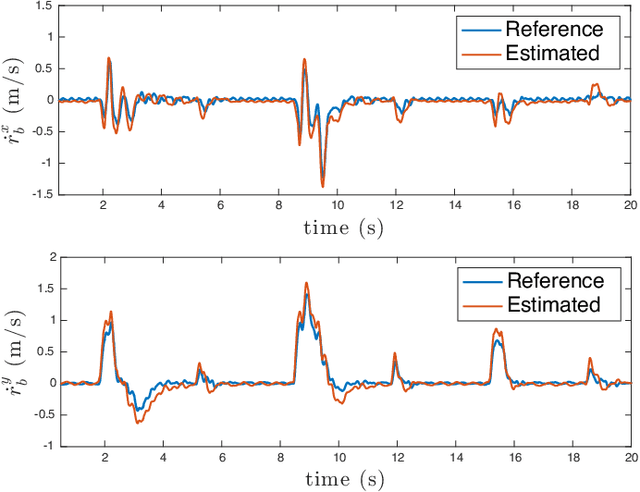
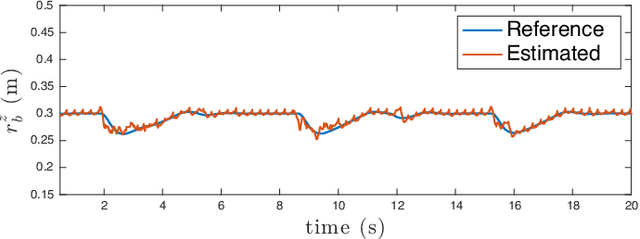
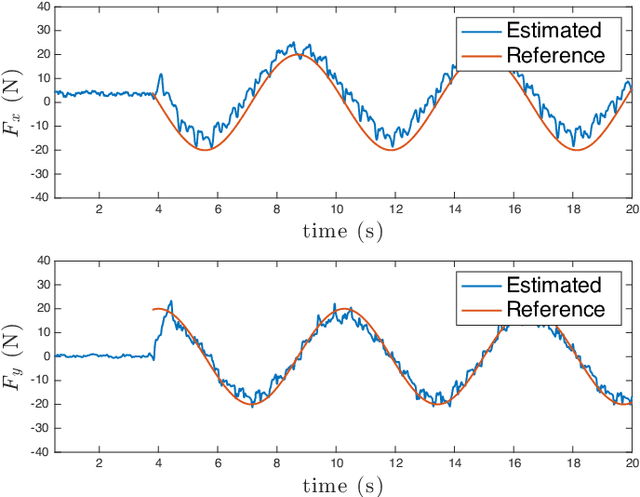
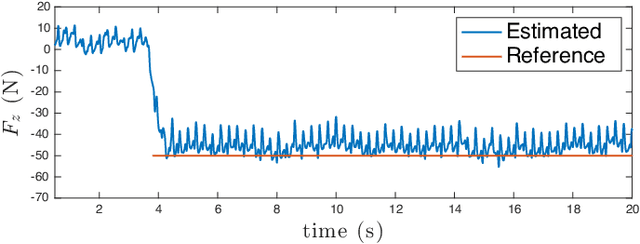
This paper presents a novel method for assistive load carrying using quadruped robots. The controller uses proprioceptive sensor data to estimate external base wrench, that is used for precise control of the robot's acceleration during payload transport. The acceleration is controlled using a combination of admittance control and Control Barrier Function (CBF) based quadratic program (QP). The proposed controller rejects disturbances and maintains consistent performance under varying load conditions. Additionally, the built-in CBF guarantees collision avoidance with the collaborative agent in front of the robot. The efficacy of the overall controller is shown by its implementation on the physical hardware as well as numerical simulations. The proposed control framework aims to enhance the quadruped robot's ability to perform assistive tasks in various scenarios, from industrial applications to search and rescue operations.
Distributed Inverse Dynamics Control for Quadruped Robots using Geometric Optimization
Dec 13, 2024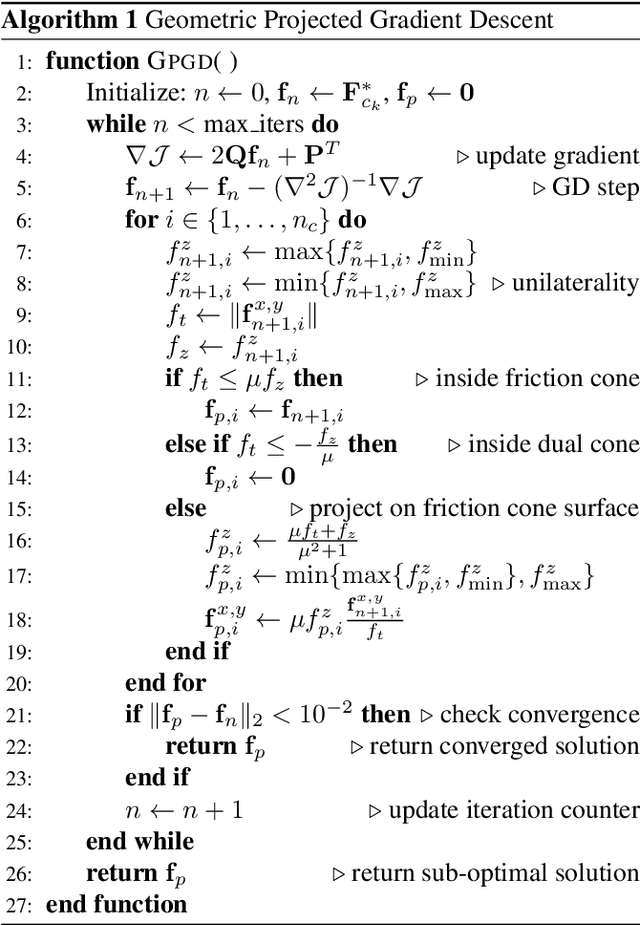
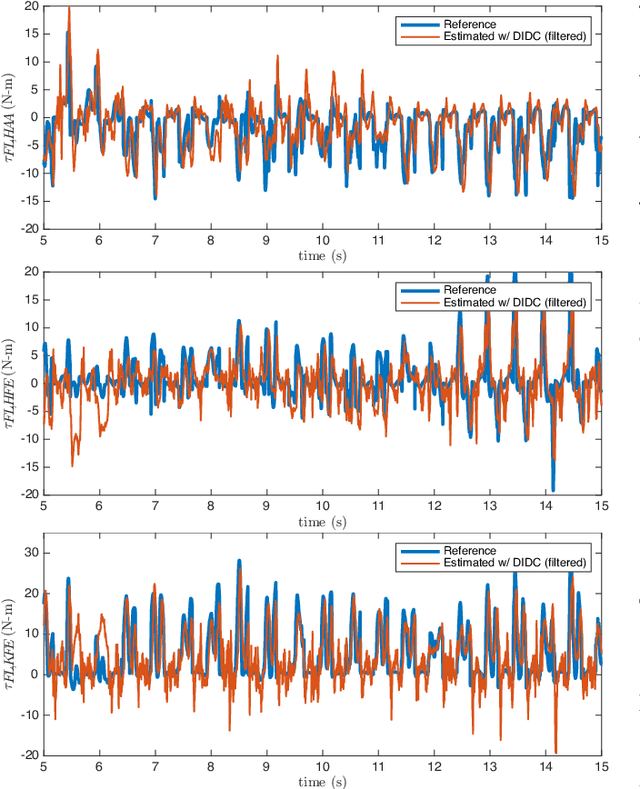
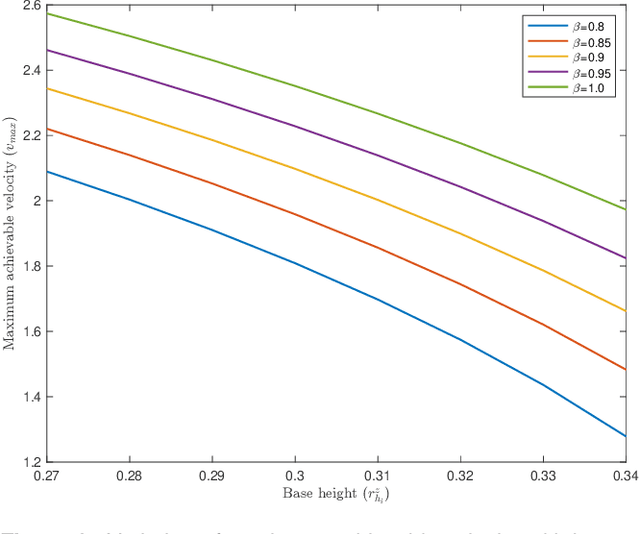
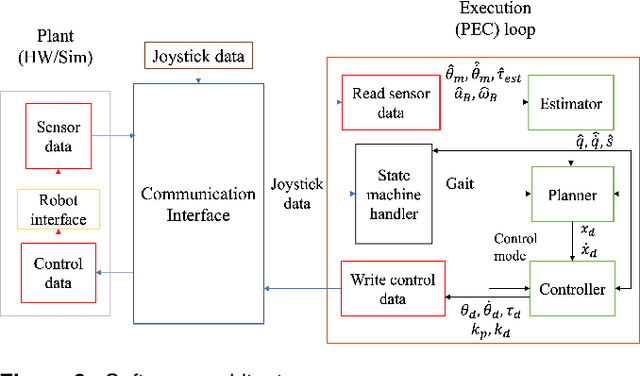
This paper presents a distributed inverse dynamics controller (DIDC) for quadruped robots that addresses the limitations of existing reactive controllers: simplified dynamical models, the inability to handle exact friction cone constraints, and the high computational requirements of whole-body controllers. Current methods either ignore friction constraints entirely or use linear approximations, leading to potential slip and instability, while comprehensive whole-body controllers demand significant computational resources. Our approach uses full rigid-body dynamics and enforces exact friction cone constraints through a novel geometric optimization-based solver. DIDC combines the required generalized forces corresponding to the actuated and unactuated spaces by projecting them onto the actuated space while satisfying the physical constraints and maintaining orthogonality between the base and joint tracking objectives. Experimental validation shows that our approach reduces foot slippage, improves orientation tracking, and converges at least two times faster than existing reactive controllers with generic QP-based implementations. The controller enables stable omnidirectional trotting at various speeds and consumes less power than comparable methods while running efficiently on embedded processors.