 Add to Chrome
 Add to Firefox
 Add to Edge
Generative Pseudo-Force Fields for Molecular Generation
May 18, 2026
Generating stable molecular conformations typically forces a tradeoff between the physical realism of energy-based relaxation and the sampling efficiency of data-driven generative models. While machine learning force fields (MLFFs) can sample stable conformations by relaxing molecular geometries according to physical forces, they require costly ab-initio training data. Conversely, diffusion models (DMs) learn from equilibrium data alone but are dependent on noise schedules and time-step conditioning. In this work, we propose generative pseudo-force fields (GPFFs) to bridge these paradigms by training an MLFF on a quadratic pseudo-potential energy surface relative to reference equilibrium structures. Because no ab-initio calculations are required for the perturbed geometries, non-equilibrium training data can be generated on the fly by perturbing the equilibria with Gaussian noise. We show that GPFFs constitute a time-step-agnostic variant of variance exploding DMs: the score comes from the predicted pseudo-forces but because force magnitudes implicitly encode the noise level, no time-step conditioning is needed. Our GPFF can hence be used as a drop-in replacement in standard diffusion sampling (ancestral, Heun) but also facilitates more efficient, adaptive variants and an MLFF inspired direct denoising scheme. Our proposed sampling algorithms support arbitrary structural priors and geometric constraints. On QM9, GPFF has 100 % validity at 256 neural function evaluations (NFE) and over 50 % at just 6 NFE, outperforming diffusion baselines across all samplers. Combined with custom priors, we showcase the fast and accurate generation process of our method in a molecular editor for a drug design setting, where a molecule is generated in real time.

Molecular relaxation by reverse diffusion with time step prediction
Apr 16, 2024

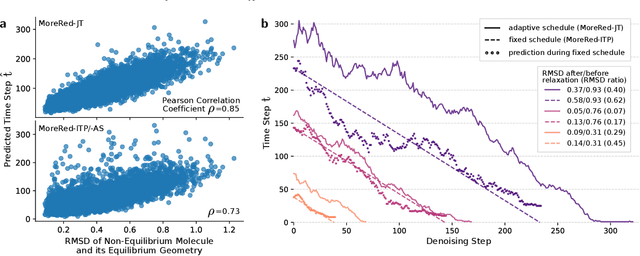
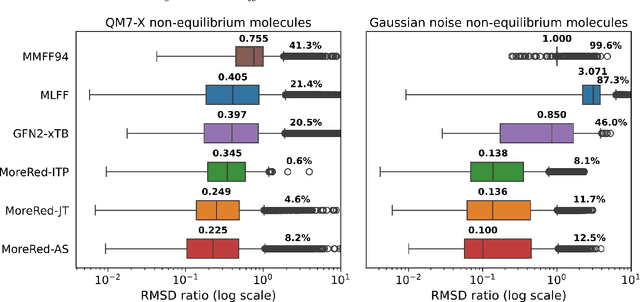
Molecular relaxation, finding the equilibrium state of a non-equilibrium structure, is an essential component of computational chemistry to understand reactivity. Classical force field methods often rely on insufficient local energy minimization, while neural network force field models require large labeled datasets encompassing both equilibrium and non-equilibrium structures. As a remedy, we propose MoreRed, molecular relaxation by reverse diffusion, a conceptually novel and purely statistical approach where non-equilibrium structures are treated as noisy instances of their corresponding equilibrium states. To enable the denoising of arbitrarily noisy inputs via a generative diffusion model, we further introduce a novel diffusion time step predictor. Notably, MoreRed learns a simpler pseudo potential energy surface instead of the complex physical potential energy surface. It is trained on a significantly smaller, and thus computationally cheaper, dataset consisting of solely unlabeled equilibrium structures, avoiding the computation of non-equilibrium structures altogether. We compare MoreRed to classical force fields, equivariant neural network force fields trained on a large dataset of equilibrium and non-equilibrium data, as well as a semi-empirical tight-binding model. To assess this quantitatively, we evaluate the root-mean-square deviation between the found equilibrium structures and the reference equilibrium structures as well as their DFT energies.