 Add to Chrome
 Add to Firefox
 Add to Edge
OP2GS: Object-Aware 3D Gaussian Splatting with Dual-Opacity Primitives
May 19, 2026
3D Gaussian Splatting (3DGS) provides an explicit and efficient scene representation, but its primitives lack inherent object-level identity, hindering downstream tasks such as open-vocabulary scene understanding. Existing methods typically address this by either distilling high-dimensional feature embeddings into Gaussians or by lifting 2D mask labels into 3D via heuristic refinement. However, feature-based approaches incur heavy storage and decoding overhead, while lifting-based pipelines remain vulnerable to label contamination: Gaussians necessary for appearance reconstruction often receive incorrect object labels during 2D-to-3D projection. We propose OP2GS, an object-aware Gaussian representation that augments each primitive with an explicit instance identity and a dedicated instance opacity $σ^{*}$ for object-mask rendering. The original opacity $σ$ remains responsible for visual reconstruction, while $σ^{*}$ models whether a Gaussian should contribute to a particular object mask. This dual-opacity formulation decouples visual existence from instance occupancy: mislabeled Gaussians can remain available for image rendering while becoming transparent in the object-mask branch. To learn this representation, we introduce a random object loss that optimizes the 1D instance occupancy field using the standard transmittance-based visibility of 3DGS. Semantic descriptors are then attached at the object level through multi-view aggregation, eliminating per-Gaussian feature storage. Compared with feature-training approaches, OP2GS achieves competitive open-vocabulary performance while significantly reducing computational overhead. Compared with training-free pipelines, it leverages physically consistent occupancy learning to resolve visibility ambiguities.

Ray Launching-Based Computation of Exact Paths with Noisy Dense Point Clouds
Mar 11, 2024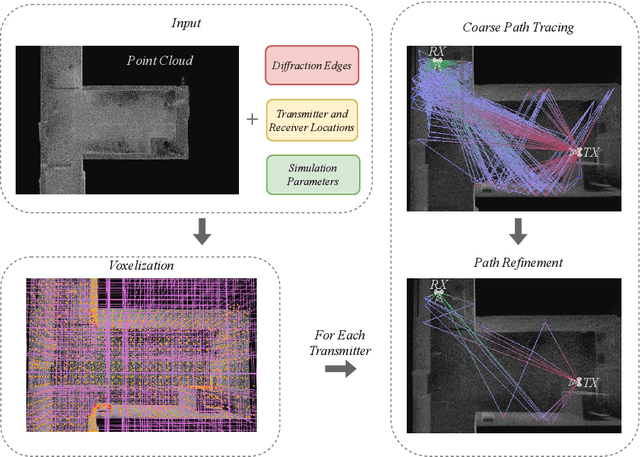
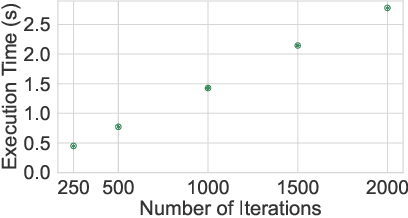
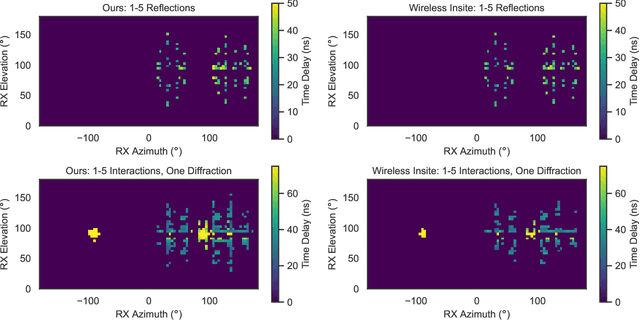
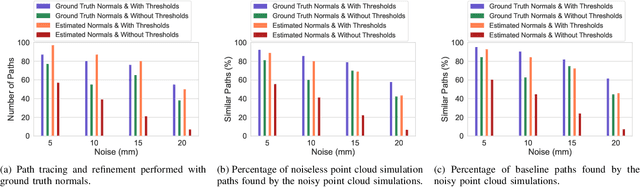
Point clouds have been a recent interest for ray tracing-based radio channel characterization, as sensors such as RGB-D cameras and laser scanners can be utilized to generate an accurate virtual copy of a physical environment. In this paper, a novel ray launching algorithm is presented, which operates directly on noisy point clouds acquired from sensor data. It produces coarse paths that are further refined to exact paths consisting of reflections and diffractions. A commercial ray tracing tool is utilized as the baseline for validating the simulated paths. A significant majority of the baseline paths is found. The robustness to noise is examined by artificially applying noise along the normal vector of each point. It is observed that the proposed method is capable of adapting to noise and finds similar paths compared to the baseline path trajectories with noisy point clouds. This is prevalent especially if the normal vectors of the points are estimated accurately. Lastly, a simulation is performed with a reconstructed point cloud and compared against channel measurements and the baseline paths. The resulting paths demonstrate similarity with the baseline path trajectories and exhibit an analogous pattern to the aggregated impulse response extracted from the measurements. Code available at https://github.com/nvaara/NimbusRT
A Ray Launching Approach for Computing Exact Paths with Point Clouds
Feb 21, 2024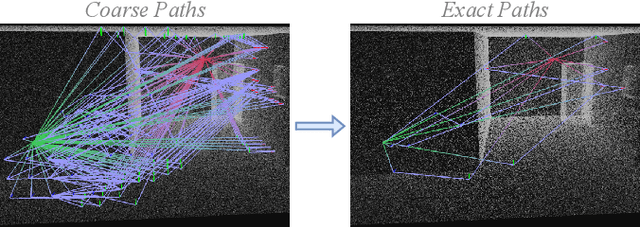
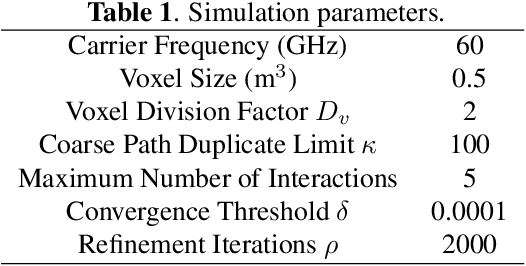
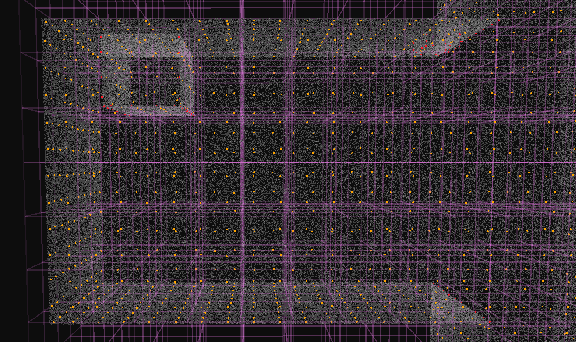
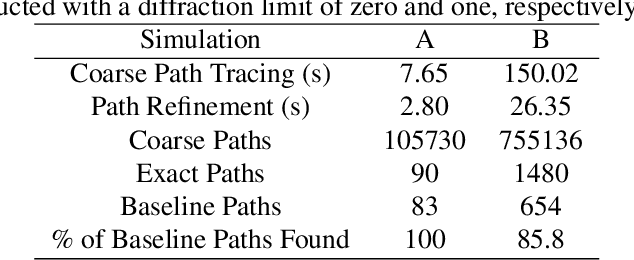
Ray tracing is a deterministic method that produces propagation paths between a transmitter and a receiver. The simulation accuracy is significantly influenced by the environment details. One way to capture the environment with great precision is the utilization of depth sensors and cameras. Such reconstructed environment is in the form of a point cloud. However, utilizing such data directly in ray tracing, a key aspect on vision-aided wireless communications, often involves a significant trade-off between accuracy and execution time. In this paper, we propose an open source novel and fast point cloud-based ray launching algorithm that produces exact paths, which provide a good basis for accurate modeling of radio channel characteristics. In experiments, preliminary validation of the ray tracer output is obtained with the aid of a commercial ray tracer.