 Add to Chrome
 Add to Firefox
 Add to Edge
Curvature-Aligned Probing for Local Loss-Landscape Stabilization
Apr 16, 2026
Local loss-landscape stabilization under sample growth is typically measured either pointwise or through isotropic averaging in the full parameter space. Despite practical value, both choices probe directions that contribute little to the dominant local deformation of strongly anisotropic neural landscapes. We recast stabilization as an observational problem and introduce a unified family of criteria parameterized by an aggregation order and a probing distribution; within this family we propose a curvature-aligned criterion $Δ_2^{(D)}$ that probes the loss increment field in the top-$D$ eigenspace of the empirical Hessian near a trained solution. Solely from a local quadratic model, we prove that $Δ_2^{(D)}$ preserves the $O(k^{-2})$ mean-squared rate of the full-space criterion while replacing ambient-dimension curvature dependence with dependence on the subspace dimension $D$; a corollary gives a closed-form spectral expression and a proposition identifies the top-$D$ eigenspace as extremal within the eigenspace-aligned family. We also derive scalable estimators based on Hessian-vector products, subspace Monte Carlo, and a closed-form Gaussian-moment proxy. On a decoder-only transformer, a curvature-aligned probe occupying a tiny fraction of parameter space already reproduces the full-space mean-squared signal to within numerical noise throughout the validated local regime, and the closed-form estimator is orders of magnitude faster than direct Monte Carlo after subspace construction.

Kandinsky 5.0: A Family of Foundation Models for Image and Video Generation
Nov 19, 2025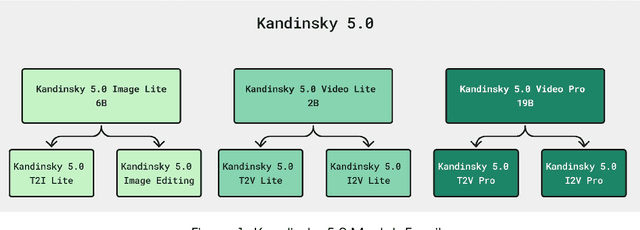
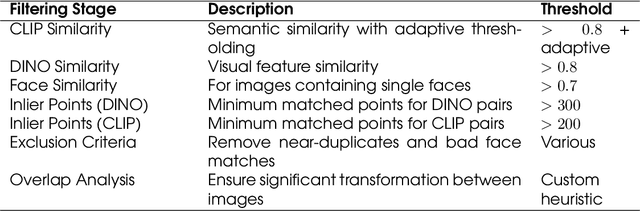
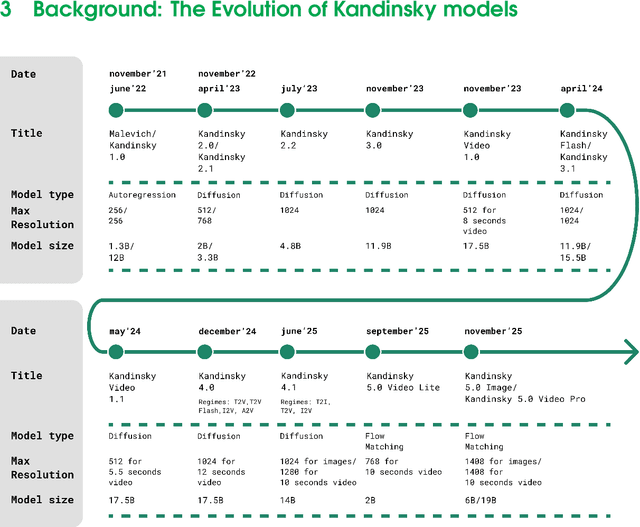
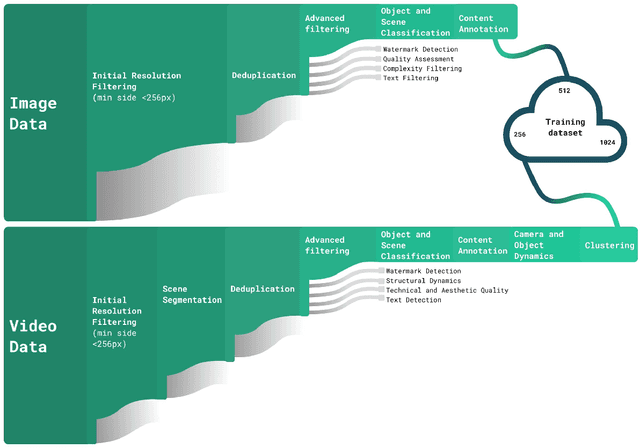
This report introduces Kandinsky 5.0, a family of state-of-the-art foundation models for high-resolution image and 10-second video synthesis. The framework comprises three core line-up of models: Kandinsky 5.0 Image Lite - a line-up of 6B parameter image generation models, Kandinsky 5.0 Video Lite - a fast and lightweight 2B parameter text-to-video and image-to-video models, and Kandinsky 5.0 Video Pro - 19B parameter models that achieves superior video generation quality. We provide a comprehensive review of the data curation lifecycle - including collection, processing, filtering and clustering - for the multi-stage training pipeline that involves extensive pre-training and incorporates quality-enhancement techniques such as self-supervised fine-tuning (SFT) and reinforcement learning (RL)-based post-training. We also present novel architectural, training, and inference optimizations that enable Kandinsky 5.0 to achieve high generation speeds and state-of-the-art performance across various tasks, as demonstrated by human evaluation. As a large-scale, publicly available generative framework, Kandinsky 5.0 leverages the full potential of its pre-training and subsequent stages to be adapted for a wide range of generative applications. We hope that this report, together with the release of our open-source code and training checkpoints, will substantially advance the development and accessibility of high-quality generative models for the research community.
Unraveling the Hessian: A Key to Smooth Convergence in Loss Function Landscapes
Sep 18, 2024The loss landscape of neural networks is a critical aspect of their training, and understanding its properties is essential for improving their performance. In this paper, we investigate how the loss surface changes when the sample size increases, a previously unexplored issue. We theoretically analyze the convergence of the loss landscape in a fully connected neural network and derive upper bounds for the difference in loss function values when adding a new object to the sample. Our empirical study confirms these results on various datasets, demonstrating the convergence of the loss function surface for image classification tasks. Our findings provide insights into the local geometry of neural loss landscapes and have implications for the development of sample size determination techniques.