 Add to Chrome
 Add to Firefox
 Add to Edge
MARVEL: A Multi Agent-based Research Validator and Enabler using Large Language Models
Jan 06, 2026
We present MARVEL (https://ligogpt.mit.edu/marvel), a locally deployable, open-source framework for domain-aware question answering and assisted scientific research. It is designed to address the increasing demands of a digital assistant for scientific groups that can read highly technical data, cite precisely, and operate within authenticated networks. MARVEL combines a fast path for straightforward queries with a more deliberate DeepSearch mode that integrates retrieval-augmented generation and Monte Carlo Tree Search. It explores complementary subqueries, allocates more compute to promising branches, and maintains a global evidence ledger that preserves sources during drafting. We applied this framework in the context of gravitational-wave research related to the Laser Interferometer Gravitational-wave Observatory. Answers are grounded in a curated semantic index of research literature, doctoral theses, LIGO documents, and long-running detector electronic logbooks, with targeted web searches when appropriate. Because direct benchmarking against commercial LLMs cannot be performed on private data, we evaluated MARVEL on two publicly available surrogate datasets that capture comparable semantic and technical characteristics. On these benchmarks, MARVEL matches a GPT-4o mini baseline on literature-centric queries and substantially outperforms it on detector-operations content, where domain retrieval and guided reasoning are decisive. By making the complete framework and evaluation datasets openly available, we aim to provide a reproducible foundation for developing domain-specific scientific assistants.

Improving significance of binary black hole mergers in Advanced LIGO data using deep learning : Confirmation of GW151216
Oct 22, 2020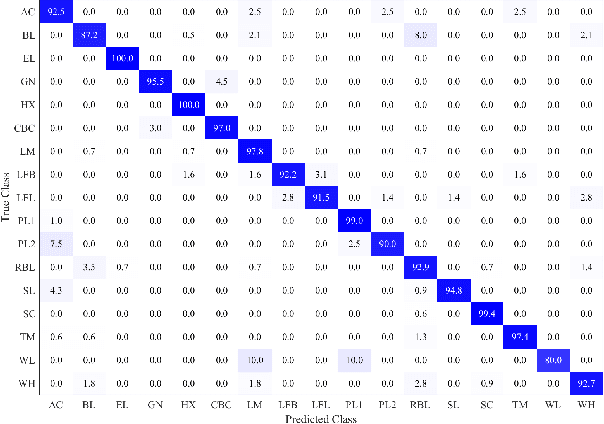
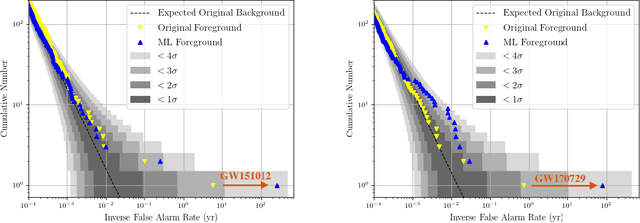
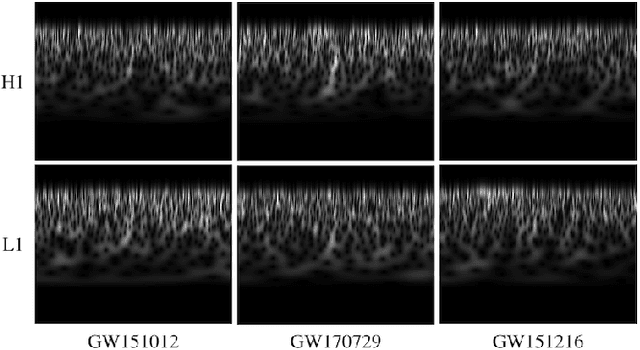
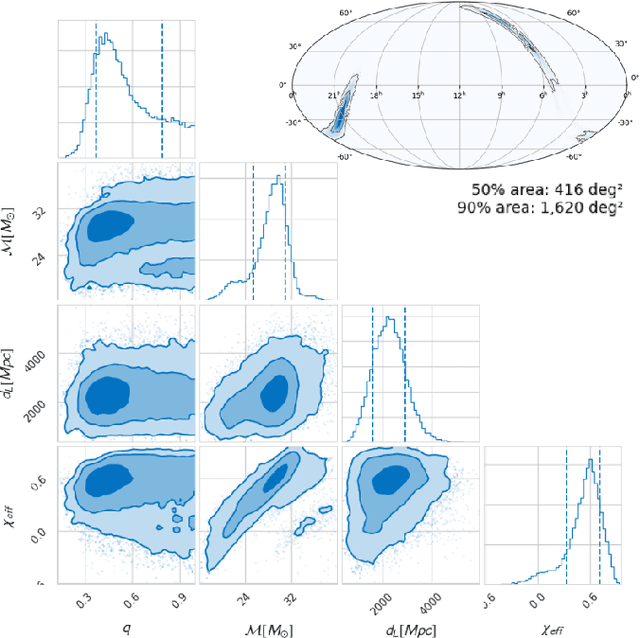
We present a novel Machine Learning (ML) based strategy to search for compact binary coalescences (CBCs) in data from ground-based gravitational wave (GW) observatories. This is the first ML-based search that not only recovers all the binary black hole mergers in the first GW transients calalog (GWTC-1), but also makes a clean detection of GW151216, which was not significant enough to be included in the catalogue. Moreover, we achieve this by only adding a new coincident ranking statistic (MLStat) to a standard analysis that was used for GWTC-1. In CBC searches, reducing contamination by terrestrial and instrumental transients, which create a loud noise background by triggering numerous false alarms, is crucial to improving the sensitivity for detecting true events. The sheer volume of data and and large number of expected detections also prompts the use of ML techniques. We perform transfer learning to train "InceptionV3", a pre-trained deep neural network, along with curriculum learning to distinguish GW signals from noisy events by analysing their continuous wavelet transform (CWT) maps. MLStat incorporates information from this ML classifier into the standard coincident search likelihood used by the conventional search. This leads to at least an order of magnitude improvement in the inverse false-alarm-rate (IFAR) for the previously "low significance" events GW151012, GW170729 and GW151216. The confidence in detection of GW151216 is further strengthened by performing its parameter estimation using SEOBNRv4HM_ROM. Considering the impressive ability of the statistic to distinguish signals from glitches, the list of marginal events from MLStat could be quite reliable for astrophysical population studies and further follow-up. This work demonstrates the immense potential and readiness of MLStat for finding new sources in current data and possibility of its adaptation in similar searches.