 Add to Chrome
 Add to Firefox
 Add to Edge
Similarity-Aware Mixture-of-Experts for Data-Efficient Continual Learning
Mar 24, 2026
Machine learning models often need to adapt to new data after deployment due to structured or unstructured real-world dynamics. The Continual Learning (CL) framework enables continuous model adaptation, but most existing approaches either assume each task contains sufficiently many data samples or that the learning tasks are non-overlapping. In this paper, we address the more general setting where each task may have a limited dataset, and tasks may overlap in an arbitrary manner without a priori knowledge. This general setting is substantially more challenging for two reasons. On the one hand, data scarcity necessitates effective contextualization of general knowledge and efficient knowledge transfer across tasks. On the other hand, unstructured task overlapping can easily result in negative knowledge transfer. To address the above challenges, we propose an adaptive mixture-of-experts (MoE) framework over pre-trained models that progressively establishes similarity awareness among tasks. Our design contains two innovative algorithmic components: incremental global pooling and instance-wise prompt masking. The former mitigates prompt association noise through gradual prompt introduction over time. The latter decomposes incoming task samples into those aligning with current prompts (in-distribution) and those requiring new prompts (out-of-distribution). Together, our design strategically leverages potential task overlaps while actively preventing negative mutual interference in the presence of per-task data scarcity. Experiments across varying data volumes and inter-task similarity show that our method enhances sample efficiency and is broadly applicable.

An end-to-end convolutional selective autoencoder approach to Soybean Cyst Nematode eggs detection
Mar 25, 2016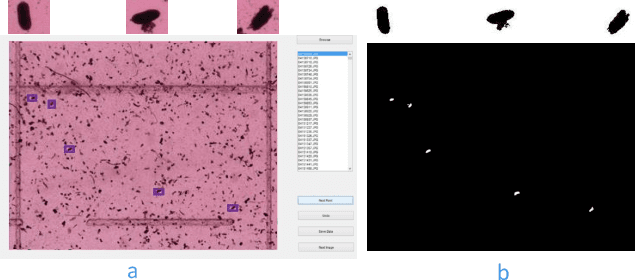
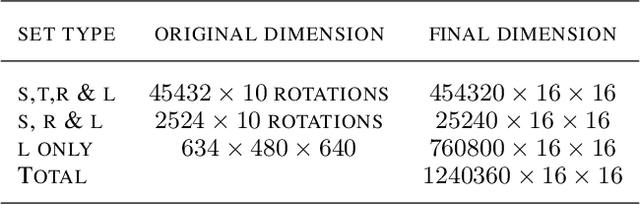
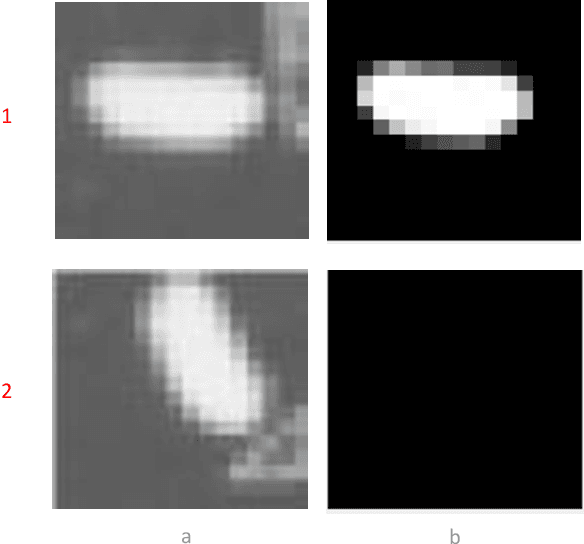
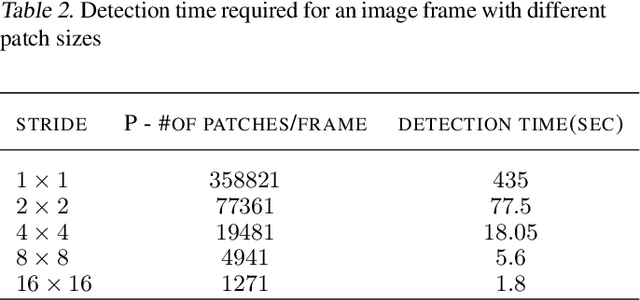
This paper proposes a novel selective autoencoder approach within the framework of deep convolutional networks. The crux of the idea is to train a deep convolutional autoencoder to suppress undesired parts of an image frame while allowing the desired parts resulting in efficient object detection. The efficacy of the framework is demonstrated on a critical plant science problem. In the United States, approximately $1 billion is lost per annum due to a nematode infection on soybean plants. Currently, plant-pathologists rely on labor-intensive and time-consuming identification of Soybean Cyst Nematode (SCN) eggs in soil samples via manual microscopy. The proposed framework attempts to significantly expedite the process by using a series of manually labeled microscopic images for training followed by automated high-throughput egg detection. The problem is particularly difficult due to the presence of a large population of non-egg particles (disturbances) in the image frames that are very similar to SCN eggs in shape, pose and illumination. Therefore, the selective autoencoder is trained to learn unique features related to the invariant shapes and sizes of the SCN eggs without handcrafting. After that, a composite non-maximum suppression and differencing is applied at the post-processing stage.