 Add to Chrome
 Add to Firefox
 Add to Edge
Similarity-Aware Mixture-of-Experts for Data-Efficient Continual Learning
Mar 24, 2026
Machine learning models often need to adapt to new data after deployment due to structured or unstructured real-world dynamics. The Continual Learning (CL) framework enables continuous model adaptation, but most existing approaches either assume each task contains sufficiently many data samples or that the learning tasks are non-overlapping. In this paper, we address the more general setting where each task may have a limited dataset, and tasks may overlap in an arbitrary manner without a priori knowledge. This general setting is substantially more challenging for two reasons. On the one hand, data scarcity necessitates effective contextualization of general knowledge and efficient knowledge transfer across tasks. On the other hand, unstructured task overlapping can easily result in negative knowledge transfer. To address the above challenges, we propose an adaptive mixture-of-experts (MoE) framework over pre-trained models that progressively establishes similarity awareness among tasks. Our design contains two innovative algorithmic components: incremental global pooling and instance-wise prompt masking. The former mitigates prompt association noise through gradual prompt introduction over time. The latter decomposes incoming task samples into those aligning with current prompts (in-distribution) and those requiring new prompts (out-of-distribution). Together, our design strategically leverages potential task overlaps while actively preventing negative mutual interference in the presence of per-task data scarcity. Experiments across varying data volumes and inter-task similarity show that our method enhances sample efficiency and is broadly applicable.

On the Power of Source Screening for Learning Shared Feature Extractors
Feb 18, 2026Learning with shared representation is widely recognized as an effective way to separate commonalities from heterogeneity across various heterogeneous sources. Most existing work includes all related data sources via simultaneously training a common feature extractor and source-specific heads. It is well understood that data sources with low relevance or poor quality may hinder representation learning. In this paper, we further dive into the question of which data sources should be learned jointly by focusing on the traditionally deemed ``good'' collection of sources, in which individual sources have similar relevance and qualities with respect to the true underlying common structure. Towards tractability, we focus on the linear setting where sources share a low-dimensional subspace. We find that source screening can play a central role in statistically optimal subspace estimation. We show that, for a broad class of problem instances, training on a carefully selected subset of sources suffices to achieve minimax optimality, even when a substantial portion of data is discarded. We formalize the notion of an informative subpopulation, develop algorithms and practical heuristics for identifying such subsets, and validate their effectiveness through both theoretical analysis and empirical evaluations on synthetic and real-world datasets.
Mahalanobis-Aware Training for Out-of-Distribution Detection
Nov 01, 2023While deep learning models have seen widespread success in controlled environments, there are still barriers to their adoption in open-world settings. One critical task for safe deployment is the detection of anomalous or out-of-distribution samples that may require human intervention. In this work, we present a novel loss function and recipe for training networks with improved density-based out-of-distribution sensitivity. We demonstrate the effectiveness of our method on CIFAR-10, notably reducing the false-positive rate of the relative Mahalanobis distance method on far-OOD tasks by over 50%.
Network Fault-tolerant and Byzantine-resilient Social Learning via Collaborative Hierarchical Non-Bayesian Learning
Jul 27, 2023As the network scale increases, existing fully distributed solutions start to lag behind the real-world challenges such as (1) slow information propagation, (2) network communication failures, and (3) external adversarial attacks. In this paper, we focus on hierarchical system architecture and address the problem of non-Bayesian learning over networks that are vulnerable to communication failures and adversarial attacks. On network communication, we consider packet-dropping link failures. We first propose a hierarchical robust push-sum algorithm that can achieve average consensus despite frequent packet-dropping link failures. We provide a sparse information fusion rule between the parameter server and arbitrarily selected network representatives. Then, interleaving the consensus update step with a dual averaging update with Kullback-Leibler (KL) divergence as the proximal function, we obtain a packet-dropping fault-tolerant non-Bayesian learning algorithm with provable convergence guarantees. On external adversarial attacks, we consider Byzantine attacks in which the compromised agents can send maliciously calibrated messages to others (including both the agents and the parameter server). To avoid the curse of dimensionality of Byzantine consensus, we solve the non-Bayesian learning problem via running multiple dynamics, each of which only involves Byzantine consensus with scalar inputs. To facilitate resilient information propagation across sub-networks, we use a novel Byzantine-resilient gossiping-type rule at the parameter server.
Fast and Robust State Estimation and Tracking via Hierarchical Learning
Jun 29, 2023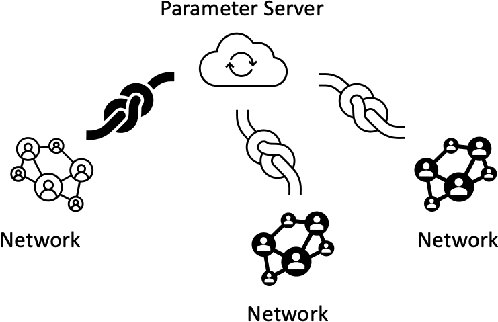
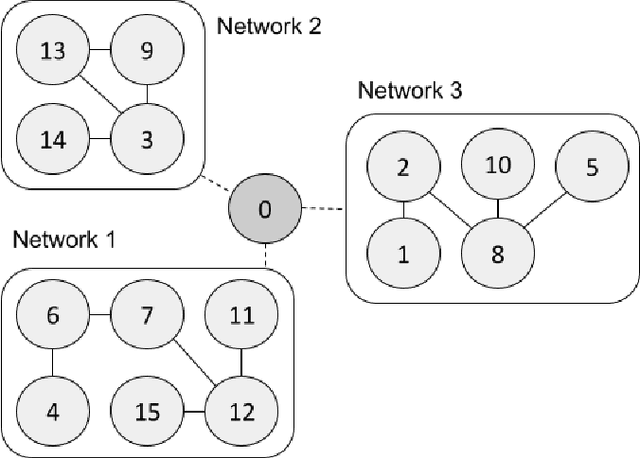
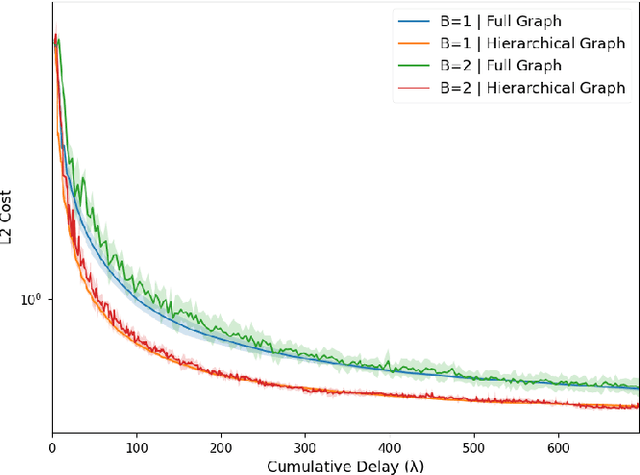

Fully distributed estimation and tracking solutions to large-scale multi-agent networks suffer slow convergence and are vulnerable to network failures. In this paper, we aim to speed up the convergence and enhance the resilience of state estimation and tracking using a simple hierarchical system architecture wherein agents are clusters into smaller networks, and a parameter server exists to aid the information exchanges among networks. The information exchange among networks is expensive and occurs only once in a while. We propose two consensus + innovation algorithms for the state estimation and tracking problems, respectively. In both algorithms, we use a novel hierarchical push-sum consensus component. For the state estimation, we use dual averaging as the local innovation component. State tracking is much harder to tackle in the presence of dropping-link failures and the standard integration of the consensus and innovation approaches are no longer applicable. Moreover, dual averaging is no longer feasible. Our algorithm introduces a pair of additional variables per link and ensure the relevant local variables evolve according to the state dynamics, and use projected local gradient descent as the local innovation component. We also characterize the convergence rates of both of the algorithms under linear local observation model and minimal technical assumptions. We numerically validate our algorithm through simulation of both state estimation and tracking problems.