 Add to Chrome
 Add to Firefox
 Add to Edge
SARLO-80: Worldwide Slant SAR Language Optic Dataset 80cm
Jun 18, 2026
Multimodal foundation models have advanced rapidly thanks to large optical benchmarks, but comparable resources for synthetic aperture radar (SAR) remain limited. Existing SAR--optical datasets largely rely on low-resolution, intensity-only Ground Range Detected~(GRD) products and do not preserve complex-valued SAR measurements or native acquisition geometry, which restricts physically grounded multimodal learning. In particular, large-scale public datasets combining very-high-resolution (VHR) SAR SLC, aligned optical imagery, and natural-language descriptions are still lacking. We present a VHR SAR--optical--text dataset built from open-access Umbra spotlight acquisitions distributed as Sensor Independent Complex Data (SICD). From around 2,500 worldwide scenes (VV/HH, 20cm--2m native resolution), we standardize all SAR data to an 80cm slant-range grid via band-limited FFT resampling and tile the imagery into 1024 by 1024 patches. For each SAR patch, we retrieve a high-resolution optical tile and warp it into the SAR grid using local coordinate correspondences for local pixel-level alignment. We further generate three caption variants (SHORT/MID/LONG) per sample to support vision--language training and evaluation. Our dataset contains 119,566 triplets (complex and amplitude slant-range SAR patch, aligned optical patch, natural-language description) covering 257 locations across 72 countries and a broad range of land types and infrastructures. We release fixed train/validation/test splits and the full preprocessing and baseline code to enable reproducible benchmarks for multimodal alignment on cross-modal retrieval and conditional generation in native SAR geometry. The dataset is publicly available on the Hugging Face Hub at https://huggingface.co/datasets/ONERA/SARLO-80.

Quantitative Comparison of Fine-Tuning Techniques for Pretrained Latent Diffusion Models in the Generation of Unseen SAR Image Concepts
Jun 16, 2025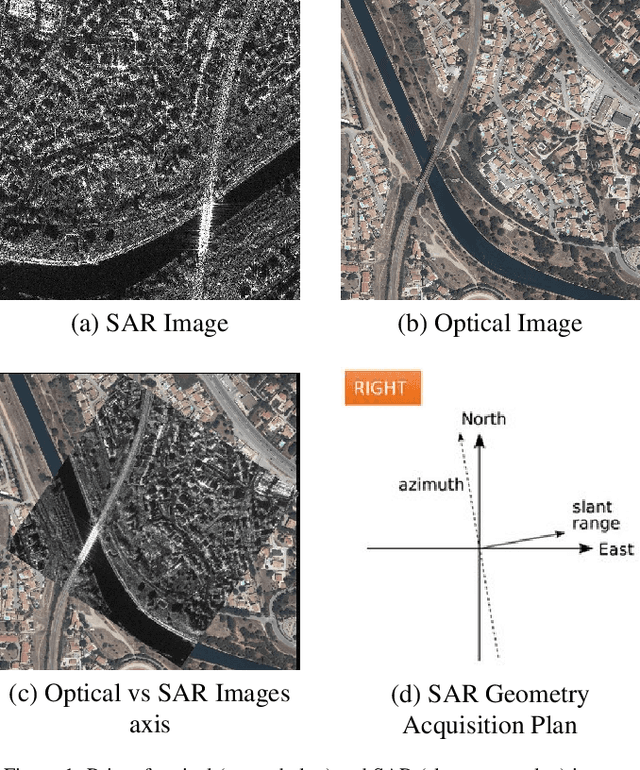
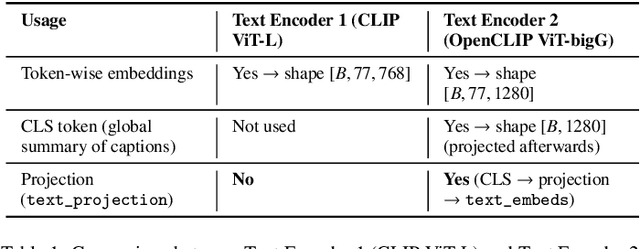
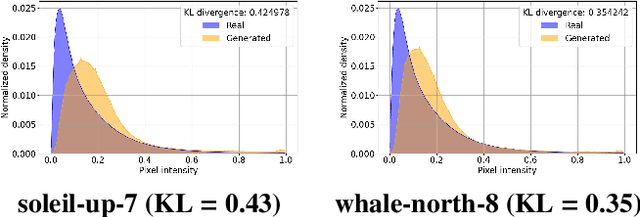
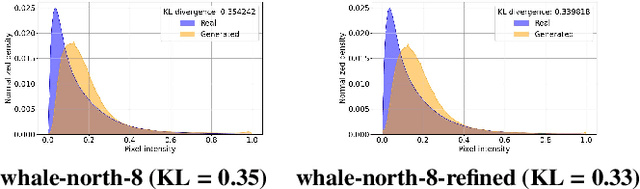
This work investigates the adaptation of large pre-trained latent diffusion models to a radically new imaging domain: Synthetic Aperture Radar (SAR). While these generative models, originally trained on natural images, demonstrate impressive capabilities in text-to-image synthesis, they are not natively adapted to represent SAR data, which involves different physics, statistical distributions, and visual characteristics. Using a sizeable SAR dataset (on the order of 100,000 to 1 million images), we address the fundamental question of fine-tuning such models for this unseen modality. We explore and compare multiple fine-tuning strategies, including full model fine-tuning and parameter-efficient approaches like Low-Rank Adaptation (LoRA), focusing separately on the UNet diffusion backbone and the text encoder components. To evaluate generative quality, we combine several metrics: statistical distance from real SAR distributions, textural similarity via GLCM descriptors, and semantic alignment assessed with a CLIP model fine-tuned on SAR data. Our results show that a hybrid tuning strategy yields the best performance: full fine-tuning of the UNet is better at capturing low-level SAR-specific patterns, while LoRA-based partial tuning of the text encoder, combined with embedding learning of the <SAR> token, suffices to preserve prompt alignment. This work provides a methodical strategy for adapting foundation models to unconventional imaging modalities beyond natural image domains.
From Spaceborn to Airborn: SAR Image Synthesis Using Foundation Models for Multi-Scale Adaptation
May 05, 2025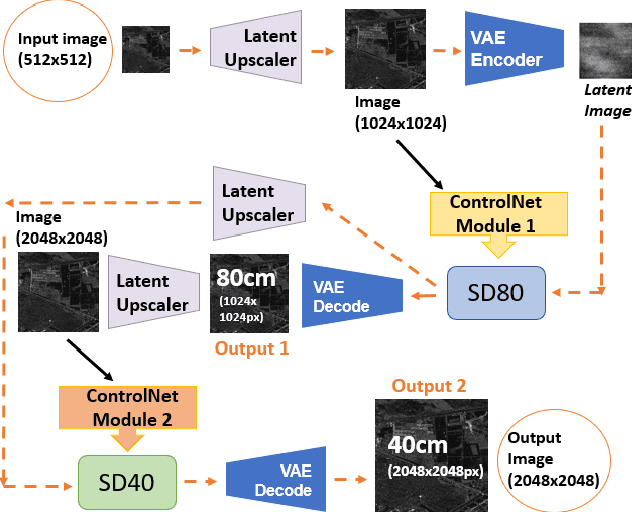
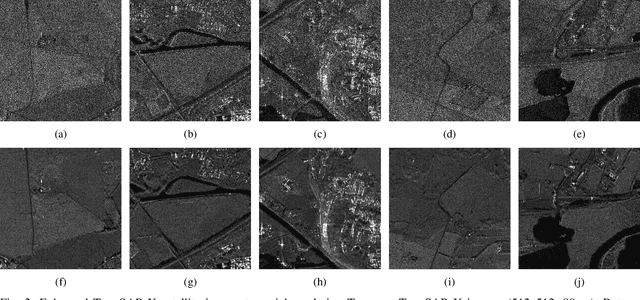
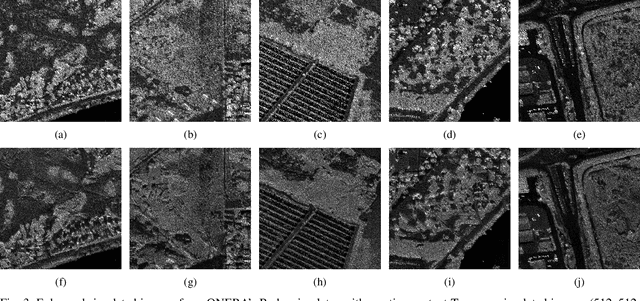
The availability of Synthetic Aperture Radar (SAR) satellite imagery has increased considerably in recent years, with datasets commercially available. However, the acquisition of high-resolution SAR images in airborne configurations, remains costly and limited. Thus, the lack of open source, well-labeled, or easily exploitable SAR text-image datasets is a barrier to the use of existing foundation models in remote sensing applications. In this context, synthetic image generation is a promising solution to augment this scarce data, enabling a broader range of applications. Leveraging over 15 years of ONERA's extensive archival airborn data from acquisition campaigns, we created a comprehensive training dataset of 110 thousands SAR images to exploit a 3.5 billion parameters pre-trained latent diffusion model. In this work, we present a novel approach utilizing spatial conditioning techniques within a foundation model to transform satellite SAR imagery into airborne SAR representations. Additionally, we demonstrate that our pipeline is effective for bridging the realism of simulated images generated by ONERA's physics-based simulator EMPRISE. Our method explores a key application of AI in advancing SAR imaging technology. To the best of our knowledge, we are the first to introduce this approach in the literature.