 Add to Chrome
 Add to Firefox
 Add to Edge
One Success Isn't Reliability: Thinkingbox, a Sandbox and Benchmark for Agents in Stateful Business Workflows
Aug 20, 2026
Recent agent benchmarks increasingly ground evaluation in executable environments, from code repair to web navigation, app APIs, and function calling. Yet completing consequential work beyond code requires more than producing a plausible response or valid tool call: agents must gather missing information over multiple turns, follow domain policies, coordinate dependent tools, and realize the correct persistent state transition without collateral effects. In this paper, we introduce Thinkingbox, a sandbox for tool-agent-user interaction that provides isolated MCP-compatible tool sessions, complete execution traces, and outcome evaluation over terminal backend state. Built on this sandbox, Thinkingbox-bench contains 507 policy-conditioned workflows across numerous scenarios, including retail, hospitality, auto insurance, neobank internal IT, and consulting IT/HR support. Each attempt is evaluated by task-specific executable checks that accept valid trajectories while rejecting wrong, missing, or extra effects; designated tasks additionally check required properties of the final response. Across proprietary and open-weight models, the strongest achieves 65.36% pass@1, but only 25.25% pass^20. Moreover, many failed trials show clean termination and valid state-changing actions, showing that response or tool-call-level signals are not clear proxies for end-to-end task completion. Thinkingbox-bench reveals a large gap between occasionally finding a successful trajectory and reliably completing stateful business tasks. We release both Thinkingbox and Thinkingbox-Bench: https://github.com/microsoft/thinkingbox

On the Prediction Network Architecture in RNN-T for ASR
Jun 29, 2022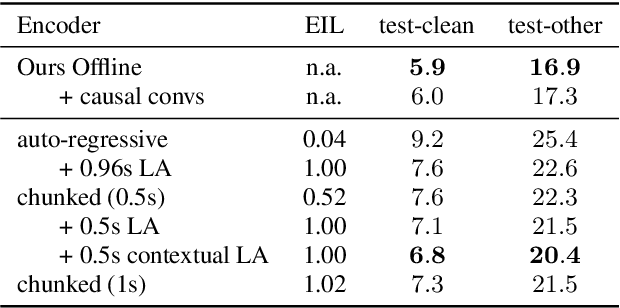
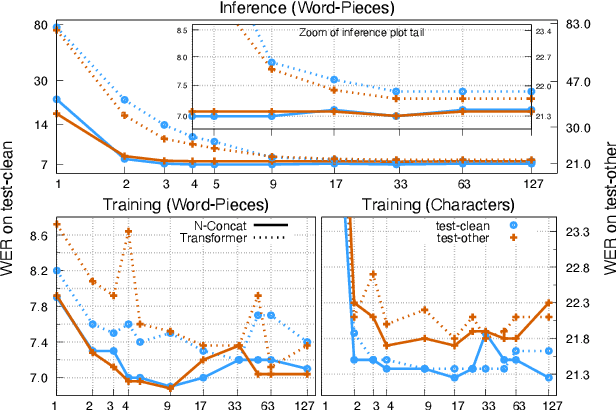
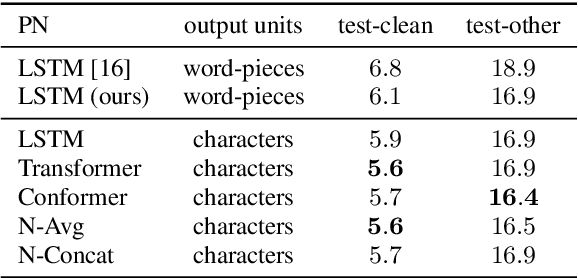
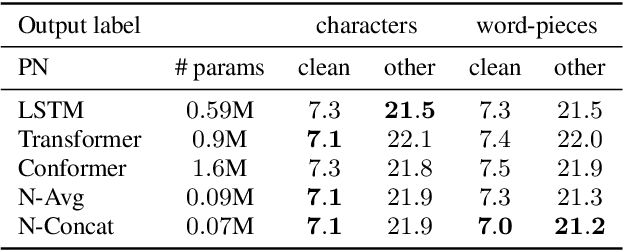
RNN-T models have gained popularity in the literature and in commercial systems because of their competitiveness and capability of operating in online streaming mode. In this work, we conduct an extensive study comparing several prediction network architectures for both monotonic and original RNN-T models. We compare 4 types of prediction networks based on a common state-of-the-art Conformer encoder and report results obtained on Librispeech and an internal medical conversation data set. Our study covers both offline batch-mode and online streaming scenarios. In contrast to some previous works, our results show that Transformer does not always outperform LSTM when used as prediction network along with Conformer encoder. Inspired by our scoreboard, we propose a new simple prediction network architecture, N-Concat, that outperforms the others in our on-line streaming benchmark. Transformer and n-gram reduced architectures perform very similarly yet with some important distinct behaviour in terms of previous context. Overall we obtained up to 4.1 % relative WER improvement compared to our LSTM baseline, while reducing prediction network parameters by nearly an order of magnitude (8.4 times).
Conformer with dual-mode chunked attention for joint online and offline ASR
Jun 22, 2022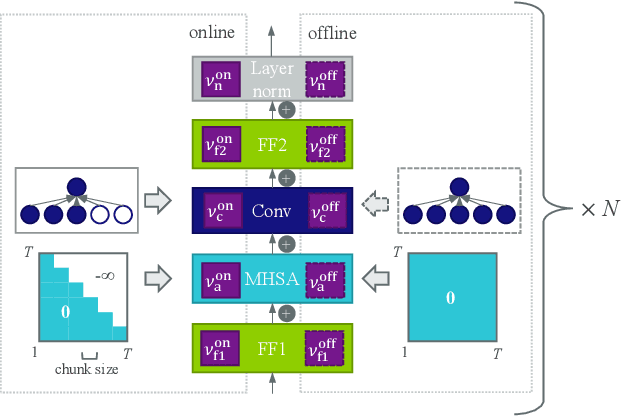
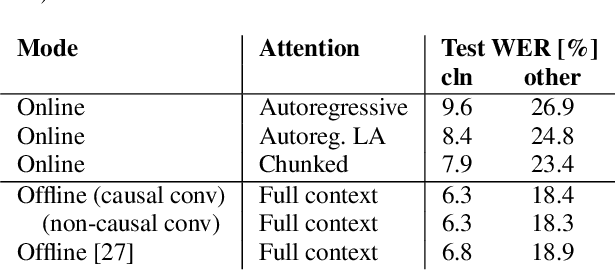
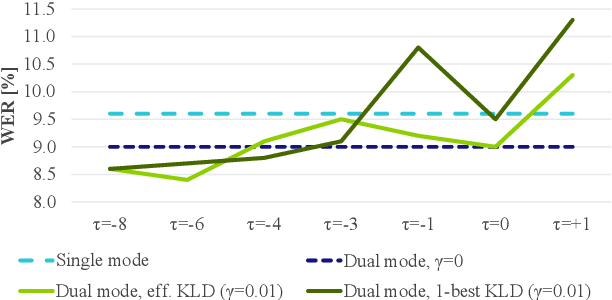
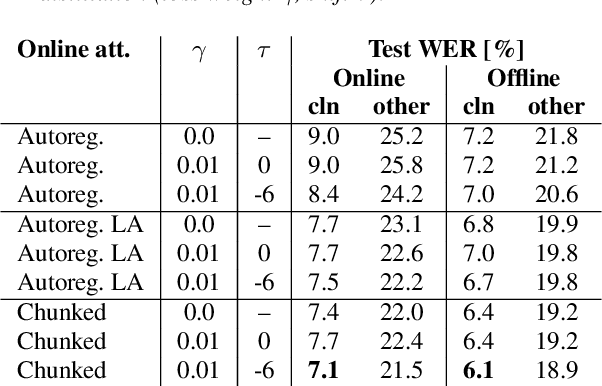
In this paper, we present an in-depth study on online attention mechanisms and distillation techniques for dual-mode (i.e., joint online and offline) ASR using the Conformer Transducer. In the dual-mode Conformer Transducer model, layers can function in online or offline mode while sharing parameters, and in-place knowledge distillation from offline to online mode is applied in training to improve online accuracy. In our study, we first demonstrate accuracy improvements from using chunked attention in the Conformer encoder compared to autoregressive attention with and without lookahead. Furthermore, we explore the efficient KLD and 1-best KLD losses with different shifts between online and offline outputs in the knowledge distillation. Finally, we show that a simplified dual-mode Conformer that only has mode-specific self-attention performs equally well as the one also having mode-specific convolutions and normalization. Our experiments are based on two very different datasets: the Librispeech task and an internal corpus of medical conversations. Results show that the proposed dual-mode system using chunked attention yields 5% and 4% relative WER improvement on the Librispeech and medical tasks, compared to the dual-mode system using autoregressive attention with similar average lookahead.